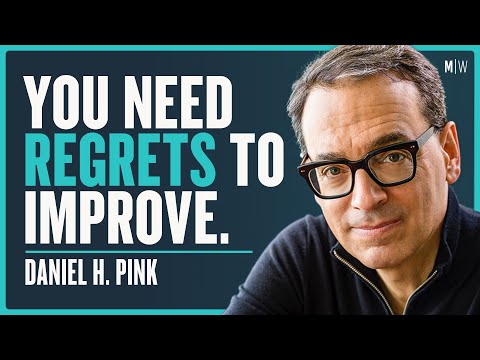
How To Overcome Regret - Daniel Pink
Daniel Pink (guest), Chris Williamson (host)
In this episode of Modern Wisdom, featuring Daniel Pink and Chris Williamson, How To Overcome Regret - Daniel Pink explores turning Regret Into Power: How Negative Emotions Guide Better Lives Daniel Pink argues that regret is our most common negative emotion and a core feature of human cognition, not a flaw to be eliminated. Modern culture’s “no regrets” mindset backfires because it rejects negative emotions instead of harnessing them for learning and growth. Drawing on large-scale research, Pink outlines four universal categories of regret—boldness, foundation, moral, and connection—that together reveal a “photographic negative” of the good life. He then offers a practical process (inward, outward, forward) to transform regrets from sources of rumination into tools for clarity, motivation, and better future decisions.
Turning Regret Into Power: How Negative Emotions Guide Better Lives
Daniel Pink argues that regret is our most common negative emotion and a core feature of human cognition, not a flaw to be eliminated. Modern culture’s “no regrets” mindset backfires because it rejects negative emotions instead of harnessing them for learning and growth. Drawing on large-scale research, Pink outlines four universal categories of regret—boldness, foundation, moral, and connection—that together reveal a “photographic negative” of the good life. He then offers a practical process (inward, outward, forward) to transform regrets from sources of rumination into tools for clarity, motivation, and better future decisions.
Key Takeaways
Regret is universal, healthy, and designed to help us learn.
Research shows regret is the most common negative emotion and is built into our cognitive machinery because it clarifies what matters to us and instructs us how to do better, much like fear or grief serve adaptive roles.
Get the full analysis with uListen AI
Most enduring regrets are about inaction, especially boldness not taken.
Across 18,000+ submissions, people overwhelmingly regret not taking chances—travel, romance, career moves—far more than overdoing boldness, especially as they age and feel time running out.
Get the full analysis with uListen AI
Four core regrets reveal what people value in a good life.
Boldness regrets (“If only I’d taken the chance”), foundation regrets (“If only I’d done the work”), moral regrets (“If only I’d done the right thing”), and connection regrets (“If only I’d reached out”) collectively point to our needs for growth, stability, integrity, and close relationships.
Get the full analysis with uListen AI
We should adopt a mild bias toward action to avoid corrosive ‘what ifs.’
Because actions can often be repaired or at-leasted (“at least X came from it”) and inactions linger as unresolved possibilities, leaning slightly toward action both reduces ongoing mental ‘anxiety cost’ and accelerates learning about what works.
Get the full analysis with uListen AI
The right way to handle regret is inward, outward, forward.
Inward: practice self-compassion rather than self-laceration; outward: disclose or write about regrets to concretize and defang them; forward: use self-distancing (“What would future me or my best friend advise? ...
Get the full analysis with uListen AI
Disclosing regrets is a powerful form of sense-making, not weakness.
Sharing or writing about regrets transforms vague, menacing feelings into specific language, enabling clearer thinking; research suggests others usually view such honesty positively rather than as a liability.
Get the full analysis with uListen AI
We can’t minimize all regrets, so we must minimize the right ones.
Future-you won’t care about trivial choices (chicken vs meatloaf, car color), but will care deeply about whether you built a stable base, acted with courage, behaved morally, and nurtured key relationships—those are the regrets worth designing your life around.
Get the full analysis with uListen AI
Notable Quotes
“Regret, more than any other emotion in our life, clarifies what we care about and instructs us how to do better.”
— Daniel Pink
“The only people who don’t have regrets are people with some kind of problem… or people who are sociopaths.”
— Daniel Pink
“We should have a bias toward action, because action extinguishes our ‘what if’ and it helps us learn in ways that we don’t often realize.”
— Daniel Pink
“What these four regrets reveal, in some ways, is a photographic negative of the good life.”
— Daniel Pink
“People who are healthy, people who learn and grow and progress see their lives in terms of redemption narratives—not as perfect, but as better.”
— Daniel Pink
Questions Answered in This Episode
Which of the four core regret categories—boldness, foundation, moral, or connection—shows up most in my own life, and what does that say about what I truly value?
Daniel Pink argues that regret is our most common negative emotion and a core feature of human cognition, not a flaw to be eliminated. ...
Get the full analysis with uListen AI
Where am I currently choosing inaction out of fear of awkwardness or failure, and what would a small ‘bias toward action’ look like this week?
Get the full analysis with uListen AI
How could I build a simple inward–outward–forward ritual for processing new regrets so they become learning tools instead of sources of rumination?
Get the full analysis with uListen AI
Is there a relationship I’ve let drift that I assume would be ‘awkward’ to reconnect—but that I would actually welcome if the other person reached out to me?
Get the full analysis with uListen AI
If I called the ‘me’ ten years from now and asked what I should minimize regretting, what specific decisions or areas of life would future-me tell me to prioritize today?
Get the full analysis with uListen AI
Transcript Preview
People who are healthy, people who learn and grow and progress see their lives in terms of redemption narratives. Not as perfect, but as better, as going in that kind of trajectory. And so when we think about these, our lives in narrative terms, we inevitably have to ask the question, okay, my life is a narrative. Am I the author of that narrative or am I a character in that narrative? (wind blows)
What's modern society's problem with regret?
Uh, we, we, we dismiss it as something that should be avoided rather than embrace it as something that can actually change our lives. Um, and I think it's part of a bigger problem with modern society in that we, we don't know how to deal with negative emotions. Uh, we think that negative emotions make us weak. We think that negative emotions are dangerous, when in fact negative emotions can make us strong and negative emotions can make us better, particularly our most common negative emotion, regret.
That's the most common negative emotion?
Yeah. There's some interesting research starting in the 1980s, um, where they, uh, s- uh, a social scientist named Susan Simanoff, who did research i- in, in the US where she recorded everyday conversations among people. And then they took the transcript of these conversations and they coded the conversations for the emotions that were expressed. The most common negative emotion people expressed is regret. The second most common emotion overall that people discuss is regret, th- the on- second only to love. So regret is, re- regret is an, is a ubiquitous emotion. Everybody has regrets. The only people who don't have regrets are people with some kind of, um, problem, people who have, uh, neurodegenerative disease or people who are sociopaths. Uh, otherwise everybody has regrets.
Why is it so common?
Well, that's a great question, and, and I think that's the puzzle that, you know, I'd, I'd love your listeners to, to, to linger, have your listeners linger in their head for a little bit, because here you have this emotion that is unpleasant, right? Okay, so let's not... Regret, regret doesn't feel good. Regret feels bad. It feels bad. It's a negative emotion, and yet it's ubiquitous. So that's a great, that's a great way to frame the issue. Why is it hard to, wh- why is regret both hard to take and hard to avoid? And, and there's a little bit of a paradox here because you say, "Well, wait a second. We human beings are wired for pleasure. We seek pleasure. Why is, is something that's so unpleasant, so ubiquitous?" And the answer is, it's good for us. It helps, it's useful. It's there for a reason. And what we know from 50 years of science is that our cognitive machinery is pre-programmed for regret. Regret is actually an important and integral part of how our brains work. And so when we embrace this idea that we shouldn't have regrets, that we shouldn't look backward, that we should dismiss negative emotions, we are doing ourselves a grave misservice.
Install uListen to search the full transcript and get AI-powered insights
Get Full TranscriptGet more from every podcast
AI summaries, searchable transcripts, and fact-checking. Free forever.
Add to Chrome