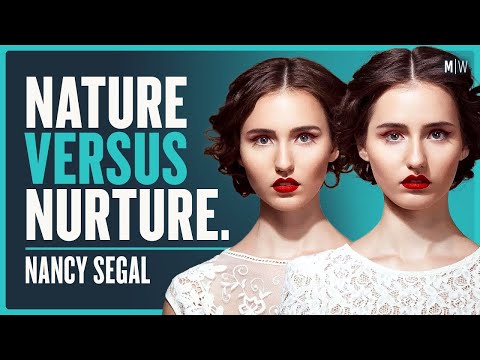
What Twins Separated At Birth Teach Us About Human Genetics - Nancy Segal
Chris Williamson (host), Nancy Segal (guest), Narrator
In this episode of Modern Wisdom, featuring Chris Williamson and Nancy Segal, What Twins Separated At Birth Teach Us About Human Genetics - Nancy Segal explores separated twins reveal genetics’ power over personality, bonds, and destiny Nancy Segal, a developmental psychologist and twin researcher, explains how twin studies illuminate the interplay of genetics, environment, and evolution in shaping human behavior. She describes why identical twins tend to be more cooperative, emotionally bonded, and behaviorally similar than fraternals, even when raised apart, and how this supports kin selection and behavioral genetics findings. Segal shares striking case studies—from Holocaust-surviving twins and politically opposite reared-apart twins to the Jim twins and accidental incest—showing deep genetic influences alongside environmental variation. She also discusses ethical issues around deliberately separating twins, the impact of genetic understanding on parenting, and a landmark citizenship case involving gay fathers and twin sons conceived via assisted reproduction.
Separated twins reveal genetics’ power over personality, bonds, and destiny
Nancy Segal, a developmental psychologist and twin researcher, explains how twin studies illuminate the interplay of genetics, environment, and evolution in shaping human behavior. She describes why identical twins tend to be more cooperative, emotionally bonded, and behaviorally similar than fraternals, even when raised apart, and how this supports kin selection and behavioral genetics findings. Segal shares striking case studies—from Holocaust-surviving twins and politically opposite reared-apart twins to the Jim twins and accidental incest—showing deep genetic influences alongside environmental variation. She also discusses ethical issues around deliberately separating twins, the impact of genetic understanding on parenting, and a landmark citizenship case involving gay fathers and twin sons conceived via assisted reproduction.
Key Takeaways
Identical twins’ cooperation and closeness are rooted in shared genetics, not just appearance or treatment.
Segal’s puzzle experiments and observational work show identical twins intuitively coordinate and cooperate more than fraternals, reflecting similar temperaments and information processing rather than social labeling alone.
Get the full analysis with uListen AI
The identical twin bond can be stronger than any other human relationship.
Grief research indicates identical twins mourn a co-twin more intensely than parents, siblings, or even children, aligning with kin selection theory that predicts deeper investment in closer genetic relatives.
Get the full analysis with uListen AI
Twins raised apart still show remarkable, often eerie, similarities across trivial and major life domains.
Cases like the Jim twins and Oscar and Jack demonstrate shared habits, preferences, and idiosyncrasies despite different upbringings, suggesting people gravitate toward environments and choices compatible with their genetic dispositions.
Get the full analysis with uListen AI
Genetic influence on many traits increases with age as people select their own environments.
Heritability of IQ, religiosity, and sports participation rises over the lifespan because, once free from parental control, individuals choose activities and contexts that fit their innate tendencies, amplifying genetic effects.
Get the full analysis with uListen AI
Understanding genetics should inform, not paralyze, personal responsibility and parenting.
Segal argues genes are propensities, not prescriptions: knowing family risks (e. ...
Get the full analysis with uListen AI
Separating twins for ideology or research is ethically indefensible.
Segal condemns historical adoption practices that split twins to study them without disclosure, framing it as a violation of a birthright; in her own work, she prioritizes reunion and never withholds twin status for data purity.
Get the full analysis with uListen AI
Mixed-race and unconventional twin cases expose how society and law struggle with genetics-based realities.
Her work on superfecundated twins and gay fathers with twin sons shows how legal and bureaucratic systems lag behind reproductive technology and genetic facts, often revealing bias and forcing landmark legal clarifications.
Get the full analysis with uListen AI
Notable Quotes
“Behavior is not built on appearance. Behavior is built on the brain.”
— Nancy Segal
“I would assert that the identical twin bond is closer than any other relationship.”
— Nancy Segal
“It’s not like behavior is coming out of nowhere; it’s coming out of somewhere.”
— Nancy Segal
“Genetics does not say it’s completely genetic… your genes don’t tell you what to do. You’re the one in command.”
— Nancy Segal
“Parents do not mold you into what you are. Good parenting is being sensitive to the child and helping them become more of who they are.”
— Nancy Segal
Questions Answered in This Episode
If genetics explains so much, what are the most realistic limits and possibilities for personal change through deliberate effort and environment?
Nancy Segal, a developmental psychologist and twin researcher, explains how twin studies illuminate the interplay of genetics, environment, and evolution in shaping human behavior. ...
Get the full analysis with uListen AI
How should adoption and fertility policies be reformed to prevent unethical twin separations while still enabling complex modern family structures?
Get the full analysis with uListen AI
In what ways could greater public understanding of behavioral genetics change how we think about merit, blame, and inequality in society?
Get the full analysis with uListen AI
How can parents practically apply behavioral genetics without slipping into determinism or neglecting their responsibility to guide children?
Get the full analysis with uListen AI
What do the strongest disagreements or critiques of twin studies miss, and what kind of evidence would genuinely challenge current behavioral genetics conclusions?
Get the full analysis with uListen AI
Transcript Preview
How would you describe what you work on when somebody asks?
Well, I tell them that I'm a developmental psychologist, but my interests also cover behavior genetics and evolutionary psychology. And I'm passionate about twins because twin studies are a simple and very elegant way of combining all three, developmental psychology, behavior genetics, and evolutionary psychology, different levels of analysis and application. But also, I'm a twin myself, and so I really think that when you're personally invested in something, you have greater, um, interest and passion for the topic. And so my whole career, I liken to a candy store. I've just had a wonderful ride, and the ride is continuing.
That's how I feel when I get to speak to anyone from the EP world or the behavioral genetics world or the sex research world. It's, uh, yeah, it's, it, it's the absolute most fun. Uh, William Costello, the guy that's doing all of this stuff on incels at the moment, famously keeps on reminding me that research is me-search. It's a little bit different for him doing it on incels and you doing it on twins. Given that you're a twin, I don't know what it says about William, given that that's what he's studying. Um, what is the evolutionary psychology angle of, uh, twin research? I c- I can see how behavioral genetics comes in. You know, we're, we're splitting apart genetically and environmentally what the contributing factors are. Uh, but I- I'm less sure about, about the others.
Right. So one of the, you know, very provocative theories that was launched was kinship genetic theory by William Hamilton, who asserted that we feel greater cooperation, altruism, investment in people with whom we share higher degrees of genetic relatedness. We don't consciously do the calculations in our head, but we behave as though we do. And so I've always known for years that identical twins are more cooperative, m- m- closer socially than fraternal twins are on average. And so I felt that this was another level of analysis that I could bring to twin studies because many people say, "Well, they're, they're closer 'cause they look alike or people encourage it," but I- I don't believe that's the case because behavior is not built on appearance. Behavior is built on the brain. And so I always felt that there was some deeper level to this. And so I've been able to use twins, I've been able to use unrelated lookalikes, I've been able to use virtual twins, many, many types of relationships that vary in genetics and in environmental connectedness. And the findings are, are beautiful 'cause they really converge on the same thing. You know, I remember when I was doing my doctoral dissertation, my first major study, and I used seven to 11-year-old children, twins, and what I did was I put them into a puzzle completion situation, a kind of semi-naturalistic study where they all completed the same puzzle under the exact same circumstances with the exact same instructions. And without a word from me, and I kept their mothers out of there, the identical twins just did this orchestrated dance, beautifully coordinated. There was little rough play. Everybody was very cooperative, and they were very successful at puzzle completion. But the fraternal twins, on the other hand, tended to grab different pieces of the puzzle to their side of the table and work on it independently, and the whole thing looked like a mess, and there were lots of elbow jabs and snatching of pieces. And so that really told me that twins can tell us so much just by being themselves.
Install uListen to search the full transcript and get AI-powered insights
Get Full TranscriptGet more from every podcast
AI summaries, searchable transcripts, and fact-checking. Free forever.
Add to Chrome