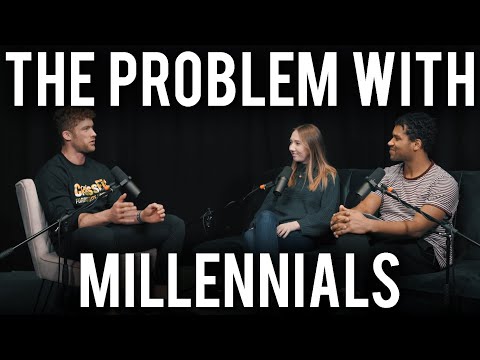
The Problem With Millennials | Theo Watt & Eve Young
Chris Williamson (host), Theo Watt (guest), Eve Young (guest)
In this episode of Modern Wisdom, featuring Chris Williamson and Theo Watt, The Problem With Millennials | Theo Watt & Eve Young explores millennials Misunderstood: Technology, Stereotypes, and Social Media’s Real Impact Chris Williamson, with guests Theo Watt and Eve Young, unpack how "millennials" have been misdefined and lazily stereotyped by media, marketers, and older generations. They argue millennials are shaped far more by unprecedented technological acceleration than by singular historical events like 9/11 or the financial crash. The conversation explores how this mislabeling distorts marketing, fuels inter‑generational resentment, and even makes millennials reject their own group identity. They then widen the lens to Gen Z and Gen Alpha, the attention economy, social media’s psychological effects, and how users, platforms, and governments are all scrambling to retrofit rules, best practices, and self‑regulation onto powerful technologies that arrived first.
Millennials Misunderstood: Technology, Stereotypes, and Social Media’s Real Impact
Chris Williamson, with guests Theo Watt and Eve Young, unpack how "millennials" have been misdefined and lazily stereotyped by media, marketers, and older generations. They argue millennials are shaped far more by unprecedented technological acceleration than by singular historical events like 9/11 or the financial crash. The conversation explores how this mislabeling distorts marketing, fuels inter‑generational resentment, and even makes millennials reject their own group identity. They then widen the lens to Gen Z and Gen Alpha, the attention economy, social media’s psychological effects, and how users, platforms, and governments are all scrambling to retrofit rules, best practices, and self‑regulation onto powerful technologies that arrived first.
Key Takeaways
Millennials are defined more by rapid technological change than by big historical events.
Theo and Eve argue that living through dial‑up, early mobiles, smartphones, social media, and constant connectivity in one 15–20 year window has shaped millennial attitudes and behavior far more than 9/11 or the 2008 crash.
Get the full analysis with uListen AI
Generational stereotypes are overly broad and actively unhelpful, especially in marketing.
Lumping 23‑year‑olds and 38‑year‑olds together as lazy, entitled ‘snowflakes’ ignores life‑stage differences; brands that rely on these clichés misread their audiences and often target them badly.
Get the full analysis with uListen AI
Marketers should prioritize mindset and behavior data over age demographics.
With fine‑grained tracking and tools like Facebook Pixel, brands can target by interest, intent, and behavior; using age as the primary proxy is crude when a 45‑year‑old and a 25‑year‑old can share more habits than two 25‑year‑olds.
Get the full analysis with uListen AI
Millennial bashing often comes from the very generations that failed to guide them through new tech.
Chris notes that older ‘gatekeepers’ never equipped young people with healthy norms for smartphones and social media, yet now condemn the results; this calls for more compassion toward millennials and Gen Z as early adopters.
Get the full analysis with uListen AI
Social media is less a pure cause of mental illness than a powerful amplifier and coping outlet.
Citing CBT research, Eve explains many depressed young people gravitate to social media rather than being made ill by it alone, suggesting it’s a correlated coping mechanism that can both help and harm depending on use.
Get the full analysis with uListen AI
Attention‑grabbing design (infinite scroll, autoplay) exploits cognitive biases and erodes focus.
Features that maximize engagement have trained users’ brains to expect constant stimulation, making low‑stimulus tasks like reading deeply harder and requiring deliberate ‘retraining’ and boundaries (e. ...
Get the full analysis with uListen AI
Future generations may benefit from today’s mistakes through better norms, tools, and regulation.
The guests predict Gen Z and Gen Alpha will inherit more mature usage rules, platform features like screen‑time controls, and cultural awareness of tech’s downsides, allowing them to use powerful tools with fewer unintended costs.
Get the full analysis with uListen AI
Notable Quotes
“In what other context would you group the behaviors of a 38‑year‑old with someone 15 years younger and say they’re the same?”
— Eve Young
“Being millennials, we feel that millennials are less defined by 9/11 and whatever, and more defined by this boom of innovation from 1982 to present day.”
— Theo Watt
“The people that pushed the narrative that millennials are this squalor sewage of low virtue were the people that were supposed to guide us through it.”
— Chris Williamson
“All this media attention that millennials are getting just refers to the snowflake generation, which people assume is teens and 20‑somethings, when it’s actually not.”
— Eve Young
“Millennials and Gen Z have been the canary in the coal mine for this technology.”
— Chris Williamson
Questions Answered in This Episode
If technology, not events, most defines a generation, how should we rethink all generational labels and their usefulness?
Chris Williamson, with guests Theo Watt and Eve Young, unpack how "millennials" have been misdefined and lazily stereotyped by media, marketers, and older generations. ...
Get the full analysis with uListen AI
What would a responsible ‘social media driver’s education’ look like for children and parents today?
Get the full analysis with uListen AI
Where is the ethical line between designing for engagement and deliberately exploiting cognitive weaknesses for profit?
Get the full analysis with uListen AI
How can individuals practically reclaim focus and deep work in an environment engineered for distraction?
Get the full analysis with uListen AI
In what ways might Gen Z and Gen Alpha actively reject millennial and Gen Z digital habits to differentiate themselves?
Get the full analysis with uListen AI
Transcript Preview
I'm joined by Eve and Theo from the Social Minds podcast. So, what are we going to talk about today?
Millennials.
Millennials.
Millennials. We have to. If you believe everything you've read, if you fall into that bracket, you are lazy, you're very narcissistic, you're probably not doing very well for money. You'll never be able to afford a house.
(laughs) Eat too much avocado toast.
Exactly. Being Millennials, we feel that Millennials are less defined by the situations around them, stuff like 9/11 and whatever. They're less defined by these situations and more defined by this boom of innovation that has happened between, say, 1982 to present day. You know, what defines a Millennial i- is the people who have lived through a vast speed of technological change.
All this media attention that Millennials are getting and the reputation that they've got just refers to the, the snowflake generation, which people assume is, like, teens and 20-somethings-
Yeah.
... when it's actually not.
Mm.
So when... I think the majority of the time, when people are saying, "Oh, Millennial, Millennial," they just mean young people-
Yeah.
... and they don't actually realize-
And that's probably-
... it stretches up to the age of 38.
Ladies and gentlemen, welcome back. I'm joined by Eve and Theo from the Social Minds podcast here in my beautiful new studio. Welcome.
(laughs)
Hello. Hello.
Hi. You all right?
Good to have you-
(laughs)
... back again. (laughs)
This is your studio.
Um, well, I mean, today, um, uh, it's an adopted studio for me-
Yeah.
Of course.
How are you? You good?
Good.
Yes. Yeah, really, really good. We've got you something, haven't we?
Got you a Soreen 'cause I know how much of a fan you are.
Look at that. How-
(laughs)
It's actually from Manchester as well, I believe.
Yeah.
Soreen, yeah.
Yeah.
It's a Manchester, it's-
Is it really?
... a Manchester cake-
Cake?
... I suppose you could call it, a squidgy loaf.
(laughs) It's a mult-
It is. So let me tell you-
It's very, uh-
A multiloaf.
Let me tell you about the difference between a cake and a biscuit. So cakes are not VAT-applicable. Biscuits are.
Mm-hmm.
Mm-hmm.
And I think the reason for that is that cakes are not seen as a luxury item because you would inevitably have to buy birthday cakes presumably throughout the year. And Jaffa Cake-hat (laughs) to, um, prove that they were a cake and not a biscuit to avoid the tax.
Ah.
And the way that you prove whether you're a biscuit or a cake is cakes, when they're left out, go hard, and biscuits, when they're left out, go soft.
Install uListen to search the full transcript and get AI-powered insights
Get Full TranscriptGet more from every podcast
AI summaries, searchable transcripts, and fact-checking. Free forever.
Add to Chrome