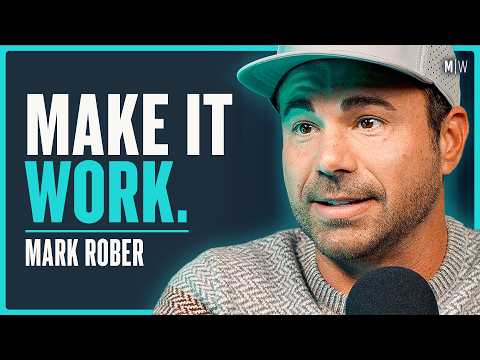
How to Engineer a Life You Love - Mark Rober
Chris Williamson (host), Mark Rober (guest)
In this episode of Modern Wisdom, featuring Chris Williamson and Mark Rober, How to Engineer a Life You Love - Mark Rober explores nASA engineer Mark Rober on failure, fun, AI and meaning Mark Rober discusses his journey from NASA Mars rover engineer to Apple’s secret car project and then to building massive educational projects on YouTube and CrunchLabs.
NASA engineer Mark Rober on failure, fun, AI and meaning
Mark Rober discusses his journey from NASA Mars rover engineer to Apple’s secret car project and then to building massive educational projects on YouTube and CrunchLabs.
He explains how engineering principles—especially prototyping, iteration, and embracing failure—shape how he builds projects, companies, and even his own skills like public speaking and fitness.
The conversation ranges from orbital mechanics and space junk to AR/VR, robotics, AI, Fermi’s paradox, and why attention, story, and emotion are crucial for learning and persuasion.
Rober’s mission now is to engineer curiosity at scale for kids and adults, using playful builds, visceral storytelling, and free school curricula to make STEM irresistible rather than obligatory.
Key Takeaways
Prototype early, ugly, and often instead of aiming for perfection first.
Rober says NASA’s biggest lesson was never to build the ‘final version’ first; you make quick, rough prototypes, deliberately break them, learn the limits, and only then commit to the real build. ...
Get the full analysis with uListen AI
Treat failure like a video game: feedback, not identity.
He frames failure as simply another ‘attempt’—like dying in a level and instantly wanting to try again—rather than proof that you’re bad at something. ...
Get the full analysis with uListen AI
Emotion and story are non‑negotiable if you want to teach or persuade.
Whether landing rovers, shutting down scam centers, or teaching magnetism with an MRI watermelon explosion, Rober insists you must evoke a visceral response first. ...
Get the full analysis with uListen AI
Curiosity is engineered by boredom plus agency, not constant input.
He argues modern life drowns us in inputs and starves us of making things; kids (and adults) need boredom and hands-on tinkering to spark real curiosity. ...
Get the full analysis with uListen AI
Pace is tolerable; complexity is what burns people out.
Rober and Williamson note that humans can handle working hard, but juggling too many different types of demands creates cognitive overload. ...
Get the full analysis with uListen AI
AI and robotics may decouple profit from employment, forcing new social models.
They discuss how AI/robots can replace large swaths of work, raising profits while shrinking payrolls and therefore consumer buying power. ...
Get the full analysis with uListen AI
Educational systems underestimate how hard it is to earn attention.
Rober contrasts curriculum writers with YouTubers: teachers are handed dry diagrams, while he has to win every second of attention or viewers click away. ...
Get the full analysis with uListen AI
Notable Quotes
“The number one mistake people make when they try and make something is they try and make the final version first.”
— Mark Rober
“In my videos, failing is the goal. You want to break this thing so you know exactly what it’s capable of.”
— Mark Rober
“We are drowning in inputs and sort of starved for outputs.”
— Mark Rober
“You could be me or you could be happy. Choose which one.”
— MrBeast, as quoted by Mark Rober
“To make a viral video, you just have to evoke a visceral response.”
— Mark Rober
Questions Answered in This Episode
How can non-engineers practically adopt NASA’s prototyping mindset in everyday life decisions—careers, relationships, or personal projects?
Mark Rober discusses his journey from NASA Mars rover engineer to Apple’s secret car project and then to building massive educational projects on YouTube and CrunchLabs.
Get the full analysis with uListen AI
If AR, robotics, and AI do converge into a ‘world’s best assistant,’ which human skills become more valuable rather than less?
He explains how engineering principles—especially prototyping, iteration, and embracing failure—shape how he builds projects, companies, and even his own skills like public speaking and fitness.
Get the full analysis with uListen AI
What concrete changes would schools need to make if they truly prioritized earning students’ attention the way successful creators do?
The conversation ranges from orbital mechanics and space junk to AR/VR, robotics, AI, Fermi’s paradox, and why attention, story, and emotion are crucial for learning and persuasion.
Get the full analysis with uListen AI
Where do you personally draw the line between healthy mastery and the kind of dopamine-driven obsession that erodes happiness?
Rober’s mission now is to engineer curiosity at scale for kids and adults, using playful builds, visceral storytelling, and free school curricula to make STEM irresistible rather than obligatory.
Get the full analysis with uListen AI
If AI and robotics trigger the ‘Great Filter’ for our civilization, what specific governance or cultural shifts might give us the best odds of avoiding that outcome?
Get the full analysis with uListen AI
Transcript Preview
I never knew that you worked on the Mars rover for NASA. That's so cool.
Well, what's really wild is my name, Mark Rober, is only two letters off from Mars rover.
(laughs)
If you change the K to an S and the B to a V.
(laughs)
And honestly-
It was meant to be.
... it took me, like, four years working at NASA to realize that. And just one day, I'm like, "Oh, dang."
What did you do?
So I'm a mechanical engineer, uh, by trade. I got my bachelor's and master's in that. And I worked on the rover that's on Mars for, like, seven years. So the way it works is they just throw you into the deep end, and like, I'm- I was responsible for a chunk of the rover. And so, you know, I designed what it should look like. I, you know, you test it, you integrate it, you put it together. You have a team of people working with you. They have gray beards, they call them at NASA, who look at your design and tell you all the reasons it sucks, so you go back and change it.
This sounds like some, uh, Gandalf the White, like you need to go and pay homage to the dude at the top of the mountain.
That's effectively what it is. (laughs) But they're smart. They know what they're doing. They've put stuff in space before.
Mm-hmm.
And so they give it to the young, the young folks who are just coming up to... And they literally, you're, I was in charge of a chunk on the top of the rover, the arm go digs in the dirt, takes that sample, puts it into the belly of the rover. And like, I designed the hardware to accept that. And it's still working, fingers crossed, on Mars, but-
So that's still going?
Yeah. Which is wild when you look up at the sky. You know, all the stars look the same. Mars has a little bit of red tint to it, right?
You know where your baby is.
Yeah, and it's like, that's 90 million miles away, and I have, I've touched and integrated, I've touched something that's rolling around on, on that dot in the sky. And what's really cool is on Earth, things oxidize and break down, so they, they crumble and go away, right? So let's say, you know, thanks to AI or whatever (laughs) you want to say, a million years from now, our species is done. There won't be any... If you came here, you would just see nature. Like at that point, everything's broken down and crumbled and rusted and gone away. So the aliens would come and they'd just see this lush planet, and then they'd go to Mars and be like, "What the hell are these?" Because on Mars, there's no oxygen, and stuff doesn't break down. So a million years from now, those rovers are just gonna be sitting there space-
Install uListen to search the full transcript and get AI-powered insights
Get Full TranscriptGet more from every podcast
AI summaries, searchable transcripts, and fact-checking. Free forever.
Add to Chrome