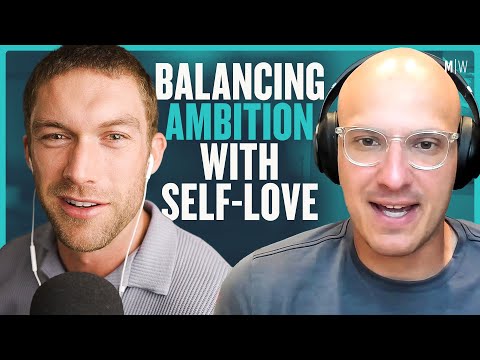
6 Principles To Stop Feeling So Frantic - Brad Stulberg | Modern Wisdom Podcast 377
Brad Stulberg (guest), Chris Williamson (host)
In this episode of Modern Wisdom, featuring Brad Stulberg and Chris Williamson, 6 Principles To Stop Feeling So Frantic - Brad Stulberg | Modern Wisdom Podcast 377 explores six Principles For Grounded Success: From Frantic Hustle To Fulfillment Brad Stulberg discusses the core ideas from his book on ‘groundedness,’ a framework designed to counter frantic, ego-driven striving and replace it with sustainable, fulfilling performance.
Six Principles For Grounded Success: From Frantic Hustle To Fulfillment
Brad Stulberg discusses the core ideas from his book on ‘groundedness,’ a framework designed to counter frantic, ego-driven striving and replace it with sustainable, fulfilling performance.
He argues that modern life and work trap people in “heroic individualism” and constant self-comparison, which undermines well-being, flow, and long-term excellence.
Stulberg proposes six principles—acceptance, presence, patience, vulnerability, community, and embodiment—to build a solid foundation so ambition comes from security and choice, not fear and compulsion.
The conversation ranges from practical routines and attention management to deep themes like ego, mental health, consumer culture, and the importance of doing ‘real things’ in the physical world.
Key Takeaways
Shift from ‘have to’ to ‘want to’ in your motivation.
Acting from compulsion—needing achievement for self-worth—creates tension and fragility, whereas acting from genuine choice and already-feeling-enough leads to better performance and a more enjoyable, sustainable path.
Get the full analysis with uListen AI
Build a foundation using the six principles of groundedness.
Acceptance, presence, patience, vulnerability, deep community, and inhabiting your body form a stable psychological base, allowing you to strive ambitiously without being dragged around by anxiety, ego, and external validation.
Get the full analysis with uListen AI
Pursue flow by loosening your grip and letting go of ego.
Flow requires a secure sense of self; if your identity hinges on outcomes, you play ‘not to lose’ and stay tight, but when you feel fundamentally okay, you can relax, immerse in the craft, and reach higher performance with less angst.
Get the full analysis with uListen AI
Reduce task-switching and digital ‘peanut M&Ms’ to reclaim presence.
Constant context switching and cheap stimulation (social media, notifications, compulsive news) drain energy and attention; batching similar work, removing apps, using offline tools, and setting time boundaries makes deep, meaningful work more likely.
Get the full analysis with uListen AI
Practice patience by consistently stopping one rep short.
Borrowing from athletic training, Stulberg suggests challenging yourself without maxing out daily—whether in writing, meetings, or workouts—so you avoid frequent mini-breakdowns and build durable capacity over years instead of burning out in spurts.
Get the full analysis with uListen AI
Use language and self-distancing to interrupt harsh self-talk.
Replacing ‘should’ with ‘want’ or ‘wish,’ and using tools like meditation, imagining advice to a friend, or consulting an older wiser self, creates space between you and your thoughts, allowing more compassionate, wiser responses instead of spirals of judgment.
Get the full analysis with uListen AI
Treat vulnerability and real-world activities as anchors against ego and isolation.
Honestly facing fears and insecurities (often with others) reveals your core values and builds trust, while doing tangible activities—deadlifting, gardening, manual work—grounds you in reality, provides clear feedback, and counters the abstractions of modern knowledge work.
Get the full analysis with uListen AI
Notable Quotes
“You have the best chance of getting better when you're doing it from a place of already feeling enough.”
— Brad Stulberg
“If you're in a candy store trying to eat brown rice, it is very hard.”
— Brad Stulberg
“Heroic individualism is being in a never-ending game of one-upsmanship against yourself and others where the finish line is an illusion.”
— Brad Stulberg
“Real vulnerability should feel hard. If it doesn't feel uncomfortable, it's probably performative.”
— Brad Stulberg
“Community is like gravity and it's also a safety net.”
— Brad Stulberg
Questions Answered in This Episode
How can someone stuck in a high-cost, high-status environment realistically begin to downshift toward a more grounded life without blowing up their responsibilities?
Brad Stulberg discusses the core ideas from his book on ‘groundedness,’ a framework designed to counter frantic, ego-driven striving and replace it with sustainable, fulfilling performance.
Get the full analysis with uListen AI
What are some concrete daily diagnostics to know when you’re ‘one rep short’ versus actually under-delivering in knowledge work?
He argues that modern life and work trap people in “heroic individualism” and constant self-comparison, which undermines well-being, flow, and long-term excellence.
Get the full analysis with uListen AI
How do you distinguish healthy ambition from heroic individualism when the behaviors on the surface can look very similar?
Stulberg proposes six principles—acceptance, presence, patience, vulnerability, community, and embodiment—to build a solid foundation so ambition comes from security and choice, not fear and compulsion.
Get the full analysis with uListen AI
What practices help people who’ve been deeply burned by relationships learn to trust vulnerability and community again?
The conversation ranges from practical routines and attention management to deep themes like ego, mental health, consumer culture, and the importance of doing ‘real things’ in the physical world.
Get the full analysis with uListen AI
In a world of increasingly abstract digital work, how much time should we deliberately allocate to ‘real things’—physical tasks with clear pass/fail outcomes—to stay psychologically healthy?
Get the full analysis with uListen AI
Transcript Preview
Sometimes you feel like you're doing something because you have to and you don't really want to, but that have to is wrapped up in self-worth, or numbers, or sales, or getting promoted, or, um, having the opposite sex be attracted to you. Or you're doing something by choice, 'cause like you're making a deliberate choice in the moment to do something 'cause it's what you actually want to do. And I think that the more that we can do the latter, the happier, healthier, and more sustainable our performance will be. (winds blowing)
Brad Stulberg, welcome to the show.
Hey, Chris. It's a pleasure to be here.
How would you describe what you do for work?
I coach and I write. I wear those two hats. So in my coaching practice, I work with executives, entrepreneurs, and a handful of physicians, and I help them on their performance and well-being. And in my writing, I am very interested in exploring those same topics, so what makes for sustainable performance, what does it actually mean to be well, how can you marry performance and well-being, and I explore that in my books and in my magazine work.
What are ... Like among the high performers that you work with, what is some of the most common errors that you see people making?
Yeah. I think that there's a lot of selection bias in my own coaching practice because the people that come to me for coaching have almost, like, unanimously read my work. So I'm fortunate that people come to me wanting to, um, to find a little bit more fulfillment in what they're doing, and I think it's a lot of people that go into whatever it is that they do off the bat for all the right reasons, uh, but then it can get noisy later on in your career, and it's hard to find that signal. And, um, I think a lot of people come to me very successful by conventional standards, but perhaps wanting to, um, feel more internally successful, if that makes sense.
Yeah. It's something that I think all of us play with, this desire for success, but also the happiness to be where we are and to sort of just have our feet underneath you. I read a, this Cal Newport article about how you downsized your life. Can you explain how you decide what you let in and out of your daily routine now?
Mm-hmm. So that Cal article, um, focused on a couple years back. Uh, my partner, Caitlin, and I and our, our young son, Theo, decided that we wanted to move out of, um, a high cost of living urban area, we were in the Bay Area, where it's very expensive to live, to go to a place that afforded us, um, a little bit more autonomy. So we felt that we wouldn't have to necessarily work as hard as often, perhaps could start saying no to things that we didn't want to do if we didn't have to pay a gazillion dollars in rent every month. Uh, so we moved to a small mountain town in North Carolina, and that's definitely the biggest thing that we've done to simplify. Um, some of the other things that I try to do to simplify my life, I, I am very structured in how I separate coaching and my writing work. So I only coach on Mondays and Fridays, and then Tuesday, Wednesday, Thursday, I have for writing and more creative activities. Um, what I have found, both in myself and with a lot of people that I work, uh, that I work with, is that oftentimes, the switching between tasks is the thing that actually drains you, not so much the task itself. So in my own life, I found that if I had a coaching client and I was in a writing groove, I would resent having to coach someone, and that is not what you want in a coach. It's not what I want in myself. And if I was, um, in a coaching groove, like just talking to clients, really being fully present, helping people, the last thing I'd want to do is have to go work on an article on deadline. So, um, something that, that has been really helpful is, again, really compartmentalizing those two components of my work. And you're talking to me in the middle of a book launch, so it's an aberration, I'd say, for the few weeks after a book comes out, but in the normal world of Brad, um, just really making sure that I prioritize, uh, physical practice, so something that I'm doing with my body, where I am not online, I am not thinking about work, uh, time outdoors with my dog, and then in the evening, really trying to shut everything down by 6:30 pretty religiously.
Install uListen to search the full transcript and get AI-powered insights
Get Full TranscriptGet more from every podcast
AI summaries, searchable transcripts, and fact-checking. Free forever.
Add to Chrome