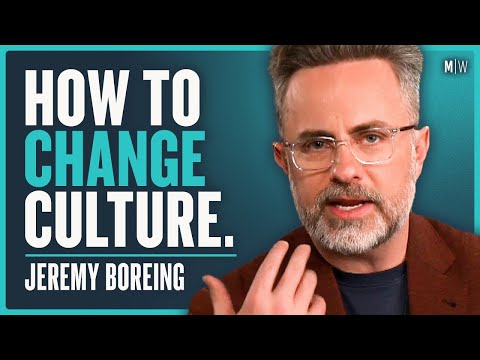
Can The DailyWire Destroy Mainstream Media? - Jeremy Boreing
Chris Williamson (host), Jeremy Boreing (guest)
In this episode of Modern Wisdom, featuring Chris Williamson and Jeremy Boreing, Can The DailyWire Destroy Mainstream Media? - Jeremy Boreing explores jeremy Boreing On Building Daily Wire, Culture Wars, And Authentic Influence Jeremy Boreing recounts the unlikely origin story of The Daily Wire, explaining how he and Ben Shapiro shifted from traditional media aspirations to talent-driven digital influence. He outlines what it takes to build durable careers and companies in the creator economy: depth of knowledge, risk-taking, value creation, and resisting audience capture. The conversation dives into the right’s reactionary nature, the dangers of populism, cultish influencers, and why Boreing favors a ‘lowercase republicanism’ that both represents and challenges its audience. He also discusses Daily Wire’s expansion into films, kids’ content, and consumer products as a strategy to shape culture rather than just critique it, while warning about fame, wealth, and power corroding both creators and movements.
Jeremy Boreing On Building Daily Wire, Culture Wars, And Authentic Influence
Jeremy Boreing recounts the unlikely origin story of The Daily Wire, explaining how he and Ben Shapiro shifted from traditional media aspirations to talent-driven digital influence. He outlines what it takes to build durable careers and companies in the creator economy: depth of knowledge, risk-taking, value creation, and resisting audience capture. The conversation dives into the right’s reactionary nature, the dangers of populism, cultish influencers, and why Boreing favors a ‘lowercase republicanism’ that both represents and challenges its audience. He also discusses Daily Wire’s expansion into films, kids’ content, and consumer products as a strategy to shape culture rather than just critique it, while warning about fame, wealth, and power corroding both creators and movements.
Key Takeaways
Durable influence requires substance, not just algorithmic success.
Boreing argues many creators can hack short-term growth, but only those who actually have something to say and do the hard intellectual work (like Michael Knowles reading two serious books a week for years) build long-lasting, trusted voices.
Get the full analysis with uListen AI
Create value-based businesses instead of relying on viral hot takes.
He distinguishes wealth perpetuation (e. ...
Get the full analysis with uListen AI
Resist audience capture and purity spirals if you want longevity.
Boreing insists The Daily Wire should represent its audience without pandering to their worst impulses or entering a ‘purity compact’ that no human can live up to, because moral or ideological absolutism eventually destroys both leaders and communities.
Get the full analysis with uListen AI
Healthy conservatism must both preserve and build.
He describes the right as inherently reactionary and necessary to check left-wing excesses, but warns that when it becomes purely revolutionary or retrograde, it risks mirroring the worst tendencies it opposes; instead, it should practice lowercase republicanism—representing and also leading its constituency.
Get the full analysis with uListen AI
Fame, wealth, and power change your incentives and can corrupt judgment.
Boreing notes that once you ‘have something to lose,’ you naturally become more risk-averse and may stop doing the very things that made you successful, so creators must constantly interrogate why they’re saying what they’re saying and guard against self-protective drift.
Get the full analysis with uListen AI
Don’t build your brand on moral purity or single-issue truth-telling.
He likens some influencers to cult leaders who gain trust by voicing a forbidden truth, then use that unearned trust to lead followers into darker or incompetent territory (e. ...
Get the full analysis with uListen AI
To win cultural ground, conservatives must create compelling entertainment and kids’ content.
Boreing says it’s not enough to criticize Hollywood or ‘woke’ media; the right must build entertaining, high-quality alternatives like Lady Ballers, Burcham, and the BentKey kids’ platform so people have a future—and a media environment—they actually want to live in.
Get the full analysis with uListen AI
Notable Quotes
“You can make a lot of money really quickly on the internet, but money doesn't stack very well.”
— Jeremy Boreing
“The voices who are gonna be around a decade from now are the voices who don't pander to their audience.”
— Jeremy Boreing
“A healthy society has to have leadership that both responds and represents the people, but also, to some degree, challenges the worst impulses of the people.”
— Jeremy Boreing
“The problem with making your identity purity is… eventually, since you are not pure, you will be destroyed by that standard that you create.”
— Jeremy Boreing
“We don't want to just be critics of the culture, we wanna be creators of the culture.”
— Jeremy Boreing
Questions Answered in This Episode
How can individual creators practically guard against audience capture while still growing and monetizing their platforms?
Jeremy Boreing recounts the unlikely origin story of The Daily Wire, explaining how he and Ben Shapiro shifted from traditional media aspirations to talent-driven digital influence. ...
Get the full analysis with uListen AI
What does a realistic, non-utopian vision of ‘lowercase republicanism’ look like in digital media and politics today?
Get the full analysis with uListen AI
Where is the line between representing your audience’s values and irresponsibly reinforcing their worst instincts for clicks or profit?
Get the full analysis with uListen AI
How should conservatives balance the desire for ‘wholesome’ content with the reality of what audiences actually choose to watch and enjoy?
Get the full analysis with uListen AI
In an era without gatekeepers, what new mechanisms—if any—should emerge to filter out genuinely harmful or incompetent voices without stifling dissent?
Get the full analysis with uListen AI
Transcript Preview
What do you say when people ask you what you do?
I say that I am just a lowly shampoo, razor, and chocolate mogul.
(laughs)
I've only been saying that for about a week though. (chuckles)
Yeah. That's a, a new, a new industry for you. What, what-
No, it, it is a terrifying question when people ask you what you do when you're an entrepreneur because, uh, y- you never quite know what to lead with. And whatever you lead with will be the box that people put you in. So I, I, uh, I try never to answer the question very honestly. When I was a teenager, I had... I was the first person I knew with a cell phone other than, you know, bankers who I didn't know. But I was an, I was an early adopter of the, of the flip phone. And my first voicemail, I sa- I was probably 17 and I said, uh, "Jeremy Boring, writer, producer, and shameless self-promoter."
Ah, very nice. Yeah. I, I, I feel that myself as well. You know, what, wha- wha- what do you say about who you are? You know, you... What you do very largely determines the way that people see you. And-
Yeah.
... yeah, if you've got a lot of different things, you're interested in lots of different things. That being said, the word entrepreneur is the most wanky title that anybody could bestow on themselves. Second only to thought leader.
Yeah. Well, I, I certainly never, uh, identified myself as either of those two things.
(laughs) Can you give me the origin story of The Daily Wire from your perspective? I'd be very interested to hear this.
Yeah, absolutely. Uh, you know, a long time ago, a boy loved a girl in 1979. No. The, the real truth is that The Daily Wire, w- it is one of those kinds of stories. So many sundry paths that were all seemingly leading in different directions brought us to this moment where The Daily Wire was formed. You have Ben Shapiro who, you know, wunderkind, child prodigy, violinist who wanted to be the first Jewish me- member of the Supreme Court, uh, who became the youngest nationally syndicated columnist as a teenager, had his first best-selling book as a teenager, who, you know, pro- went to Harvard Law and imagined a future for himself working in law and then politics, but who found himself being the fastest talker, talking person in an industry known for slow talking. Uh, you've got me who, you know, kind of the classic go West young man, small town, big aspirations guy, moves to Hollywood to be an actor, and sort of quickly encounters the reality that he doesn't have what it takes to succeed in, in that business. Uh, for i- in phases came to that realization. Um, you have Caleb Robinson, our co-founder and co-CEO, who, you know, very, got married very early, had his first kid as a teenager, and his first business as well as a, as a teenager, putting in docks underwater in lakes in Texas. Like, we just all had this background that in no way seemed like it was pointed toward running a, a major media company. But, you know, the, the shorter window version of it is that I met Ben Shapiro at a Coffee Bean on, uh, Ventura Boulevard in Studio City, and I recognized pretty quickly that Ben was a once-in-a-generation talent, and a lot of the things that people thought were liabilities, for example, how quickly he speaks, I thought could be real assets if deployed in the right areas. And I was in a low moment sort of in my Hollywood aspiration, my Hollywood journey.
Install uListen to search the full transcript and get AI-powered insights
Get Full TranscriptGet more from every podcast
AI summaries, searchable transcripts, and fact-checking. Free forever.
Add to Chrome