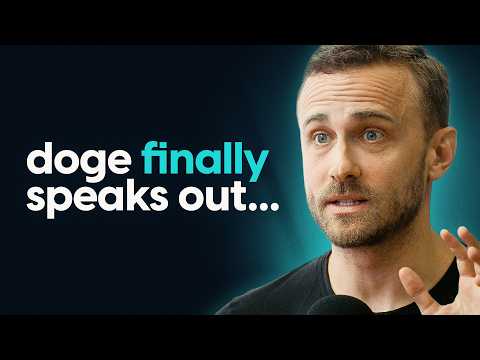
Inside DOGE, The IRS & How to Scam the US Government - Sam Corcos
Chris Williamson (host), Sam Corcos (guest)
In this episode of Modern Wisdom, featuring Chris Williamson and Sam Corcos, Inside DOGE, The IRS & How to Scam the US Government - Sam Corcos explores inside IRS Tech Chaos, Doge Reforms, And Massive Government Waste Exposed Sam Corcos, now CIO of the U.S. Treasury, explains how he was brought in to rescue the decades‑long, massively over‑budget IRS IT modernization effort and to clean up broader Treasury technology systems.
Inside IRS Tech Chaos, Doge Reforms, And Massive Government Waste Exposed
Sam Corcos, now CIO of the U.S. Treasury, explains how he was brought in to rescue the decades‑long, massively over‑budget IRS IT modernization effort and to clean up broader Treasury technology systems.
He details structural problems: non‑technical leadership in technical roles, extreme procurement dysfunction, misaligned contractor incentives, and civil-service rules that make it nearly impossible to remove poor performers.
Corcos describes how Doge-linked reformers have been cutting billions in wasteful contracts, recomposing teams so engineers do engineering, and attacking bizarre legacy practices like the IRS’s dependence on 60 million faxes a year.
Throughout, he emphasizes that the real leverage is organizational and cultural—fixing incentives, leadership, and hiring pipelines—so that any technical modernization can stick beyond his limited tenure in government.
Key Takeaways
Put technical leaders in charge of technical decisions.
Corcos argues that multi‑billion‑dollar IT decisions were being made by leaders who “don’t know how computers work. ...
Get the full analysis with uListen AI
Fix procurement and contract oversight to unlock massive savings.
Government vendors exploit misaligned incentives, often ballooning prices once they’re embedded. ...
Get the full analysis with uListen AI
Recompose organizations so engineering orgs are actually staffed by engineers.
At the IRS, the engineering org had roughly one engineer for every ten non‑engineers. ...
Get the full analysis with uListen AI
Attack data fragmentation and legacy sprawl before chasing ‘modernization.’
The IRS has around 108 conflicting “sources of truth” and dozens of unintegrated systems for basic data like addresses. ...
Get the full analysis with uListen AI
Align incentives and accountability around cost, risk, and outcomes—not process.
Because it’s not “their” money and firing is nearly impossible, leaders default to safety and process: renew every contract, declare everything “mission critical,” avoid tough calls. ...
Get the full analysis with uListen AI
Simplify and rationalize hiring and performance systems to raise talent density.
Current civil‑service rules, veterans’ preferences, and tenure‑based RIFs mean you often hire the minimally qualified candidate quickly and then can’t remove them. ...
Get the full analysis with uListen AI
Treat software like a living system that needs continual care, not a one‑off project.
The IRS historically spends billions on big‑bang ‘modernization’ projects, then is told never to touch them again, immediately starting a new rewrite cycle. ...
Get the full analysis with uListen AI
Notable Quotes
“If the IRS were a private company, it would have gone bankrupt many, many years ago because people would stop buying the service because it’s bad.”
— Sam Corcos
“Historically, if you want to hire a good engineer [at the IRS], you have to hire five, because you just don’t know what you’re gonna get.”
— Sam Corcos
“Executive orders are not self‑actualizing. Just having the policy is a very small part of the amount of work that actually needs to get done.”
— Sam Corcos
“We receive 60 million faxes per year at the IRS. We have, I believe, 50,000 active fax lines… and I cannot for the life of me figure out where the lever is to turn this off.”
— Sam Corcos
“It is hubris to think that a system that has had quite literally a million hours of labor put into it… you can rewrite from scratch and then cut over one day and it will suddenly start working.”
— Sam Corcos
Questions Answered in This Episode
Given entrenched civil-service protections and union dynamics, what realistic reforms could enable performance-based hiring, promotion, and RIFs without reviving the old spoils system?
Sam Corcos, now CIO of the U. ...
Get the full analysis with uListen AI
How can the government redesign procurement to preserve anti-corruption safeguards while eliminating value‑added resellers, fake competitiveness, and the ‘soft touch’ reputation on pricing?
He details structural problems: non‑technical leadership in technical roles, extreme procurement dysfunction, misaligned contractor incentives, and civil-service rules that make it nearly impossible to remove poor performers.
Get the full analysis with uListen AI
What concrete milestones should taxpayers and policymakers use over the next 3–5 years to judge whether IRS modernization and Doge‑driven reforms are actually succeeding?
Corcos describes how Doge-linked reformers have been cutting billions in wasteful contracts, recomposing teams so engineers do engineering, and attacking bizarre legacy practices like the IRS’s dependence on 60 million faxes a year.
Get the full analysis with uListen AI
How should the U.S. balance the need for speed and modernization in government IT with the very real national security and privacy risks of moving more critical systems to the cloud?
Throughout, he emphasizes that the real leverage is organizational and cultural—fixing incentives, leadership, and hiring pipelines—so that any technical modernization can stick beyond his limited tenure in government.
Get the full analysis with uListen AI
If simplifying the tax code would dramatically reduce IT complexity and administrative burden, what political and institutional barriers make that simplification so hard—and how could they be overcome?
Get the full analysis with uListen AI
Transcript Preview
You got a new job. Congratulations.
(laughs) Yeah.
How'd that happen?
I, uh, I had a lot of friends reach out to me from the administration, uh, saying that they really needed help doing, really looking into IRS modernization. It's one of the worst managed IT projects in the government. Uh, I think maybe second only to the VA's attempt at implementing an electronic health records system. Uh, it's about 15 billion dollars over budget. It was actually started right around the time I was born, and it's still ongoing. It's still five years away. It was five years away in 1991, it's still five years away. So, they said they really needed somebody to look into this and see if we could fix it. So, um, I, I've always wanted to do government service. It's a thing that has been important to me. I, I care a lot about the future of the country, especially the national debt. But I, I kind of assumed this would be a thing that I would do in my 50s, after I'm retired, um, but my, my wife really encouraged me to, uh, to give this a go. So about six months ago, I made the plunge and, and here I am. (laughs)
What are you?
I'm, uh, I'm the chief information officer of the Treasury Department. That's my official role.
What's that mean? What's that guy do?
So the chief information officer in, in private companies is usually the CTO, is the, the primary technical leader. In the government, it's the chief information officer.
Mm-hmm.
Um, it's an interesting one. I think a lot of what I've learned is tracking the history of a lot of these things can be interesting. So, the chief information officer really stems from, if you go way back, it stems from when it was effectively a librarian role, if you want to call it that.
Mm.
Where it, the, the, the legacy of chief information officer is when things were in filing cabinets. Where is the information? How do you keep track of this stuff? And it slowly evolved into what it is today. But part of the challenge that I've seen internal to government is that most of the chief information officers, at least before this administration, were non-technical, and the main reason is there's no technical standards or requirements for the role. And so, you can kind of see how you get there where, when it's a librarian role, it's not, there, there's no requirement to really know how computers work.
Mm.
And if you never update the standards, you just sort of fall into the situation.
Is that prescient? That not only were the systems not updated, even the job title wasn't?
I think it's, it's less the job title, it's more the qualifications for the job. Like we have standards for being like the chief counsel of an agency. You have to be a lawyer. I think most people would think that's reasonable. We just never updated that for technology or, in government they really call it IT. That's the, that- that's- that's the more common way they would describe it.
Install uListen to search the full transcript and get AI-powered insights
Get Full TranscriptGet more from every podcast
AI summaries, searchable transcripts, and fact-checking. Free forever.
Add to Chrome