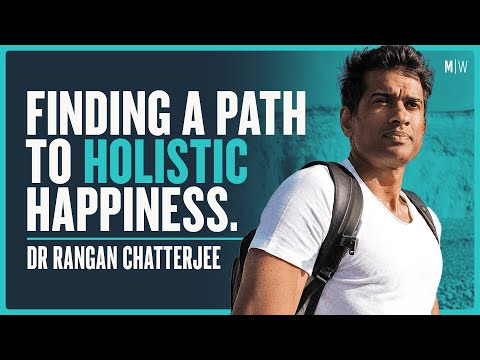
A Doctor's Prescription For Happiness - Dr Rangan Chatterjee
Dr Rangan Chatterjee (guest), Chris Williamson (host)
In this episode of Modern Wisdom, featuring Dr Rangan Chatterjee and Chris Williamson, A Doctor's Prescription For Happiness - Dr Rangan Chatterjee explores doctor Reveals Happiness As Trainable Skill, Not Life’s End Goal Dr. Rangan Chatterjee argues that happiness is a practical, trainable skill rather than a vague byproduct of success or meaning. He introduces his “core happiness” model—alignment, contentment, and control—contrasted with “junk happiness” from numbing behaviors like scrolling, drinking, or gambling. Through personal stories, patient examples, and figures like Tiger Woods and Jonny Wilkinson, he shows how chasing status, fame, or childhood-driven dreams often deepens emptiness instead of relieving it. The conversation emphasizes reframing stories, understanding values, and treating friction as a teacher to build lasting wellbeing and even better physical health.
Doctor Reveals Happiness As Trainable Skill, Not Life’s End Goal
Dr. Rangan Chatterjee argues that happiness is a practical, trainable skill rather than a vague byproduct of success or meaning. He introduces his “core happiness” model—alignment, contentment, and control—contrasted with “junk happiness” from numbing behaviors like scrolling, drinking, or gambling. Through personal stories, patient examples, and figures like Tiger Woods and Jonny Wilkinson, he shows how chasing status, fame, or childhood-driven dreams often deepens emptiness instead of relieving it. The conversation emphasizes reframing stories, understanding values, and treating friction as a teacher to build lasting wellbeing and even better physical health.
Key Takeaways
Train happiness by strengthening alignment, contentment, and control.
Chatterjee’s ‘core happiness stool’ says you become happier by daily actions that align your behavior with your values, cultivate calm/contentment, and build a sense of agency over your responses—not by chasing fleeting highs.
Get the full analysis with uListen AI
Differentiate junk happiness from core happiness.
Activities like compulsive scrolling, drinking, or gambling can feel good briefly but don’t resolve deeper misalignment; overreliance on them often signals a void created by living out of sync with one’s values.
Get the full analysis with uListen AI
Interrogate the source of your dreams and ambitions.
Goals driven by fear, lack, or a need to prove worth (e. ...
Get the full analysis with uListen AI
Use values, not job titles or fame, to define purpose.
Even in an unfulfilling job, you can live meaningfully by expressing a core value—like kindness or integrity—in everyday interactions; this reduces the void that fuels destructive coping habits.
Get the full analysis with uListen AI
Reframe situations to choose ‘happiness stories’ over victim narratives.
The same event can be interpreted in multiple ways; practicing compassionate, alternative explanations (e. ...
Get the full analysis with uListen AI
View friction and triggers as opportunities for self-inquiry.
When you feel jealousy, anger, or resentment, instead of blaming others, ask what insecurity or belief in you is being exposed; over time this builds psychological freedom and reduces reactivity.
Get the full analysis with uListen AI
Recognize the health cost of unmanaged emotions and stress.
Chronic anger, resentment, and emotional stress contribute to conditions like hypertension, heart disease, autoimmune issues, and possibly cancer; mental reframing and happiness practices are therefore medical, not just psychological, interventions.
Get the full analysis with uListen AI
Notable Quotes
“Happiness is a skill. It’s a skill that we can develop. It’s a skill that we can get better at.”
— Dr. Rangan Chatterjee
“When I was losing at pool, I’d go into the bathroom, slap myself in the face, call myself a loser, and then come out and usually win.”
— Dr. Rangan Chatterjee
“Would you pay the price of Tiger Woods’ life to be Tiger Woods?”
— Chris Williamson
“At the end of our life, we know what’s important. We look back and regret often that we didn’t do these things.”
— Dr. Rangan Chatterjee
“The greatest prison you will ever live inside is the prison you create inside your mind.”
— Dr. Rangan Chatterjee (quoting Edith Eger)
Questions Answered in This Episode
How can I practically identify my core values and notice where my life is out of alignment with them?
Dr. ...
Get the full analysis with uListen AI
Which of my current ‘dreams’ might actually be driven by lack, fear, or a need to prove myself rather than genuine desire?
Get the full analysis with uListen AI
In what situations do I default to junk happiness, and what deeper void or misalignment might those habits be masking?
Get the full analysis with uListen AI
How could I start using daily triggers—jealousy, irritation, criticism—as prompts for inner work instead of proof that others are the problem?
Get the full analysis with uListen AI
Where in my life am I unconsciously worshiping the wrong heroes, and how might that be distorting my definition of success and happiness?
Get the full analysis with uListen AI
Transcript Preview
So people at the end of their life, they all pretty much say the same things: "I wish I'd worked less. I wish I'd spent more time with my friends and family. I wish I'd allowed myself to be happy. I wish I'd lived my life and not the life that other people expected of me." (wind blows)
Rangan Chatterjee, welcome to the show.
Chris, delighted to be back on.
Welcome. How is it in the UK? What's happening?
It's hot at the moment. It's sunny. I'm, uh, I'm very warm in my studio at the moment, so tha- that's a good thing. You're, you're definitely missing some British sun at the moment. But, um, yeah, life's pretty good, mate, if I'm honest. Life, life feels good a lot of the time these days, and, um, yeah, I gotta say, I feel this kind of level of calmness and contentment that I don't think I've really had before. So, yeah, yeah, I'm, I'm feeling in a pretty good place, if I'm honest.
You say in your new book that you think happiness is a skill, and it seems like that's been something that you've worked at here as well, right? That calmness is something that you've had to cultivate, it's not something that you've randomly stumbled upon.
I've not felt this way for most of my life. Absolutely. Um, I don't think I've really thought about happiness in the early part of my life. I, I think like many people, I thought happiness was this kind of vague concept that I knew I wanted, but, like, I didn't know how to get it. I kind of thought, you know, at some point in life when everything goes my way and I've got a smile on my face the whole time, you know, I'll probably be happy. But, you know, as you've, you know, from, from reading the new book, it's, it's not that at all. I think we get happiness wrong. I think society gets happiness wrong, certainly a lot of society. I think society confuses happiness with success. Or we often think that happiness is, it's that billboard image where we see, you know, the smiling couple, uh, on a beach, uh, with their kids and the ocean behind them, and we think that's happiness, and that's our aspirational idea of where I want to get to one day. And I am convinced more and more that happiness is a skill. It's a skill that we can develop. It's a skill that we can get better at. We can practice it every day. And the more we practice it, the happier we feel. And I think fundamentally, especially when we be very clear what we mean by happiness, I think fundamentally that's what every human really wants.
What do you mean by happiness?
For me, happiness has three core components: alignment, contentment, and control. And this is the model of core happiness that I've really been working on over the past couple of years, and that I've been writing about. Because a lot of people say things like, "You know, it's not about happiness, it's about meaning and purpose." You know, "It's not happiness, it's joy." "It's not happiness, it's this." And, and I thought, well, okay, you can say the word happiness to 10 different people, and I think they will have 10 different interpretations of what that word means to them. So I thought it's really important at the start of a conversation or a book that you define what you mean. So for me, I have this concept called core happiness, as opposed to something that I call junk happiness. So junk happiness, I think is what we often mistake for real, deep, meaningful happiness. And that's, you know, stuff that we might, you know, have a few beers with our friends, or, um, spend a few hours scrolling Instagram, or going to the casino and gambling. And again, to be really clear, context is everything, because I'm not saying that those things are necessarily good or bad. The problem with those things, I think, is if we do them too often, so too frequently, and if we confuse them and think that that's what's giving us that deep level of happiness, I think that's where we run into problems. So core happiness has these three components, right? Alignment, contentment, and control. So what do I mean by that? Alignment: This is when your inner values and your external actions match up. It's when the person who you really want to be, the person who you actually really are inside, and the person who you actually show up as in the world are one and the same. That's alignment, right? So the more we can become aligned in our life, I'm saying that we're gonna strengthen that alignment leg of this core happiness stool. The second leg is contentment. So contentment is about feeling calm, feeling at peace with your life and your decisions. So what are those things in your life that give you that sense of contentment? And then the third leg is control. Now, uh, now Chris, I thought long and hard before using the word control, because control, again, is another word that can feel problematic to some people, and can be misinterpreted. When I say control, I'm not talking about us controlling the world, right? The world is inherently uncontrollable. I mean, it always has been, but the last (laughs) couple of years have really shown us that, right? No matter what we may want to happen, the world is gonna just keep going the way it wants to keep going, right? So this is about a sense of control, right? What is it that you can do in your life that gives you a sense of control? And, you know, we know from the research, a sense of control is linked with academic success, social maturity, uh, health, longevity, happiness. So I, I designed this concept of happiness to try and... I really wanted to come up with a complete model, but also a practical model, because I do think sometimes we have this vague concept of what these things are, and we can, you know, be philosophical about it and think about these things as ideas.... but my drive to write this book was to help myself and also to help my patients, right? 'Cause there's a strong link between happiness and health, which I think is very much underappreciated in society. It's very much underappreciated in my profession. So I wanted to make something practical that people can, you know, kind of take with them in their back pocket and take around with them in their life and try and figure out, "Oh, this is why this ... Oh, this feeds the contentment leg of the stool. That's why it's helping me w- with my happiness. Oh, when I do this, man, I'm not acting in alignment. That's why afterwards I feel really crap and I can't sleep and I keep replaying that over and over again in my head." And so, I've used this model with people, and most people I've come across who I've, I've talked about s- this model to love it, and they find it a very simple and practical way of helpin- of helping them get more out of their lives.
Install uListen to search the full transcript and get AI-powered insights
Get Full TranscriptGet more from every podcast
AI summaries, searchable transcripts, and fact-checking. Free forever.
Add to Chrome