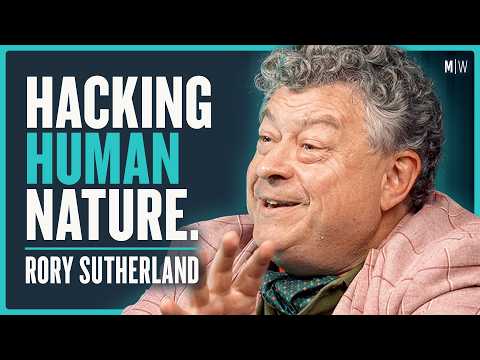
Waymo, Texas Culture, Airline Lounges, OpenAI & Uber Eats - Rory Sutherland
Chris Williamson (host), Rory Sutherland (guest), Narrator
In this episode of Modern Wisdom, featuring Chris Williamson and Rory Sutherland, Waymo, Texas Culture, Airline Lounges, OpenAI & Uber Eats - Rory Sutherland explores rory Sutherland Deconstructs Driving, Airports, AI, and Modern Convenience Chris Williamson and Rory Sutherland bounce through an enormous range of topics, using everyday experiences—driving, airports, Uber, food delivery, hotels, and AI—as case studies in human psychology and choice architecture.
Rory Sutherland Deconstructs Driving, Airports, AI, and Modern Convenience
Chris Williamson and Rory Sutherland bounce through an enormous range of topics, using everyday experiences—driving, airports, Uber, food delivery, hotels, and AI—as case studies in human psychology and choice architecture.
Rory frames much of modern life as the unintended shift from options to obligations: technologies and social changes that began as conveniences (parking apps, two-income households, smartphones) now trap people in new forms of stress and inequality.
They discuss how interface design changes behavior (McDonald’s kiosks, AI agents, real-estate search), why cars and motoring teach social calculus, and how status signaling has shifted in a social‑media and remote‑work world.
The conversation also touches on deeper structural issues like housing and land value tax, inequality (via Gary Stevenson’s arguments), and how better incentives and design could dramatically improve things like airports, delivery apps, and even advertising itself.
Key Takeaways
Interface design quietly rewires behavior and demand.
Shifting from human interaction to screens (e. ...
Get the full analysis with uListen AI
Motoring teaches social calculus and pro‑social behavior.
Driving forces people to constantly trade off their own convenience against others’—letting someone merge, thanking with hazard lights, adjusting for traffic speed—so widespread non‑driving among younger urban generations may be eroding an important everyday training ground for reciprocity and social skill.
Get the full analysis with uListen AI
Many conveniences start as options but end as obligations.
Rory argues that things like parking apps, smartphones, and especially the two‑income household began as attractive choices but became effectively mandatory, stripping people of slack time and making systems hostile to anyone who can’t or won’t comply (e. ...
Get the full analysis with uListen AI
Reverse benchmarking is a powerful innovation strategy.
Instead of copying the best competitor, identify what they neglect or do disappointingly—like coffee and beer at the world’s top restaurant—and double down there, turning overlooked aspects into your signature differentiators and creating outsized delight for a subset of customers.
Get the full analysis with uListen AI
Airports could be radically improved by rethinking constraints.
Ideas like London City’s minimal shopping, DFW’s ambiguous gates to reduce pointless queuing, mobile “lounges” that drive to planes, and concierge‑style handovers for rental cars show that most airport misery is design‑driven rather than inevitable; small behavioral fixes can yield large perceived gains.
Get the full analysis with uListen AI
AI likely flips advertising from brands‑to‑people to people‑to‑brands.
If consumers appoint AI agents to find them the best options—homes, cars, toasters—search costs plummet and the logic of marketing inverts: rather than companies broadcasting to everyone, individuals will have personal ‘agencies’ that hunt for products matching their revealed preferences and constraints.
Get the full analysis with uListen AI
Housing inequality is driven more by land than by income.
Rory supports Georgist ideas: we aggressively tax labor income while treating asset-based wealth—especially land—as sacrosanct, turning property into an extractive store of value where older owners passively gain while younger workers struggle, and suggesting land‑value taxation as a corrective.
Get the full analysis with uListen AI
Notable Quotes
“Something comes along as an option and quietly turns into an obligation.”
— Rory Sutherland
“Driving’s only really enjoyable when you do it frequently—when it becomes system one, not system two.”
— Rory Sutherland
“If you change the context or the interface through which people choose, everybody’s behavior changes.”
— Rory Sutherland
“Nearly all businesses over‑invest in customer acquisition and under‑invest in customer retention, because retention is slower and harder to measure.”
— Rory Sutherland
“We’ve sanctified wealth and been pretty mean on income—income inequality is heavily taxed, but wealth inequality is monumental and largely untouched.”
— Rory Sutherland
Questions Answered in This Episode
If AI agents become the dominant way people choose products, what will still matter in brand-building and advertising—if anything?
Chris Williamson and Rory Sutherland bounce through an enormous range of topics, using everyday experiences—driving, airports, Uber, food delivery, hotels, and AI—as case studies in human psychology and choice architecture.
Get the full analysis with uListen AI
How can cities and governments prevent ‘options’ like parking apps and two‑income households from becoming coercive obligations that hurt the vulnerable?
Rory frames much of modern life as the unintended shift from options to obligations: technologies and social changes that began as conveniences (parking apps, two-income households, smartphones) now trap people in new forms of stress and inequality.
Get the full analysis with uListen AI
What specific behavioral tweaks would most dramatically improve the typical airport experience without needing billion‑dollar rebuilds?
They discuss how interface design changes behavior (McDonald’s kiosks, AI agents, real-estate search), why cars and motoring teach social calculus, and how status signaling has shifted in a social‑media and remote‑work world.
Get the full analysis with uListen AI
Could land‑value taxation realistically rebalance housing affordability without politically detonating existing homeowners’ expectations?
The conversation also touches on deeper structural issues like housing and land value tax, inequality (via Gary Stevenson’s arguments), and how better incentives and design could dramatically improve things like airports, delivery apps, and even advertising itself.
Get the full analysis with uListen AI
How might we design food delivery and discovery tools that reduce choice overload yet still encourage exploration and local, unique experiences?
Get the full analysis with uListen AI
Transcript Preview
Welcome back. Good to see you.
It's a pleasure. What a joy it is. And, and here in Austin, too.
Here in Austin. Uh, Buc-ee's. You went to Buc-ee's. Tell me-
Absolutely. I actually brought you a present.
Oh.
I thought, uh, you know, it wouldn't be fair if I didn't bring you-
This is-
... local specialties. And of course, some, uh, some, some beef jerky as well.
This is-
Jalapeno honey, which I thought would be good.
Thank you.
But the Buc-ee's thing is particularly good because they have a brand partnership with the, uh, TXDOT, the Texas Department of Transportation.
Okay.
So they licensed the Don't Mess With Texas advertising slogan.
Mm-hmm.
Okay? Now, this may surprise you, that Don't Mess With Texas, the rights to it actually belong to the Texas Department of Transportation because it was an anti-littering campaign.
You're kidding.
No, no, no.
How old is this?
It dates back, crikey, to the s- I think the '70s or, or at least the very early '80s. I think the 1970s.
Okay.
And it's a kind of famous advertising case study because how do you tell Texans not to litter? Okay. Now, in other parts of the world, you know, simple kind of blandishments or appeals to their sort of, uh, you know, (laughs) their, you know, higher order concerns might work. But this is a uniquely Texan message, which takes-
So low-key aggression, unspoken threat of-
Uh, there, there's a slight un-
... kinetic interaction.
Exactly. Exactly.
Yeah, yeah, yeah. Yeah.
Yeah, yeah. And actually, funnily enough, when they presented it, one of the people said, "I find this a bit abrupt. Could we not make it, 'Please don't mess with Texas'?"
(laughs)
But of course, that doesn't work, does it? No.
No, unfortunately not.
So it developed rather lo- rather beautifully. Buc-ee's, which for the benefit of non-Texan, um, audiences, is ... It's one of those things which I think is proof that one of the great things Americans do is, it proves that you can take something that at a small scale is atrocious, and if you make it big enough, it's a work of art.
(laughs)
And Buc-ee's has done this with the gas station. By making it so enormous-
Yep.
... you take it from something, you know, comparatively-
Yeah.
... ghastly. Marching bands would be another case. You know, if you go and watch the Texas A&M marching bands. Marching bands are appalling at a small scale. I think they're atrocious.
Until there's 100 people or more.
But if there are 500 people doing it-
Yep. Yeah.
... it suddenly becomes magnificent.
Yeah. Well, I think the thing, the interesting thing about Buc-ee's, for the people that haven't been, again, it's 100 pumps, maybe 200 pumps-
Install uListen to search the full transcript and get AI-powered insights
Get Full TranscriptGet more from every podcast
AI summaries, searchable transcripts, and fact-checking. Free forever.
Add to Chrome