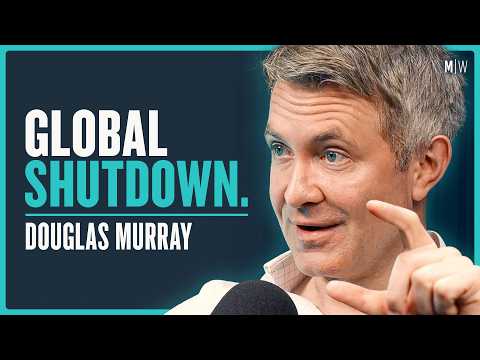
The Collapse Of The West Or The Birth Of A New Era? - Douglas Murray
Chris Williamson (host), Douglas Murray (guest), Narrator
In this episode of Modern Wisdom, featuring Chris Williamson and Douglas Murray, The Collapse Of The West Or The Birth Of A New Era? - Douglas Murray explores douglas Murray Warns West: Demoralized Democracies Face Fanatical Death Cults Douglas Murray and Chris Williamson discuss the state of Western democracies amid Trump’s second term, rising populism, and the rollback of DEI, ESG, and progressive orthodoxies across institutions and corporations. Murray argues that America is beginning to correct its cultural excesses while the UK and much of Europe remain economically stagnant, culturally demoralized, and unable to act decisively. Drawing on his frontline experiences in Ukraine and Israel, he contrasts the lethargy and self‑hatred of Western societies with the clarity, sacrifice, and resolve of people literally fighting for their survival. His new book, *On Democracies and Death Cults*, explores how life‑loving liberal societies should respond to movements like Hamas and jihadism that openly glorify death, and what happens when a demoralized West no longer believes its own civilization is worth defending.
Douglas Murray Warns West: Demoralized Democracies Face Fanatical Death Cults
Douglas Murray and Chris Williamson discuss the state of Western democracies amid Trump’s second term, rising populism, and the rollback of DEI, ESG, and progressive orthodoxies across institutions and corporations. Murray argues that America is beginning to correct its cultural excesses while the UK and much of Europe remain economically stagnant, culturally demoralized, and unable to act decisively. Drawing on his frontline experiences in Ukraine and Israel, he contrasts the lethargy and self‑hatred of Western societies with the clarity, sacrifice, and resolve of people literally fighting for their survival. His new book, *On Democracies and Death Cults*, explores how life‑loving liberal societies should respond to movements like Hamas and jihadism that openly glorify death, and what happens when a demoralized West no longer believes its own civilization is worth defending.
Key Takeaways
Political overreach produces corrections, but those corrections can become new extremes.
Murray argues that the American left’s embrace of radical identity politics, trans activism, and street‑movement aesthetics triggered a backlash that helped fuel Trump’s return and the rollback of DEI/ESG—but warns that over‑correction to a different form of irrationality is a real risk.
Get the full analysis with uListen AI
A country that cannot act decisively on basics signals deeper civilizational weakness.
He cites the UK’s decades‑long paralysis over projects like Heathrow’s third runway and HS2 as symbolic of a culture that is economically stagnant, over‑bureaucratized, terrified of offense, and incapable of basic infrastructure decisions—eroding public confidence and pride.
Get the full analysis with uListen AI
You cannot sustain a willingness to fight for a country you’re taught to despise.
Polls showing low numbers of young Brits and Americans willing to fight for their country are, in his view, the predictable outcome of decades of education and media insisting that Western nations are uniquely guilty and oppressive; demoralization undermines any future resistance to real threats.
Get the full analysis with uListen AI
The online information environment rewards conspiracism and erodes shared reality.
From lab‑leak denial to JFK theories, Murray notes that proven institutional lies and the attention economy’s reward for sensationalism have pushed many toward a conspiratorial mindset, where even basic facts (e. ...
Get the full analysis with uListen AI
War reveals both the worst and the best in human beings, often simultaneously.
His frontline stories—from Ukrainian soldiers in trenches to Israelis who repeatedly drove back into danger to rescue others—illustrate what he sees as extraordinary courage and altruism that coexist alongside horrific brutality, showing the full range of human potential under extreme pressure.
Get the full analysis with uListen AI
Liberal democracies must learn how to confront ‘death cults’ without losing themselves.
In discussing Hamas and jihadist groups that openly glorify death, he argues that simply ‘loving life’ is insufficient: free societies must be prepared to fight, metaphorically and literally, for the conditions that make that life possible, while recognizing that some adversaries do not share their values.
Get the full analysis with uListen AI
Western self‑contempt ignores the basic evidence of global ‘footfall’.
Murray highlights migration patterns—people risking their lives to reach Western countries and not the reverse—as empirical proof that these societies remain uniquely attractive, making the dominant narrative of Western moral inferiority both factually wrong and strategically corrosive.
Get the full analysis with uListen AI
Notable Quotes
“You need to know what you’re fighting for. It’s not enough just to like life—you have to be willing to fight for it.”
— Douglas Murray
“We’ve been told that what we were born into is not good. If you tell people that long enough, you can really demoralize a society.”
— Douglas Murray
“The footfall alone tells us all we need to know. Nobody is trying to get out of America to the safe harbor of Venezuela.”
— Douglas Murray
“War shows humankind at its absolute worst and at its absolute best—sometimes at the same moment.”
— Douglas Murray
“Tell me what you accuse the Jews of, and I’ll tell you what you’re guilty of.”
— Douglas Murray, quoting Vasily Grossman
Questions Answered in This Episode
If Western societies are so demoralized, what concrete steps could realistically rebuild civic pride without sliding into jingoism or denial of past wrongs?
Douglas Murray and Chris Williamson discuss the state of Western democracies amid Trump’s second term, rising populism, and the rollback of DEI, ESG, and progressive orthodoxies across institutions and corporations. ...
Get the full analysis with uListen AI
How can liberal democracies strike a balance between necessary gatekeeping (experts, institutions) and the public’s justified skepticism after episodes of misinformation or censorship?
Get the full analysis with uListen AI
To what extent is the rollback of DEI and ESG a genuine philosophical shift versus opportunistic ‘wind‑blowing’ in response to Trump and market pressures?
Get the full analysis with uListen AI
What ethical obligations do media consumers have in an age where attention algorithms reward outrage and conspiracy, especially around war and mass violence?
Get the full analysis with uListen AI
How can individuals cultivate the kind of courage and sense of duty Murray describes in soldiers and civilians under fire, before a ‘time of trial’ actually arrives?
Get the full analysis with uListen AI
Transcript Preview
Douglas Murray, welcome to the show.
Very good to be back with you in your native Austin.
Ah, yes, you have. You're here for 24 hours. Salubrious.
Wonderful.
Mm.
Watching your success with great admiration.
Thank you.
And great pride as well in a way, I don't know why I feel pride, but I just-
Well, you definitely contributed to it, I think, uh, managed to get you to take a dice roll, uh, many, many years ago, five years ago, six years ago.
That's right, I think I was doing The Madness of Crowds. And you were in your, uh, place in Newcastle with the mold on the ceiling.
Wasn't mold, it was because I had-
(laughs)
... as I explained for a long time, it's because I had a Yankee Candle addiction, uh, which also actually is something to be embarrassed about, not quite as bad as mold. Uh, and I had to get it repainted. After our episode, the internet shamed me so much-
(laughs)
... that I had to get the ceiling of my old bedroom repainted, uh-
And now you're here in Austin. And-
Look at me now.
... it's great to see you.
Well, uh, you too. Trump's been in office for 78 days. What do you make of his efforts so far?
(inhales deeply) Um, uh, mixed, I think, as with anyone. Um, he got the very, very large and considerable mandate. Um, won the popular vote, made it pretty impossible for people to criticize him from the election onwards. Um, first couple of months there's been very little, I think, pushback or rallying around against him. Um, then inevitably there are things that are now happening, you may have noticed, if you keep an eye on the markets or anything like that, uh, which very much people are going for him on. Um, but yes, I mean, it's, it's kinda early days, but a mixed bag I'd say.
It, it feels like a lot's happened-
Well, a lot has happened.
... 78 days.
Yes. I mean, uh, one of the things you can say, whatever your view is on Trump, you can say with certainty, and I did ahead of the election and have since, which is that he does what he says he's going to do.
Mm-hmm.
So whether it's tariffs or foreign policy or domestic policy, border, you know, he, he, he campaigns about it and then he does it, tries to do it.
Mm-hmm.
And, um, I am always quite amused by the people who, who are surprised at that, you know. "What's he doing with all this tariff stuff?" I mean, like, every rally I covered of his, tariffs was a big thing.
Mm-hmm.
So, uh, so yes, there are, there are some corners of it, uh, principally the Ukraine stuff which I'm concerned about. Um, but it's early days.
Install uListen to search the full transcript and get AI-powered insights
Get Full TranscriptGet more from every podcast
AI summaries, searchable transcripts, and fact-checking. Free forever.
Add to Chrome