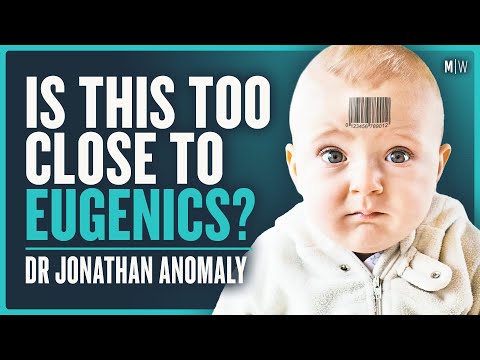
The Wild Ethics Of Human Genetic Enhancement - Dr Jonathan Anomaly
Dr Jonathan Anomaly (guest), Chris Williamson (host), Narrator
In this episode of Modern Wisdom, featuring Dr Jonathan Anomaly and Chris Williamson, The Wild Ethics Of Human Genetic Enhancement - Dr Jonathan Anomaly explores the Coming Genetic Arms Race: Ethics, Inequality, And Human Futures Dr. Jonathan Anomaly and Chris Williamson explore the ethics, history, and future of eugenics and genetic enhancement, arguing that much of what we already do in mate choice is effectively informal eugenics. They explain how technologies like IVF, embryo selection, polygenic risk scores, and future methods such as in vitro gametogenesis (IVG) could allow parents to select for traits like health, intelligence, and personality at unprecedented precision and scale. Anomaly contends that the real moral line is not between environment and genes, or between ‘eugenics’ and ‘enhancement,’ but between voluntary, welfare-promoting uses and coercive, abusive ones. They also warn that these technologies will amplify existing genetic and social inequalities, potentially drive societal stratification or even speciation, and collide head‑on with blank-slate political ideologies and collapsing birth rates in wealthy societies.
The Coming Genetic Arms Race: Ethics, Inequality, And Human Futures
Dr. Jonathan Anomaly and Chris Williamson explore the ethics, history, and future of eugenics and genetic enhancement, arguing that much of what we already do in mate choice is effectively informal eugenics. They explain how technologies like IVF, embryo selection, polygenic risk scores, and future methods such as in vitro gametogenesis (IVG) could allow parents to select for traits like health, intelligence, and personality at unprecedented precision and scale. Anomaly contends that the real moral line is not between environment and genes, or between ‘eugenics’ and ‘enhancement,’ but between voluntary, welfare-promoting uses and coercive, abusive ones. They also warn that these technologies will amplify existing genetic and social inequalities, potentially drive societal stratification or even speciation, and collide head‑on with blank-slate political ideologies and collapsing birth rates in wealthy societies.
Key Takeaways
Eugenics in practice already exists through mate choice and reproductive decisions.
Anomaly defines eugenics broadly as using knowledge of heredity to shape offspring traits, noting that sexual selection, mate preferences, and existing IVF screening are all forms of ‘soft’ eugenics long predating explicit genetic technologies.
Get the full analysis with uListen AI
Embryo selection with polygenic scores is already technically possible for many traits.
Using genome-wide association studies and polygenic risk scores, clinics can now rank embryos for risks of diseases (e. ...
Get the full analysis with uListen AI
Voluntary, welfare-enhancing genetic choices differ morally from coercive state programs.
Anomaly stresses that the crucial ethical line is between parents using options to improve their children’s welfare versus governments imposing sterilizations, bans, or mass ‘improvements’; he argues the Nazi analogy is misapplied to contemporary, consent-based enhancement.
Get the full analysis with uListen AI
Genetic and social inequality will likely increase, but bans may worsen it.
Assortative mating by intelligence and education is already concentrating genetic advantages; adding genetic tech will accelerate this. ...
Get the full analysis with uListen AI
Environmental and genetic interventions are ethically analogous when outcomes are similar.
The discussion likens choosing against low-IQ embryos to preventing prenatal brain damage from lead or alcohol: both are irreversible, life-shaping interventions, so privileging environment as ‘natural’ while demonizing genes is often just a naturalistic fallacy.
Get the full analysis with uListen AI
Future tech like IVG could radically expand selection power and drive divergence.
In vitro gametogenesis could turn adult cells into eggs or sperm, giving couples hundreds or thousands of embryos to choose from; combined with improved scoring and eventual safer gene editing, this could yield much healthier, smarter populations and possibly create human sub-lineages akin to dog breeds.
Get the full analysis with uListen AI
Fertility collapse and ideology will determine who shapes the future genome.
Anomaly argues liberal, secular societies with low birth rates are evolutionarily unstable; groups that are both high-fertility (e. ...
Get the full analysis with uListen AI
Notable Quotes
“Eugenics, in the broadest sense, is any attempt to harness the knowledge that we have about heredity to influence the traits of our kids.”
— Jonathan Anomaly
“We're already getting increasing genetic inequalities in the West without any of this technology. What’ll the technology do? It’ll accelerate those inequalities.”
— Jonathan Anomaly
“The decision to refrain from [embryo gene editing] is itself a form of either eugenics or genetic enhancement.”
— Jonathan Anomaly
“All new technology is a toy for the rich until it’s not.”
— Jonathan Anomaly
“The decision to do nothing is a decision to shape future humans in very specific ways, whether you like it or not.”
— Jonathan Anomaly
Questions Answered in This Episode
If genetic enhancement and embryo selection become cheap and safe, should they be framed as parental obligations rather than optional luxuries?
Dr. ...
Get the full analysis with uListen AI
How should societies draw ethical and legal lines between acceptable trait selection (e.g., health) and controversial ones (e.g., personality, political temperament, or sex)?
Get the full analysis with uListen AI
What policies could prevent a permanent genetic underclass while still allowing innovation and individual freedom in reproductive choices?
Get the full analysis with uListen AI
How might widespread enhancement interact with collapsing birth rates and the potential demographic dominance of religious or nationalist groups?
Get the full analysis with uListen AI
At what point would differences created by genetic enhancement justify speaking of new human ‘subspecies,’ and how should rights and social cohesion be managed in such a world?
Get the full analysis with uListen AI
Transcript Preview
Even before you have gene editing or embryo selection, which has just come online, what we've had is increased genetic inequality in the last century. Why would we have that? Well, women's education. So for the first time, women are getting actually more education than men, and because of their choosiness and their preferences, what's happening is, like, a female doctor will just marry a male surgeon or a, a really successful male lawyer. Intelligence is the number one trait along which people assortatively mate. We're already getting increasing genetic inequalities in the West without any of this technology. What'll the technology do? It'll accelerate those inequalities.
(wind blowing) What do people misunderstand about what eugenics is and means?
Good question. So I would say eugenics, in the broadest sense, is any attempt to harness the knowledge that we have about heredity to influence the traits of our kids. And in that sense, eugenics is as old as people, and actually much older. Um, you know, any mammal that uses sexual selection, um, ends up in such a situation where females choose males on the basis of traits that will partly influence their own welfare, but will also influence the welfare of their kids. And so, in a way, eugenics is as old as you can think, uh, uh, as old as humanity. But the, the term dates back to 1883 and, uh, Francis Galton, who coined the term, and I would say the reason that that term was invented and the concepts of eugenics, in a really explicit way, made a comeback, is that we had a few things happen in the 1800s. First, we get Mendel's experiments on pea plants, so we started getting to know a little bit more about how heredity works, um, a little bit more about what eventually became called genes. Gene, the, the term gene wasn't actually coined until 1905, but we, we understood there must be some unit of heredity that somehow blends and recombines to shape traits. So first, it starts with Mendel, then, of course, Darwin comes up with his theory of evolution by natural selection applied to all animals, not just plants, including people, and his cousin, Francis Galton, who studied the heredity of specific traits that we care about in humans. Intelligence, so he wrote a book called Hereditary Genius, but also just banal traits like height and skin color and hair texture and stuff like that. And in fact, in fact, Francis Galton was the first to invent twin studies. So this is the idea that we now use in behavioral genetics, where he thought, "Hey, here's a thought experiment. What would happen if we took identical twins and fraternal twins and raised them apart and just saw how they ended up? Like, would they be really similar, really different?" And as you know, uh, fraternal twins share half of their DNA. Um, identical twins share all of their DNA. And so he thought of this really cool natural experiment to tease out what part of our personality, our physicality is due to nature, nurture, et cetera. So, so in short, what you get is this kind of Golden Age in the 1800s where we're starting to discover how evolution works, how heredity works, and then this thought that, "Well, maybe we can control it to some extent in the same way we do for animals and the same way we do for plants." I mean, look at what corn used to look like 3,000 years ago. It's this pathetic little weed that yields a few calories, and through selective breeding, obviously we make it more nutritious, more delicious. You know, you take those honeycrisp apples, like, they didn't start that way. They were these sort of bitter fruits, and now they taste like just pure sugar. You know, you can amp up the vitamin C, you can do these kinds of things, and of course it gets dangerous when you talk about selective breeding for, for people, and we'll get into that, but it's pretty clear once you understand heredity, one of your first thoughts is gonna be like, "Okay, how does this influence, like, my choice of mates, what kind of children I'm gonna end up with, and how do those children end up influencing the traits of people around us and the overall social welfare of people?"
Install uListen to search the full transcript and get AI-powered insights
Get Full TranscriptGet more from every podcast
AI summaries, searchable transcripts, and fact-checking. Free forever.
Add to Chrome