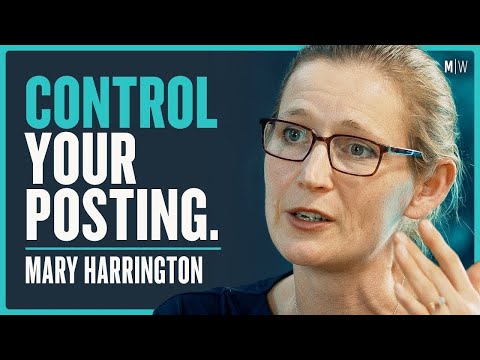
Why You Shouldn’t Share Your Private Life Online - Mary Harrington (4K)
Chris Williamson (host), Mary Harrington (guest)
In this episode of Modern Wisdom, featuring Chris Williamson and Mary Harrington, Why You Shouldn’t Share Your Private Life Online - Mary Harrington (4K) explores digital Modesty, Intimacy, and Modern Relationships in an Online Age Mary Harrington and Chris Williamson explore “digital modesty” – the practice of setting firm boundaries around what aspects of one’s private life are shared online – and argue that oversharing erodes intimacy, fuels audience capture, and invites unnecessary harm. Harrington outlines her personal rules (no selfies, no family/home content, no mining relationships for content) and connects them to a broader critique of transparency culture, influencer dynamics, and terminally-online dating norms.
Digital Modesty, Intimacy, and Modern Relationships in an Online Age
Mary Harrington and Chris Williamson explore “digital modesty” – the practice of setting firm boundaries around what aspects of one’s private life are shared online – and argue that oversharing erodes intimacy, fuels audience capture, and invites unnecessary harm. Harrington outlines her personal rules (no selfies, no family/home content, no mining relationships for content) and connects them to a broader critique of transparency culture, influencer dynamics, and terminally-online dating norms.
They extend the conversation into how radical transparency, porn/OnlyFans, and political polarization reshape mating markets and restrict future relationship possibilities, especially for extremely online people. Harrington also criticizes surrogacy and self-expressive, consumerist models of marriage, arguing that children’s needs and embodied realities are routinely subordinated to adult desires.
Later, they discuss anti-family cultural cues, the crisis of embodied humanness in an information economy, the failure of simplistic “trad” or anti-feminist prescriptions, and why most real-life men and women still quietly form ordinary, functional relationships away from online extremism.
Key Takeaways
Set explicit digital boundaries to protect intimacy and mental health.
Harrington refuses to post selfies, her home, husband, or child, and avoids sharing intimate social or family details without consent. ...
Get the full analysis with uListen AI
Recognize that radical transparency undermines real relationships.
Filming dates or constantly performing for an imagined online audience makes genuine intimacy almost impossible; if there’s no difference between what you say “on main” and in private, privacy and closeness lose meaning.
Get the full analysis with uListen AI
Don’t mistake photography for performance—separate memory-keeping from content.
Williamson notes he stopped taking personal photos because he associated them with self-promotion, then realized he was losing precious memories. ...
Get the full analysis with uListen AI
Understand that online opinions and sexual economies can shrink your future dating pool.
Pseudonymous political shitposting or deep involvement in OnlyFans (as creator or subscriber) can become long-term liabilities when a future partner, or their family, discovers them, given rising political tribalism and stigma around porn ecosystems.
Get the full analysis with uListen AI
Keep your private life private, especially if you have or want a public platform.
Turning relationships, breakups, or family drama into content is an efficient way to gain attention, but it permanently entangles millions of strangers in your personal life and feeds a machine that “always wants more,” often at huge relational cost.
Get the full analysis with uListen AI
Be skeptical of simple ‘trad’ or anti-feminist fixes that only police women.
Harrington argues you cannot just keep modern economic and technological conditions the same while demanding only women change (e. ...
Get the full analysis with uListen AI
Center children’s needs in debates about surrogacy and family formation.
She contends surrogacy should be banned because pregnancy biologically primes mothers for attachment, and designing a child’s life around a planned severing of that bond prioritizes adult desires over the developmental needs of the newborn.
Get the full analysis with uListen AI
Notable Quotes
“Transparency is not just the enemy of desire; transparency is the enemy of intimacy.”
— Mary Harrington
“Ultimately, everything becomes performant. Everything's content.”
— Chris Williamson
“Because it doesn't just belong to me, I can't mine it; I have no right to mine [my relationships] for content.”
— Mary Harrington
“Pregnancy doesn't just create a baby. Pregnancy creates a mother.”
— Mary Harrington
“If you think that having a relationship is hard, try having a relationship with a couple of million people who are also invested in the outcomes of your relationship.”
— Mary Harrington
Questions Answered in This Episode
How can an average, non-public person practically define and enforce their own ‘digital modesty’ rules without feeling socially isolated?
Mary Harrington and Chris Williamson explore “digital modesty” – the practice of setting firm boundaries around what aspects of one’s private life are shared online – and argue that oversharing erodes intimacy, fuels audience capture, and invites unnecessary harm. ...
Get the full analysis with uListen AI
To what extent can intimacy be rebuilt once a relationship has already been heavily performed online and consumed as content?
They extend the conversation into how radical transparency, porn/OnlyFans, and political polarization reshape mating markets and restrict future relationship possibilities, especially for extremely online people. ...
Get the full analysis with uListen AI
How should people weigh their desire for political expression or edgy online personas against the long-term impact on employability and romantic prospects?
Later, they discuss anti-family cultural cues, the crisis of embodied humanness in an information economy, the failure of simplistic “trad” or anti-feminist prescriptions, and why most real-life men and women still quietly form ordinary, functional relationships away from online extremism.
Get the full analysis with uListen AI
What would a realistic, non-ideological ‘productive household’ look like today, given that most work is informational rather than physical?
Get the full analysis with uListen AI
If surrogacy is morally wrong because it separates gestation from parenting, how should society ethically address infertility and same-sex couples who want children?
Get the full analysis with uListen AI
Transcript Preview
What do you mean by digital modesty?
(clears throat) Oh, yeah, that's- that's an idea I've been playing with a lot recently, which is really just about where we've got to with the exposure of everything on the internet. Um, this is something I found myself thinking about a lot more, uh, the more I- the more I found myself writing in public and speaking in public and really sort of being present online, whether it's on Twitter or wherever, which is, is- is there anything that we shouldn't be posting? Um, and the more I think about that, the more- the more I conclude that, yes, there are absolutely things that we shouldn't be posting, or rather, um, if there are things which if- if we- if we do share them, we should expect negative consequences to follow from that. I mean, I've... And the more I thought, I- I've read, I've derived a set, I guess, of basic principles for what I won't post. I won't post selfies online. I mean, I'll- I'll post... M- my face is all over the internet, right? But in the context of a conversation. You know, I'm, you and I here, you and I here is not, we're not here to talk about my face. I mean, my face is just my face. We're here to, uh, we're here to exchange ideas and to have a conversation. But I won't post, I won't post selfies. Yeah, I can... Uh, actually, I remember the point where I realized that you should, I shouldn't, I didn't want to post selfies was- was just after I could, I ran over the finish line of a marathon a couple of years ago, and I trained for it, and I trained for it, and I trained for it, and I worked so hard at it. And at that point, I think I had maybe 10,000 followers on Twitter, and I- and I took a photo of myself having crossed the finish line looking like hell, um, completely exhausted and I'd, uh, high as a kite on endorphins, and I nearly, I nearly pressed send and then I was like, "Whoa, don't do that. Do not do that." And I, and I deleted it, and I didn't, I- I did not post the selfie of myself having just crossed the finish line.
Why?
'Cause, because I realized if I did, like, probably 75% of the people who follow me would say, "Great, well done. Congratulations," and I get lots of love. The other 25% will be the people who hate follow, because they- they exist. Once you get past a certain point, you go, you have haters on the internet, 'cause like people can find, people can hate anything. You know, that's just the law of the internet. People will find something insane to hate, even if it's just people doing, like middle-aged women doing marathons. Um, and- and then, and- and it would have, there would have been one mean comment which would have just crushed me and it would have ruined my day. And I thought, what's the easiest way of not experiencing that one mean comment is just not... n- just don't post a picture. But it's more than that. It's also that it- it exposes something intimate and personal, which I realized was just not something which was, it wasn't for everybody else. It was my- my- my f- that- that moment was for me and it was for my, for my family and for the people who'd supported me. It wasn't for... And- and for the people who'd, who'd, who'd sp- who'd supported me to fundraise. It wasn't for general consumption. And- and I realized that- that actually there is a boundary. Um, and then I've, I've spent more time online. I've- I've- I've appeared in public more since then. And the more, the more I do it, the more I've- I've come to think that actually we need, yeah, the more exposed you are potentially online, the more, the more intentional you have to be about thinking, thinking, thinking clearly on, uh, where you draw the line.
Install uListen to search the full transcript and get AI-powered insights
Get Full TranscriptGet more from every podcast
AI summaries, searchable transcripts, and fact-checking. Free forever.
Add to Chrome