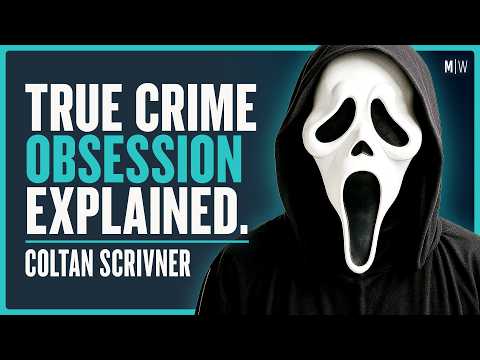
Why We’re Drawn to Death, Crime, & Danger - Coltan Scrivner
Chris Williamson (host), Coltan Scrivner (guest)
In this episode of Modern Wisdom, featuring Chris Williamson and Coltan Scrivner, Why We’re Drawn to Death, Crime, & Danger - Coltan Scrivner explores why Morbid Curiosity Helps Us Learn From Danger, Not Just Gawk Coltan Scrivner explains how he became a researcher of morbid curiosity and why humans are uniquely drawn to threats, violence, and dark content from a safe distance.
Why Morbid Curiosity Helps Us Learn From Danger, Not Just Gawk
Coltan Scrivner explains how he became a researcher of morbid curiosity and why humans are uniquely drawn to threats, violence, and dark content from a safe distance.
He outlines four domains of morbid curiosity—violence, minds of dangerous people, bodily injury, and the paranormal—and argues they all serve an evolutionary function: threat learning and preparation.
Scrivner discusses individual differences (age, gender, personality, psychopathy, disgust sensitivity) and how morbid curiosity can be linked to psychological resilience, as seen during COVID-19.
The conversation extends into horror films, zombies, true crime, children’s play, and serial-killer fandoms, showing how modern media tap into ancient threat-detection systems without real-world risk.
Key Takeaways
Morbid curiosity evolved to help us learn about threats safely.
Humans, like other animals, benefit from observing predators and dangerous situations, but our capacity for stories, films, and dreams lets us ‘inspect’ threats without direct risk, turning fear into a learning sandbox.
Get the full analysis with uListen AI
Morbid curiosity comprises distinct but related domains.
Scrivner’s research identifies four domains—witnessing violence, understanding dangerous people, examining bodily injuries, and engaging with paranormal dangers—all united by interest in what can harm us and how to avoid it.
Get the full analysis with uListen AI
Individual differences only partly explain morbid curiosity.
Traits like psychopathy (especially rebelliousness), age (younger higher than older), and modest gender effects (men more into violence, women more into dangerous minds) predict some variance, but personality and disgust explain only about half, meaning morbid curiosity is a distinct construct.
Get the full analysis with uListen AI
Morbid curiosity can enhance psychological resilience in crises.
During early COVID, people higher in morbid curiosity and interest in horror/true crime reported greater resilience and lower relative anxiety and depression, suggesting prior engagement with simulated threats may buffer real-world stress.
Get the full analysis with uListen AI
True crime for women and war stories for men reflect sex-specific threat profiles.
Women’s real-world threat landscape skews toward intimate-partner and interpersonal male violence (mirrored in true crime), while men’s historic threats are more intergroup and combat-based (mirrored in war stories and UFC).
Get the full analysis with uListen AI
Horror relies on a powerful antagonist versus a vulnerable protagonist.
Scrivner proposes horror is best defined structurally, not by subjective fear: a highly formidable ‘monster’ pitted against a weak or trapped protagonist creates an underdog survival scenario ideal for threat learning and emotional engagement.
Get the full analysis with uListen AI
Enjoying horror does not imply low empathy or desensitization.
Empirical work finds horror fans are not less empathetic than others, and audiences must empathize with the protagonist for fear to work; the stereotype that horror lovers are callous is a lay bias, not a data-backed fact.
Get the full analysis with uListen AI
Notable Quotes
“Any animal that exists in the world should know something about potential threats around. Humans are no different—we just get to do it through stories.”
— Coltan Scrivner
“Morbid curiosity is really about threat learning—what can hurt me, and what do I not yet know about it?”
— Coltan Scrivner
“Evolution kind of imbues curiosity with a positive feeling, otherwise we would just avoid dangerous things altogether and never learn from them.”
— Coltan Scrivner
“A dangerous person is only dangerous to you if they don’t like you. If they like you, they become a huge asset.”
— Coltan Scrivner
“People assume horror fans are less empathetic because they can enjoy these things, but empirically that just isn’t true.”
— Coltan Scrivner
Questions Answered in This Episode
How can individuals channel their morbid curiosity in ways that improve real-world preparedness rather than just passive entertainment?
Coltan Scrivner explains how he became a researcher of morbid curiosity and why humans are uniquely drawn to threats, violence, and dark content from a safe distance.
Get the full analysis with uListen AI
Are there thresholds where high morbid curiosity shifts from adaptive threat learning into maladaptive obsession or distress?
He outlines four domains of morbid curiosity—violence, minds of dangerous people, bodily injury, and the paranormal—and argues they all serve an evolutionary function: threat learning and preparation.
Get the full analysis with uListen AI
How might parents and educators responsibly handle children’s natural morbid curiosity without either suppressing it or overexposing them?
Scrivner discusses individual differences (age, gender, personality, psychopathy, disgust sensitivity) and how morbid curiosity can be linked to psychological resilience, as seen during COVID-19.
Get the full analysis with uListen AI
Could understanding the four domains of morbid curiosity help design more effective safety training, therapy, or public health messaging?
The conversation extends into horror films, zombies, true crime, children’s play, and serial-killer fandoms, showing how modern media tap into ancient threat-detection systems without real-world risk.
Get the full analysis with uListen AI
What does the link between morbid curiosity and resilience during COVID suggest about how media consumption might shape our responses to future crises?
Get the full analysis with uListen AI
Transcript Preview
How do you get into studying morbid curiosity? I'm intrigued by what the character arc is that leads you to doing that.
(laughs) Uh, you know, a lot of people ask me, did I always want to study, uh, scary movies and the psychology of them? And the answer is no, I didn't always know that I wanted to study that. But I have always enjoyed them. I've always kind of liked scary things when I was a kid, you know. Not because I wasn't scared of them, but because they, they were scary, um, and that made them, you know, interesting and fun to me, especially when I could kind of have them at a distance, right? You could pause the movie or pause the game, uh, and kind of collect yourself. Um, but, you know, growing up I didn't really think... I was into archeology. I thought I was going to be an archeologist. Um, and then I studied, uh, you know, anthropology, a little bit of biology in undergrad. Studied some forensic science, uh, for my master's, and then I kind of made the switch into psychology during my PhD. And, you know, like a lot of eager young grad students, I was interested in everything under the sun that had to do with human behavior. Uh, but that doesn't work in grad school. You have to kind of pick something and, and stick with it. And so, I remember, you know, I had a couple of these sort of paradoxes in my mind that humans did, and there's lots of paradoxes about humans, the strange things they do, or at least things that seem strange on the surface. And one of those was that in almost every aspect of life, we, uh, we think violence is bad, and we try to... we shun it, we, we punish it. Uh, but there are certain circumstances where violence is okay, and not only okay, but maybe even revered. So you think, you know, like, the Colosseum for the Romans, for example, a great example of where violence was, um, was revered in many ways and en- and enjoyed by tens of thousands of people. And so I was really interested in how people made sense of this. So how did people make sense of, like, this violence is okay and this violence is not okay? And that kind of got me into the, uh... That, so that was sort of my first step into morbid curiosity, and that was, like, the left foot in. And then the right foot in was, uh, I started thinking about these other interesting related paradoxes. Like, well, humans also scare themselves for fun. I scare myself for fun sometimes, right? Like, kind of an interesting thing, and it seemed related in some ways. And so I looked up, you know, who... like, a quick Google search or Google Scholar search, like, who is studying why people like fear? And the answer was almost nobody in psychology. And, uh, you know, as a grad student, that's, like, a gold mine. You find something really interesting that everyone kind of understands at an intuitive level, but nobody is studying. Um, and so I kind of got into it that way. I, uh, I hooked up with Mathias Clasen, who's the director of the Recreational Fear Lab at Aarhus University in Denmark when I was a young grad student, and he invited me over and we started doing these haunted house studies, and that really got me into kind of studying fear in the wild. Um, and then over time, those two sort of, those two interests in, in why humans are interested in violence and why humans scare themselves for fun kind of went into this whirlwind of, "Well, why are we interested in things that are threatening, broadly? Uh, and what, what, what does that mean about us? Um, is it good? Is it bad? Can we learn something from it? How has it served us throughout our evolutionary history? Is it still serving us today, or is it something we should try to avoid?" That's kind of how my... That was the, the character arc for getting into that.
Install uListen to search the full transcript and get AI-powered insights
Get Full TranscriptGet more from every podcast
AI summaries, searchable transcripts, and fact-checking. Free forever.
Add to Chrome