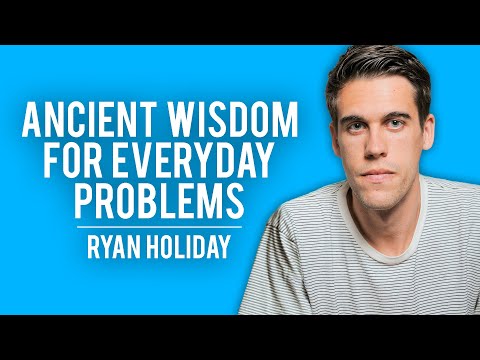
Taking Wisdom From The Lives Of The Stoics | Ryan Holiday | Modern Wisdom Podcast 226
Chris Williamson (host), Ryan Holiday (guest), Narrator, Narrator
In this episode of Modern Wisdom, featuring Chris Williamson and Ryan Holiday, Taking Wisdom From The Lives Of The Stoics | Ryan Holiday | Modern Wisdom Podcast 226 explores ryan Holiday Explores Why Ancient Stoicism Perfectly Fits Modern Life Ryan Holiday joins Chris Williamson to discuss why Stoicism, a 2,000-year-old philosophy, feels uniquely relevant and modern today. They explore Stoicism’s core ideas—focusing on what we can control, resilience in adversity, justice, and memento mori—through the lives of figures like Zeno, Seneca, Epictetus, and Marcus Aurelius.
Ryan Holiday Explores Why Ancient Stoicism Perfectly Fits Modern Life
Ryan Holiday joins Chris Williamson to discuss why Stoicism, a 2,000-year-old philosophy, feels uniquely relevant and modern today. They explore Stoicism’s core ideas—focusing on what we can control, resilience in adversity, justice, and memento mori—through the lives of figures like Zeno, Seneca, Epictetus, and Marcus Aurelius.
Holiday explains his aim with Lives of the Stoics: to show Stoicism as something lived by real, often flawed people in chaotic times, not just abstract theory. The conversation ranges from ancient plagues to COVID-19, from Roman emperors to modern politics, from information overload to the Lindy effect and the timelessness of classic texts.
They also examine tensions within Stoicism and within modern life: wealth and virtue, ambition and contentment, discipline and instinct, excellence and self-compassion. Holiday shares his personal practices (journaling, writing, memento mori) and candidly reflects on his own struggles with temper, burnout, and doing less.
Throughout, they argue that the core human problems have barely changed across millennia—and that Stoicism endures because it offers tested, practical answers rather than fashionable but unproven ideas.
Key Takeaways
Focus relentlessly on what you can control, not external events.
Holiday emphasizes the Stoic core: we don’t control the world, only our response. ...
Get the full analysis with uListen AI
Treat adversity as a training ground, not an interruption.
Stoicism itself began with Zeno losing his fortune in a shipwreck and Marcus Aurelius ruling during a devastating plague. ...
Get the full analysis with uListen AI
Study lives, not just ideas—philosophy must be lived to matter.
Holiday wrote Lives of the Stoics to show how these thinkers actually behaved under pressure: governing provinces fairly, advising emperors, enduring slavery, and running an empire. ...
Get the full analysis with uListen AI
Use time‑tested wisdom instead of chasing the latest intellectual trends.
Invoking the Lindy effect, Holiday argues that ideas that have survived for millennia (Stoicism, classic literature, foundational texts on race or morality) are pre‑vetted by history. ...
Get the full analysis with uListen AI
Design an information diet as carefully as your food diet.
Stoic suspicion of noise maps cleanly onto modern news and social media addiction. ...
Get the full analysis with uListen AI
Aim for cultivated spontaneity: train hard so virtue becomes instinctive.
Holiday endorses a middle path between rigidly over‑structuring life and blind instinct. ...
Get the full analysis with uListen AI
Pursue excellence in the work, then detach from external results.
Holiday describes shifting from obsessing over sales and bestseller lists to judging success by whether the book does what it was meant to do. ...
Get the full analysis with uListen AI
Notable Quotes
“The core premise of Stoicism is basically, look, we don’t control the world around us, but we control how we respond.”
— Ryan Holiday
“At the core of it, Stoicism is supposed to be a philosophy that you do, not something that you say.”
— Ryan Holiday
“If you want to understand what’s happening in the world, you’ve got to stop watching the news and you’ve got to start reading books.”
— Ryan Holiday
“Life is constantly teaching us that lesson… when you actually get the things that you think you wanted, you realize that they were never capable of giving you what you thought you wanted.”
— Ryan Holiday
“The ability to not do is, in some cases, the hardest thing to do.”
— Ryan Holiday
Questions Answered in This Episode
If Stoicism is so focused on action, what are some practical daily rituals—beyond journaling—that an ordinary person could start this week to live more Stoically?
Ryan Holiday joins Chris Williamson to discuss why Stoicism, a 2,000-year-old philosophy, feels uniquely relevant and modern today. ...
Get the full analysis with uListen AI
How should we think about figures like Seneca, who wrote powerfully about virtue while serving a tyrant and amassing great wealth—are they role models, cautionary tales, or both?
Holiday explains his aim with Lives of the Stoics: to show Stoicism as something lived by real, often flawed people in chaotic times, not just abstract theory. ...
Get the full analysis with uListen AI
In an era of social media outrage and constant news, what would a genuinely Stoic approach to politics and public discourse look like?
They also examine tensions within Stoicism and within modern life: wealth and virtue, ambition and contentment, discipline and instinct, excellence and self-compassion. ...
Get the full analysis with uListen AI
Given the Stoics’ limited belief in human agency (e.g., acceptance of slavery, dynastic succession), how far should we update Stoicism for modern values versus preserving it as-is?
Throughout, they argue that the core human problems have barely changed across millennia—and that Stoicism endures because it offers tested, practical answers rather than fashionable but unproven ideas.
Get the full analysis with uListen AI
How can ambitious people balance the Stoic call for moderation and detachment from outcomes with the drive to achieve big external goals in career, business, or sport?
Get the full analysis with uListen AI
Transcript Preview
Can you explain why Stoicism is having such modern day popularity at the moment? It's not like I'm seeing tons of people turn into Taoism or Confucianism, but Stoicism is like the hot new girl in school at the moment.
Yeah. I don't, I don't know exactly why that is. It's been a- an interesting journey. I mean, I've been writing about Stoicism for almost 15 years. So, I- I ... Even in my own time writing about it, I've seen some sort of peaks and valleys. But, I- I- I think ultimately it comes down to Stoicism is a philosophy designed both around and for dealing with adversity. So, I don't think it should surprise us that- that it- it- it tends to pop back up when, you know, things are difficult. I mean, Marcus Aurelius is writing Meditations during the Antonine Plague. So, the idea that, you know, it- it would have something to teach us during, you know, the COVID-19 pade- pandemic, I don't think should be that surprising.
(instrumental music plays)
Y- you're totally right. It- it does read very modern. Why is it that Stoicism reads like it was written two weeks ago and not two millennia ago?
Well, e- even- even when you think about how Marcus Aurelius is writing, so he's writing during the Antonine Plague, but- but his book, Meditations, it translates ... He was writing in Greek, uh, instead of the less formal Latin, and- and he was writing ... It- it- the title of it translates "To Himself." Right? So, he was writing his book to himself. It wasn't ever intended for publication. And- and even Seneca's writing, who's probably the most accessible of the Stoics, you know, a good chunk of it survives to us in the form of letters he was writing to his friend. Letters of a Stoic, Letters From a Stoic, is really Seneca writing to his friend, Lucilius. And so, i- if- if we can think of the literary implications of that, that instead of trying to sort of get down this brilliant theory or to perfectly craft their words in such a way, that it's accessible and- and I ... That's what I love about the Stoics is that a- again, it's not a collection of theories, it's just, you know, real people talking about real problems. And- and as it happens, the problems of the ancient world, although unique in many ways, were not that different than the problems we have today. Like pe- people are people, we get jealous, we, you know, we have urges, you know, we have ambitions, we make mistakes. You know, people are people.
I understand that, yeah. I did some research. I- in the time that most of the Stoics were alive, the entire global population was somewhere between about 150 and 330 million people. So, at most, it was like the same as today's population of the United States. (laughs) Given that there's-
Install uListen to search the full transcript and get AI-powered insights
Get Full TranscriptGet more from every podcast
AI summaries, searchable transcripts, and fact-checking. Free forever.
Add to Chrome