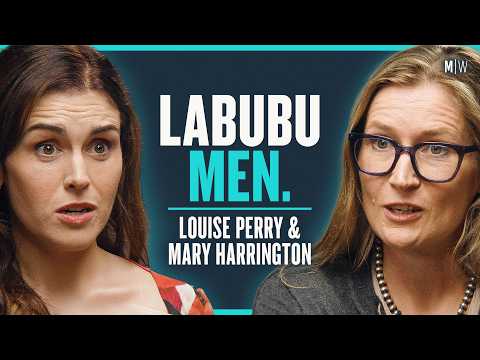
The Performative Male Epidemic - Louise Perry & Mary Harrington (4K)
Chris Williamson (host), Louise Perry (guest), Mary Harrington (guest), Narrator, Narrator, Narrator
In this episode of Modern Wisdom, featuring Chris Williamson and Louise Perry, The Performative Male Epidemic - Louise Perry & Mary Harrington (4K) explores sex Recession, Limbic Capitalism, And Rise Of The Performative Male Chris Williamson, Louise Perry, and Mary Harrington explore why people are having less sex despite more permissive sexual norms, arguing that smartphones, limbic capitalism, obesity, and collapsing social structures are undermining relationships, fertility, and desire.
Sex Recession, Limbic Capitalism, And Rise Of The Performative Male
Chris Williamson, Louise Perry, and Mary Harrington explore why people are having less sex despite more permissive sexual norms, arguing that smartphones, limbic capitalism, obesity, and collapsing social structures are undermining relationships, fertility, and desire.
They discuss how celebrity culture, K‑pop contracts, and parasocial relationships shape fertility norms, and whether propaganda or high‑status role models like Taylor Swift can realistically shift birth rates.
A long middle section examines new male and female archetypes—performative males, Labubu men, himbos, princess treatment, tradwives, and lifestyle BDSM—showing how post‑MeToo anxieties, social media, and the attention economy feminize male behavior and commodify relationships.
The conversation ends with politics and class: migration, flags, British class history, online mobs, and how women may shift rightward as maternal instincts and safety concerns override earlier progressive solidarities.
Key Takeaways
Less sex coexists with more permissive sexual norms because stable pair bonds are disappearing.
Perry notes you can have a culture that permits casual sex while people still have very little actual sex, since sporadic hookups and fewer long‑term partnerships yield low overall frequency.
Get the full analysis with uListen AI
Smartphones and limbic capitalism divert people from relationships and reproduction.
Harrington cites David Courtwright’s 'limbic capitalism'—business models that hijack dopamine via junk food, porn, and social media—arguing that constant digital stimulation outcompetes sex, family life, and even going outside.
Get the full analysis with uListen AI
High‑status role models can nudge fertility, but propaganda has limits.
They discuss Taylor Swift’s engagement and a Georgian priest who boosted third births by offering baptisms, concluding that memetic and status‑based nudges help but are insufficient to reverse structural birth decline.
Get the full analysis with uListen AI
Post‑MeToo, many men have overcorrected into 'performative' or Labubu masculinity.
The panel describe a soft, aestheticized, risk‑averse male type—matcha, tote bag, floppy hair—who is extremely HR‑safe and feminized, often signaling progressive values as a mating strategy but leaving women cold and reducing sexual polarity.
Get the full analysis with uListen AI
Hyper‑online relationship scripts mirror BDSM dynamics and erode genuine intimacy.
Concepts like 'princess treatment,' tradwife branding, and lifestyle BDSM often present as submission but, in practice, place power with the supposedly submissive partner and turn private life into monetizable content.
Get the full analysis with uListen AI
Male formation must happen offline through older men, not online gurus.
Harrington stresses that good men are formed by other men in real‑world contexts—work, family, community—where competence and responsibility are modeled; gangs often fill this void for fatherless boys.
Get the full analysis with uListen AI
Class and demography drive very different reactions to migration and nationalism.
They argue that British migration debates are fundamentally class wars—working‑class 'flaggers' vs middle‑class 'de‑flaggers'—rooted in a thousand‑year Norman–Saxon divide, and that women with children increasingly oppose policies they see as endangering local safety.
Get the full analysis with uListen AI
Notable Quotes
“You could argue we are being selected against by our own commercial infrastructure.”
— Mary Harrington
“Birth rate decline might be a slightly bigger challenge than can be fixed by Taylor Swift.”
— Louise Perry
“What if the noodle‑armed Labubu guys are actually more evolutionarily fit in an office economy?”
— Mary Harrington
“Online advice is no good. What forms men is not women, it’s other men.”
— Mary Harrington
“It seems like we’ve optimized for a very reductive meme version of ourselves.”
— Chris Williamson
Questions Answered in This Episode
If limbic capitalism is structurally embedded in our economy, what realistic levers exist to re‑prioritize family and fertility without authoritarian measures?
Chris Williamson, Louise Perry, and Mary Harrington explore why people are having less sex despite more permissive sexual norms, arguing that smartphones, limbic capitalism, obesity, and collapsing social structures are undermining relationships, fertility, and desire.
Get the full analysis with uListen AI
How can men cultivate a form of masculinity that is both non‑predatory post‑MeToo and still offers the polarity and initiative many women say they want?
They discuss how celebrity culture, K‑pop contracts, and parasocial relationships shape fertility norms, and whether propaganda or high‑status role models like Taylor Swift can realistically shift birth rates.
Get the full analysis with uListen AI
What concrete institutions or practices could rebuild 'auntie/uncle' networks and offline mentorship for young adults in highly mobile, digital societies?
A long middle section examines new male and female archetypes—performative males, Labubu men, himbos, princess treatment, tradwives, and lifestyle BDSM—showing how post‑MeToo anxieties, social media, and the attention economy feminize male behavior and commodify relationships.
Get the full analysis with uListen AI
To what extent are emerging female‑led anti‑migration movements driven by genuine safety concerns versus being re‑channeled class resentment or political manipulation?
The conversation ends with politics and class: migration, flags, British class history, online mobs, and how women may shift rightward as maternal instincts and safety concerns override earlier progressive solidarities.
Get the full analysis with uListen AI
Are tradwife/princess‑treatment and performative‑male/himbo archetypes harmless personal aesthetics, or do they risk locking people into scripts that worsen the very loneliness and low birth rates they’re reacting against?
Get the full analysis with uListen AI
Transcript Preview
Americans are having a record low amount of sex, even less than they did during COVID. Just 37% of American adults have sex weekly, down from 55% in 1990. Does this counter the view that sex is becoming more casually accepted than ever before?
Who goes first?
Uh, do you wanna go first? I think I, I glanced at these statistics and I, and what I, what I thought was interesting and sort of haven't really had a chance to burrow into is how does it split between the long-term partnered and-
Unpartnered.
... the casually-
Yeah, yeah.
... and the unpartnered?
Yeah, ex-
'Cause that's, that's been s- generally the, the, that's where the commentary gets interesting and people have often, uh, the, the, the, the conservative side will say, "No, actually, the, the, the not getting, the not getting any is, is very much the people who are not married."
Mm-hmm.
And actually the, the, the married are getting any. And if I remember rightly, the recent headlines, no, no, actually the people who are not, who are married are also, um, pan- becoming more panda-like.
Sex recession is happening across the board.
Yeah, yeah, yeah. It's happening across the board.
Yeah, yeah, yeah.
Relationship, uh, agnostic?
So I think that the paradox where people are simultaneously having less sex and apparently being at least more permissive towards casual sex, whether or not they're having lots of it, I think is solved by that marriage issue. So if people are, are less likely to be in long-term partnerships and people in long-term partnerships have more sex. So there's a g- I think there's a, there's a model that works where, say gen Z are having casual sex but they're only having casual sex.
Mm-hmm.
So like one hookup a year, for instance-
Hm.
... works out as very little sex. But it's also not to say that casual sex culture doesn't exist.
So you're able to have both of these things happening at the same time.
I think that those things work.
And they might actually be causing each other...
Yeah. But I also think it's plausible that even married people might be having less sex, and that might be to do with things like obesity, things like, I don't know, xenoestrogens. Like there could be biological things going on. Or people just looking at their phones too much.
I think, eh, people looking at their phones is at least as plausible on, on a practical level, uh, as xenoestrogens or any other sort of exotic biological explanations. I mean, if you're, you know, it's, it's very, it's very absorbing and, you know, at the end of the day, you know, a certain amount of, of the, a certain amount of action happens just, you know, there's nothing, nothing to do, nothing on TV-
Install uListen to search the full transcript and get AI-powered insights
Get Full TranscriptGet more from every podcast
AI summaries, searchable transcripts, and fact-checking. Free forever.
Add to Chrome