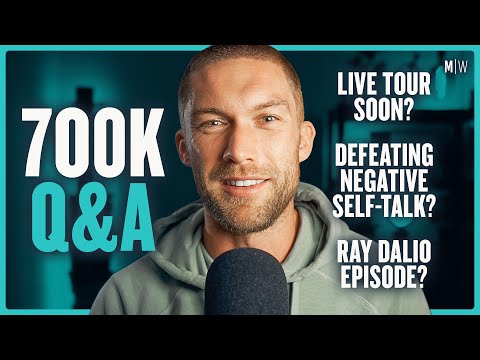
700k Q&A - Self-Talk, Live Tour & Ray Dalio
Chris Williamson (host)
In this episode of Modern Wisdom, featuring Chris Williamson, 700k Q&A - Self-Talk, Live Tour & Ray Dalio explores chris Williamson Reflects On Growth, Self-Talk, Burnout And Future Plans In this 700k-subscriber Q&A, Chris Williamson answers wide-ranging audience questions about his personal habits, mindset, and the evolution of Modern Wisdom. He discusses dealing with negative self-talk, performance anxiety, and burnout, and explains how relentless reps and honoring small commitments changed his identity. Chris also talks about monetization and mid-roll ads, future live tours, dream guests like Naval and Ray Dalio, and his concerns about cultural trends like the mating crisis and hormonal birth control. Throughout, he emphasizes curiosity, rigorous self-reflection, and building proof to outgrow insecurity and fear.
Chris Williamson Reflects On Growth, Self-Talk, Burnout And Future Plans
In this 700k-subscriber Q&A, Chris Williamson answers wide-ranging audience questions about his personal habits, mindset, and the evolution of Modern Wisdom. He discusses dealing with negative self-talk, performance anxiety, and burnout, and explains how relentless reps and honoring small commitments changed his identity. Chris also talks about monetization and mid-roll ads, future live tours, dream guests like Naval and Ray Dalio, and his concerns about cultural trends like the mating crisis and hormonal birth control. Throughout, he emphasizes curiosity, rigorous self-reflection, and building proof to outgrow insecurity and fear.
Key Takeaways
Use low-stakes beginnings to overcome fear of judgment.
When you start any creative or public endeavor, almost no one is watching, which means your early mistakes are largely invisible; by the time you have an audience that could judge you, you’ve built enough reps that you no longer suck.
Get the full analysis with uListen AI
Transform nerves into excitement by building an “undeniable stack of proof.”
Chris’s anxiety before big-name guests diminished as he accumulated hundreds of episodes plus a pre-game routine (diet, exercise, breathwork, prep, music); repeated successful performances give you evidence that you can do the thing and reframe fear as excitement.
Get the full analysis with uListen AI
Outwork negative self-talk with consistent performance and kept promises.
Instead of trying to fix inner dialogue directly, he focused on executing—making small commitments, keeping them, and stacking wins until his identity had to update to match reality, which weakened the credibility of the vicious inner critic.
Get the full analysis with uListen AI
Don’t live only in “the gap” between you and your ideal.
Self-improvement always posits an ideal you’ll fall short of; if you only compare yourself to that ideal, you’ll feel perpetually inadequate. ...
Get the full analysis with uListen AI
If you care about a craft, review your own “game tape.”
Chris improved as an interviewer by re-listening to his episodes, noting what worked and what didn’t, and refining his language and timing—mirroring how comedians and athletes study their performances to get better.
Get the full analysis with uListen AI
Curiosity-first interviewing helps you stay impartial with controversial guests.
He approaches conversations by prioritizing understanding over winning arguments, asking clarifying questions when something doesn’t make sense, and only planting a firm ethical flag when a clear line is crossed.
Get the full analysis with uListen AI
Monk mode should be periodized, not permanent, especially for dating.
He supports focused solo periods for growth, but argues that permanently opting out of romance is unwise given human needs and fertility windows; alternating between seasons of deep work and seasons of relational openness is healthier.
Get the full analysis with uListen AI
Notable Quotes
“Spending time doing self-improvement immediately posits an ideal. As soon as you posit an ideal, you then begin to compare yourself to that ideal and the gap is pretty painful.”
— Chris Williamson
“Living in the gap is not helping you.”
— Chris Williamson
“If you have an undeniable stack of proof that you can do the thing that you're supposedly trying to do, you should turn that nervous energy into a good amount of excitement.”
— Chris Williamson
“You are free to never listen to the show again if you have a problem with me doing two mid-roll ads that last exactly 60 seconds out of a two-hour podcast that cost tens of thousands of dollars and took six months to plan.”
— Chris Williamson
“I can't really hide from my negative emotions. They don't so much creep up on me in the middle of the night as they burst the door open and smash me in the face with a hammer.”
— Chris Williamson
Questions Answered in This Episode
How can someone practically shift from “living in the gap” to “living in the gain” in their daily self-talk?
In this 700k-subscriber Q&A, Chris Williamson answers wide-ranging audience questions about his personal habits, mindset, and the evolution of Modern Wisdom. ...
Get the full analysis with uListen AI
What specific moments or metrics finally convinced you that you had built an ‘undeniable stack of proof’ as a podcaster?
Get the full analysis with uListen AI
Where do you personally draw the ethical line on monetization—what types of ads or products would you refuse even if they paid for big productions?
Get the full analysis with uListen AI
How do you plan to preserve depth and curiosity as Modern Wisdom scales, adds live events, and potentially becomes more of a business?
Get the full analysis with uListen AI
Given your concerns about hormonal birth control and the mating crisis, what concrete policy changes or cultural shifts would you most like to see in the next decade?
Get the full analysis with uListen AI
Transcript Preview
I can't really hide from my negative emotions. They- they don't so much creep up on me in the middle of the night as they burst the door open and smash me in the face with a hammer. Spending time doing self-improvement immediately posits an ideal. As soon as you posit an ideal, you then begin to compare yourself to that ideal and the gap is pretty painful. You notice, "Oh my God, look at all of the things that I could/should/would be doing," but look at how far you've come. You've nailed it, you're like, a million miles further ahead than where you were and almost everybody else as well. Living in the gap is not helping you. (wind blows) Hello, friends. Welcome back to the show. It is a 700,000 subscriber Q&A episode, so as is tradition, I asked for questions on Twitter and Instagram and Locals and YouTube Community, and there was lots and lots. Uh, it goes without saying, thank you very much for the support. Uh, growth has been just insane over the last couple of months and it's, uh, line continued to go up, uh, which is very good. So, yes, let's get into it. First one... Oh g- oh yeah, also, uh, I'm gonna butcher everybody's usernames because you don't have easy to pronounce usernames mostly, so sorry in advance. ogihollywood, "What stopped you from caring what others thought when getting started?" This is quite an easy one because when you're getting started, no one is watching the stuff that you're doing. It's one of the advantages of things in the beginning, that if you do make mistakes, uh, no one is there to see them. Me and Darren, my business partner, when we used to run a bad club night, um, we would always... It would be a double-edged sword, right? Because a- a bad club night that maybe didn't have many people attend, only a few hundred people went to it, uh, would make us feel bad because only a few hundred people saw that there weren't many other people there, but there was only a few hundred people to see how few people there were there. Uh, so (laughs) it was actually not that bad. Uh, so d- you don't need to worry. If you started- worried about starting something, no one's watching you in any case, uh, up until the point at which enough people watch you for you to bother caring, you don't need to care. And when you get to that stage, you'll have accumulated enough experience to not suck at the thing you're doing. Uh, coachowenmiller, "Do you get nervous before podcasts? The ones with the likes of Goggins, Jocko, Huberman, et cetera?" Uh, that's got better over the last year, specifically, over the last year, it's got better. Um, the first and second Peterson ones, I was a little bit antsy. I've started to build up a little pre-routine that I do during the day of, um, a type of diet that I eat, um, an amount of exercise that I do, a little pre-game ritual of breath work and meditation and reading and prep and then good music. And, um, it's started to calm down. But yeah, I- I still do get... It's excitement now more than nerves. Especially before Goggins, I was just excited, and I think this comes as a byproduct of, uh, putting a lot of reps in. And the same with anything, man. Like, if you have an undeniable stack of proof that you can do the thing that you're supposedly trying to do, uh, you should turn that nervous energy into a good amount of excitement, or at least that's the way it feels at the moment. tod_kennedy, "Are you concerned about burnout? You're absolutely killing it, Chris, but as my friend wheatwaffles says, 'Your type of lifestyle and work style and a lot of other content creators are sprinting on a treadmill.'" So wheatwaffles is a black pill YouTuber from the dating space. Um, am I concerned about burnout? I don't know, man. One man's sprint is another man's stroll, and my ability to deal with discomfort in terms of workload is pretty high. I spent all of my 20s working really, really late nights. And I remember this one day where me and Darren, business partner, drove down to launch our events company in Manchester for the first time, and I think we set off at 4:00 in the afternoon. We'd worked the whole day prepping for the event in Newcastle, rented a van from Enterprise Rent-A-Car, set off at 4:00 in the afternoon, hit rush hour traffic leaving Newcastle going across this bridge that- where everybody goes over to get out. Had to pick up, I think, three or four different things, like CO2 canisters and lights and maybe another member of staff (laughs) um, en route to Manchester. Went, arrived at 9:00, set the club up, ran the event, cashed up and then at 2:30 in the morning or 3:00 in the morning when the event finished, we got back in the van and drove back and dropped everything off en route back... Or it might have even been later, it might have been 4:00 in the morning that we left. And then we hit rush hour traffic getting back into Newcastle across the same bridge at 7:00 in the morning or 7:30 AM as the sun was coming up. And I remember thinking, "This is an absolutely ridiculous routine." My point being that I've, uh, created a routine of dealing with discomfort through, um, just habit in my 20s. It's one- one of the things that Peterson said, "During your 20s, work as hard as you can and see what your tolerance for discomfort is. See how hard you can work and see how hard you can rest." Turns out for me that I deal with rest a lot more poorly than I deal with work. Uh, maybe in five years' time, I'm going to look back and go, "Oh yeah, I was- I was pushing too hard there and I could have extended my longevity." But I've been doing this at this pace for three years at three episodes a week and four years at two episodes a week and five years at one episode a week, and I'm still going at the moment, so fingers crossed. jamesholmegren, "Reading your top 100 books list, love it! How did you find the books in the first place? Do you have a special reading technique? Will there be more books added in future?" So, if you haven't got a copy of my reading list, it's 100 of the most interesting and impactful books, the most life-changing ones that I've ever read. You can get it at chriswillx.com/books or there will be a button up here on YouTube. Uh, and it's free and it's got links to go and buy them and descriptions about why I like them and stuff. Um, how did I find the books in the first place? They were just accumulated throughout my, um...... uh, how would you say? Like apprentice ascendancy from total idiot to slightly less idiot throughout the backend of my 20s and then the start of the show. Uh, some of them are from guests that have been on the show. Uh, do I have a special reading technique? There was a lot of questions to do with this. Um, uh, memorization, if I have some structure where... H- how am I able to recall some of the things that I do? Dude, I- I'm not... This isn't me trying to do a humblebrag. I was so embarrassed about my recall for forever. Ask any of my friends. Toward the backend of my 20s, I was super embarrassed because I was listening to people like Jordan Peterson or Ben Shapiro or Sam Harris, and they just had this... It felt like an encyclopedia, like a photographic memory, which apparently Shapiro actually has. But it just felt like they could recall anything that they needed, and I was trying to read this stuff and then would try and tell my friends about it or remind myself of it, and I couldn't. And I would get so frustrated because I'd think, "Oh my God, like, the-, you know, these guys can do it and why can't I do it?" And it makes me feel like... And it's just crushing, crushing volumes of time and attention with content I cared about. And then the most important thing is having an outlet through which I, I had a reason to learn it, right? I have a reason to learn this stuff and to recall it because I have to talk about it on the show or write about it in the newsletter. The Feynman Technique really, really does work. "Will there be more books added in future?" Uh, maybe. Um, I'm trying to grow the mailing list really, really hard. So if you haven't got a copy of that thing, go chriswilkes.com/books. Um, I'll do a second volume once I reach another 100 that I think are life changing and, um, probably up to about 50 now, I think since the last one, which was maybe three years ago. So, uh, yeah, at some point. Inyovoot, "Why the ads on the Goggins episode?" Very glad that you asked this because had a number of one-star and three-star reviews on Apple Podcasts because of ads, mid-roll ads on the Goggins episode, which is one episode out of 600 episodes that I've done. You are free to never listen to the show again if you have a problem with me doing two mid-roll ads that last exactly 60 seconds out of a two-hour podcast that cost tens of thousands of dollars and took six months to plan. Feel free to go somewhere else. Like, that really did get to me, the fact that for the first time ever, I started to do mid-roll ads simply because it is very, very expensive to fly an entire team, a production team, out to Andrew Schulz's studio in New York and then set everything up and have everybody on site or with Goggins to build a custom set inside of a sound stage in Vegas. Uh, it was so expensive, um, and I... Like, I need to be able to pay for the people that come out, which means that I need to sell ads on the YouTube, which means that I need to put them into the episode. So yeah, I said all along I'm not a massive fan of mid-roll ads and I'm not. I'm still not. I would rather be able to make the money in a different way and if I start releasing a product and make a, a bunch of money that can support the show that way, then you can have the episodes for free. But I... Like, I can't go and just dip into tens and tens of thousands of dollars to fund these shoots. And I think if the price that you have to pay to watch a cinematic 4K, two-hour conversation with one of the hardest men on the planet is 120 seconds of me talking about two products that I actually care about, um, then that is a fair price. I feel like that's a fair price. Um, but, look, I understand why people don't like them. I'm sorry that they do interject into the podcast. It's easy to skip past, but I also try and make them interesting. So, look, I, I hope that they are a fair enough balance for you. Glen Thompson93, "When is the Modern Wisdom merch coming? Congratulations on your success so far." Thank you. Uh, I'm having conversations at the moment about merch. To be honest, I've realized I'm really bad at monetizing and turning anything into a business, so it is going slowly, but it will be happening at some point. I literally can't even give you a timeline because it's all on me if... I really need a business manager or like a brand manager of some kind, because the only way that anything happens is if I do it, and that means I'm always the bottleneck. I'm the bottleneck if we want to change a podcast hosting platform. I'm the bottleneck if we want to update the, the branding and the artwork logo. You remember the logo thing that happened on, um, audio platforms? That took, I think, five months (laughs) to do because it's all on... It's a combination of all on me and all on Dean. So, it'll happen at some point. And the designs that we've got are ridiculously cool. They're so good. But I can't give you a date yet, sorry. Uh, Marc Cushen, "Thoughts on Alex O'Connor's recent decision to go back to eating meat after championing veganism for so long?" Alex, Alex, Alex. So, for those of you who don't know, cosmic skeptic, Alex O'Connor is a very good friend of mine and he was for a long time an atheist YouTuber, then pivoted into veganism and then, uh, put a community post out saying that he has begun eating meat, not just exclusively seafood, but also other types of meats. Um, me and Alex have had a couple of conversations about this. I know that he's going to do a longer term video, so I won't, uh, prematurely ejaculate all over what he's going to talk about. But the bottom line is, like, he still fundamentally believes in the ethics and the philosophy around veganism. I think he found the personal toll on him in terms of his health, uh, too great, and he wanted to see what would happen if he switched back to eating meat.The problem is, Alex is so ethical. Like he's so ridiculously ethical that he felt like he should tell his entire audience as soon as he made that decision as opposed to waiting. My advice to him, which I'm happy to tell you about, when he rang me and said, "Should I do this community post?" was, "Dude, just do the video." Like, "Why do you need to do the post?" And he's like, "Oh, well, it feels a little bit unethical for me to not tell people immediately." And I was like, "Dude, like that's so..." I mean, fair play, but it's so unbelievably transparent. Like, and you're going to take shit in the interim between the post and after... uh, before the video. So I was like, "Look, you need to, uh..." Uh, fair play. Like th- the guy, I very much respect him. For the people that don't know him or are concerned about whether he's a virtuous human, he's like a fantastic, fantastic human. I wouldn't hang around with him if he wasn't. So, he's made a personal health decision. Like, who is anybody to say, "Oh, what I want you to do is sacrifice your health in service of a, a greater cause." Maybe he should do, but I- I mean, he's done a lot more for veganism than almost every vegan on the planet, so I don't think that he's done too badly. Chris Les Poivdevyn, "Do you have any plans for the one million subscriber episode?" Uh, no, I really don't. Uh, perhaps not something that I considered or would need to think about given that we only hit, um, 100K two years ago? Uh, uh, less than two years ago, uh, I didn't think that this would be a thing. So, any suggestions, please let me know. Uh, comment. I- I- I really don't know what to do. Doing another Q&A like would be cool, or a live stream, or maybe a Q&A from a special location. But I don't know. Scented Popsicle, "Personally, I think you're doing great and the production is great, but what are some things you're trying to improve with future guests or future episodes?" So I have a list of big names that I'm trying to get on this year. Um, if I can even get through a quarter of them, I'll be very, very impressed and I think that (laughs) you guys will be pretty happy. Um, with regards to the production, I do want to do some, uh, different locations. I don't wanna give away too much just 'cause I don't want anyone else to do it just yet. But we want to try and do some like really, really insane location shoots, which would be really exciting. I've got a couple of locations in mind. Uh, and then we're gonna try some with different technology, different shooting styles and things like that too. Uh, but it's just rinse and repeat. Find people that I find interesting, talk to them. It's the same shit that I did five years ago when I started the show, like find someone interesting, sit down and talk to them. The only difference is that more people watch and listen now. That's it. Apu the Contrarian, great name. "Any chance you'll get Naval or Curtis Yavin on the podcast?" So, Naval is probably, is probably pretty close to number one. Problem is that he's taking this massive sabbatical from podcasts, apart from he released one with David Deutsch the other day. But, um, I- he would be like the final boss in Final Fantasy IX for me to get on. I would just adore having that conversation with him, and that would do something so special for the production as well. Curtis Yavin, I've met a couple of times in Austin. Seems like a nice guy. Not super familiar with that, what's it, Meldibus Moldbug thing, that his moniker that he uses online. I'm not really familiar with his work. I don't really understand what I'd talk to him about, so I'd have to do a lot of research. Whereas Naval, like I'm ready to go (laughs) . Naval, if you're listening, come on. Uh, but yeah, uh, I hope so. And Yavin, I'll think about it. Owen, "Joe Navarro praised you as being one of the best interviewers, stating that he loved your questioning. You truly deserve all the praise for this." Thank you. I didn't know, I don't know where he said that. Uh, "Your genuine curiosity, matched with your ability to ask phenomenal questions, inspires me. How did you learn to ask such good questions?" So there's a lot of questions similar to that one around, um, podcasting, conversation, stuff like that. Honestly, it's just time and attention. The same as the, the learning thing. You know, I've done this 600 times, and inevitably you end up accumulating some good skills. Some more practical tips that you could take beyond, like, do it 600 times, um, think carefully about what you're going to say, what you're trying to say. Learn to be as precise as possible with your speech, which means use the right words. Uh, assess your language. Don't berate yourself if you say the wrong thing or if you slightly mess up a word or if you misspeak. You don't need to fucking get the cat of nine tails out and start whipping yourself. But assessing and listening back to your performance and saying, "Okay, like what was good? What was bad? I really loved the way that I used that. I re- don't like the way that I did that." And then, re-reviewing game tape of yourself. Rogan and all of the big comedians will review their comedy sets and say, "Don't like that pause. I do like this thing." Why not do that for conversations or for podcasting? If you genuinely care about becoming as good as possible at it, then that's something that you should do, and that was something that I did for a good chunk of the start of the show. I would listen back to episodes and I would observe my own performance, and I would, uh, try not to lambast myself too much, but would critique myself when I got things wrong. Um, and then in terms of the actual questions themselves, just follow your curiosity. Like, you know what you want to know. You know someone's talking to you and something arises inside of you that's like, it- it's like being prodded in the back, and you go, "Oh that, I wanna know about that. What's that thing?" And don't be scared of interrupting. You can't go too hard. But if someone f- i- if someone hasn't... There was a clip that went a little bit viral online of me asking Goggins, "What do you mean?" while he was talking because he'd left a, a statement unqualified or whatever. And the only reason I asked it is because it came up inside of me. It just said, "I don't know what he means. What do you mean?" And it just came out. So maybe trying to get out of your own way.... a little bit. So you need the skill to be able to do the communicating bit, and then you need to allow the curiosity and just turn that into a monster. Allow your curiosity to go on a big hypertrophy program. John Hawk, "Are you anti-woke? If so, why? What's wrong with being conscious of racial discrimination in society and other forms of oppression and injustice?" I think that the being conscious of racial discrimination thing must be an online definition of being woke. I wouldn't class myself as anti-woke depending on, like, uh, using that definition. I do think that some of the, like, progressive overreach and ridiculous intersectionality, gender dynamics, everything is homophobia, transphobia, patriarchal superstructure stuff, not a massive fan of that. But I'm not against people being for racial, like, consciousness, and, and understanding oppression and injustice and trying to raise up people from, you know, uh, disempowered groups. Like, I was, that's me. I came from super working class town, you know, not (laughs) a, it's hardly palatial, right? Like people are born, live, and die in this place. It's not th- this is the sort of thing that I would be for. It's incredibly blue in the UK where I'm from as well, or at least it used to be. Um, they've ruined that a bit recently. But I wouldn't say that I'm anti-woke. Um, I would say that I am concerned about some of the progressive overreach, but I'm concerned about some of the, like, boring, permanently reactionary, defensive stuff that comes from the right as well. And that's getting super boomery recently too, um, from certain areas, which is, like, something to keep your eye on. Uh, Konstantin Kisin had an interesting tweet where he said, "The future is not woke or anti-woke. The future is post-woke." I think that's pretty good. XjFx, "Opinions on tap water, especially in the UK?" Good question. So I'm really getting into the quality of water at the moment. At dinner last night, this guy is doing research into aluminum buildup in people's bodies. Obviously fluoride in water has been a big deal for a long time. In the UK, I don't know as much. I certainly know that I don't like the taste of the water from the taps in America anywhere near as much as I did in the UK. Is that just acclimatizing to the taste? No idea. I have literally just today, an hour and a half ago, got off a call with a company called AquaTru, and they make a reverse osmosis, uh, filtration, uh, system tabletop, and they can fit it to your house. So I've got a bunch of different things from them being sent out, and I will try them and I will tell you, and if they are shit, I will tell you as well. If I don't like them, I will tell you, I promise. Uh, but I think that quality of water is going to be a big consideration. And if you're not thinking about it, at the very least, just get a Brita filter. It's not doing that much, but it's doing more than taking it straight out of the tap. Um, yeah, I mean there's even stuff to do when you're talking about the quality of water, drinking chilled water is also not fantastic for you according to some views of physiology. So I- I'm, I'm like way too deep down certain rabbit holes within Austin's health and wellness community. But the problem is I'm not sufficiently deep that I actually know what I'm talking about. So, uh, yeah, I'll, I'll report back. But yeah, be careful with tap water. Drink as much bottled water as possible. Aim for bottled water in glass water if you can. Spring water or rainwater is great. Harsh Daji, "Why did you quit modeling?" Uh, out of the country, man. I think the last job that I did was just after COVID. I was modeling a lot up until COVID happened, and then COVID happened, and then I got (laughs) a buzz cut because I couldn't get my hair cut and I wasn't gonna grow it back out. And then all of my portfolio didn't look like me because I didn't have the hair of my portfolio, and then, uh, ruptured my Achilles and lost m- like a stone in weight and muscle, uh, and still would've been able to go back to it. But to be honest, I just, I don't want to do anything other than do the podcast, like, and have a life. But in terms of work, if I was to get, I don't know, flown back to the UK to do an ad for Tesco or something, uh, they wouldn't be able to pay me enough to counteract what I would lose from not doing the podcast. And also I'd just be thinking about the podcast, like while I'm on a photo shoot, I'd just be wanting to talk to someone. So that's it. Although fun, enjoyable industry, do it if you've got the opportunity. Sabz P, "How did you get started with meditation? Are there any tools you use? Guided meditation apps, videos, et cetera? Any books or methods you recommend?" Yes. So I started probably when I was 28, and the first thing that I used was Headspace. I think a lot of people do. Andy Puddicombe from Headspace, very good. Uh, great starting, starting point. Um, so I did about 500 sessions guided through Headspace and, um, Corey Allen, I think it's called Release into Now. Uh, and that is a meditation that's probably the deepest guided meditation I've ever done, which has got binaural beats behind it. You can get that if you search Corey, without the E, uh, Allen, just search him and meditation and it'll come up. That's great. That's really good. Buy. And now I use a combination of InsightTimer for unguided and Sam Harris's Waking Up for Daily. Um, just start doing it 10 minutes in the morning every morning. Um, don't miss two days in a row. And don't overthink it. Don't berate yourself if you get distracted. Just keep on learning the process. And after, you know, like 500 sessions, you'll become moderately not incompetent. Richard Morley, "What's your view on Decoding the Gurus podcast?" Okay, so, uh, I was on Decoding the Gurus coming upon a year and a half ago now to do a right of reply after they criticized an episode that I'd done. Uh, and they have got themselves into hot water recently. Um, Chris Kavanagh, one of the hosts, was called out by Scott Alexander twice on two different newsletters. Uh, Konstantin Kisin from Triggernometry had a problem with them.... uh, uh, they are able to poke people in, uh, very tender spots one (laughs) and they're able to rile them up. Um, I think one of the reasons that they cause, uh, a little bit of... I mean, Sam Harris went back on, so did I. Uh, Robert Wright went back on. Uh, Konstantin Kisin went back on. Jamie Wheal went back on. I think one of the reasons is that the, their ability to have fun whilst doing this is quite admirable. Like, it- it- it is... Th- they're evidently enjoying themselves, uh, which means that you think, "Oh, well (sighs) fuck, maybe there's some truth in this," because it's not just, it doesn't feel like it's just out to be snide, but there is some- sometimes, like, um, vicious top spin applied to the things that they say, so I can understand why it, it causes people, um, like, discontent. For me, personally, it was a very important corrective measure. I have a lot to thank Chris and Matt about, um, even though it's got... Not necessarily (laughs) that this was the reason they were doing it or perhaps even anything that they intended to do, but one of the byproducts of turning some lead into gold with this. I alchemized my experience on go- Decoding the Gurus, um, because I was certainly not thinking enough about balance on the show, um, and this was just before Rogan was about to do his, uh, double whammy of first the Robert Malone thing and then the N-word video, um, and it just all came together. Uh, and I speak to Chris, like, moderately regularly. Like, I'd- I'd- I'd say that we're mates, and we talk about all sorts of stuff that's going on in the world, and (sniffs) you know, even though that's not the sort of show that I do, I, uh... They enjoy it, man. And like, I don't know. It- it was useful for me. As a creator, it was a useful corrective measure, and (sniffs) I appreciate the fact that, uh, they stepped in and told me where I was going wrong. Uh, Jools Drums, "How do you stay impartial or at least compartmentalize your partiality during interviews?" This is super easy, I th- I, if I think I know what you're getting at, which is, I just want to find out what the person is saying. I just want to ask questions. And if you ask questions, you will inevitably end up kind of slicing through any of the biases or concerns or, um, existing stances that you have. For instance, the David Lee episode, the, uh... One (laughs) of the world's leading cook researchers. If you missed this one, go back and, and check that out. Um, he... You know, I- I- I- it, I make no bones about it. I don't think that cooking makes any sense evolutionarily, psychologically, socially. I- it just, it, it blows my mind that people can do this, uh, to watch porn about it, let alone allow it to happen in their lives, and... But I was interested, I'm like, "Look, I, I want to find out." And I think if you go into a conversation believing that the other person genuinely has something interesting to say to you or to add to your conversation, that you- you can't really go wrong. Like, you're just going to continue to find out more, and even if you disagree with what it is that they're saying, if your pursuit of knowledge takes precedence over everything else, then I don't know, it- it seems to work for me and I... Yeah, it- it comes across as impartiality, I suppose, uh, even if I'm not all the time. And, you know, there will come a time when something crosses a line. I said it with David, I was like, "Look, I don't think... It doesn't matter what you say. I don't think that using porn to educate, um, like, underage kids, even if they are teenagers that are maybe sexually active." I don't, I- I struggle to find a place to stand firmly on that ethically. Um, there are points and walls at which I'll do that, but I'll ask more questions, and that seems to, like, defuse tensions quite nicely. (notification sound) Cryptic15, "I totally get the idea behind the phrase 'Do not outsource your self-worth to the world.' Yet, at the same time, the combined wisdom and foresight of the world is much larger than our own. As Jordan Peterson says, 'We outsource our sanity to the world.' How do we strike a balance between avoiding being a grandiose, narcissistic (laughs) person and avoiding being a people pleaser with no genuine sense of their own self-value?" Very good question. Dude, you... All of the questions are awesome. This audience is so insightful. I really, really appreciate all of the questions that you guys ask, so just... Interjection, thank you. Um (sighs) , "Do not outsource your sense of self-worth to the world, and yet the world has more insight and foresight around us than everyone else." Yeah, it's- it's difficult. I would say that, um, this is one of those times where the different stages of your development, this will be more and less appropriate. So, "Don't outsource your sense of self-worth to the world," may be more useful as you become a little bit more mature and are more, um, well-settled and understand your own capacities and can have faith in your own abilities, but at the beginning of any endeavor, using a little bit of feedback from the people around you is a good idea, right? Like, you don't want to just be a single-minded, "I know what I'm doing" person if you've never done this thing before. You need to get some feedback. If you walked onto a Brazilian jiu-jitsu mat and said, "I know what I'm doing with BJJ," didn't listen to the coach at all, and just kept on getting tied up, but didn't listen to the feedback, then you're- you're evidently dispelling obvious wisdom that could help you in what it is that you're doing. (sniffs) So, perhaps one of the balances to look at here is, "How much insight do I have and how much experience do I have, and how much should I take from this person? Does this person have my best interests at heart? Do they actually have experience and expertise in what they're talking about? Do I have any countervailing evidence that suggests I don't need to listen to them?" I think that would be a balance. A healthy dose of self-belief in things that you have earned it in, a healthy dose of, uh, feedback in situations where you feel like you need it, and then play with those two scales appropriately. (notification sound) Mrs. Anthony Bridgeton, "When will you start to tour like Jordan Peterson?"Okay, so, um, there has been a lot of conversations about this, uh, like more... I think this is probably the first time I've mentioned it on the show. A lot of conversations about doing a live show, uh... I'm still not even of the bel- like, I still can't believe the size of the show, so my sense of identity is playing catch-up, uh, with where the show is at now, uh, but it would be really cool to do, and I'm quite excited about the prospect of... kind of like the lessons, 14 Lessons From 2022 or the five-year anniversary or the, like the big episodes, the 100th episode things that I do. I would love to do an extended version of that, perhaps with a little bit of production, live. That would be awesome, and I mean, to tour doing this would be exciting. Um, so I think, at some point this year, there will be maybe one or two UK dates and one or two US dates where I can test the show live and start to play around with the ideas. I am going to do a few spots, one in Miami at the start of March, one at, uh, the International Fitness Summit in Brighton in August or September, and one in Dubai, I think, in October. I'm going to do one at each of those where I'm going to test the show as well, um, and then, yeah, maybe next year there will be a bigger, more well put-together show or tour, which sounds insane to say, and I would absolutely love to see every single one of you there. Bill: "Will you play cricket again?" No, it snapped my Achilles the last time that I'm playing. Uh, I would need an awful lot more reassurance before I can do that. Went back to playing it after 10 years off, ruptured my Achilles, not too quickly. Jay Liu: "What's the song at the beginning of every podcast? I literally make sure to listen to it every time." Fuck, what's it called? Uh... (keyboard clacking) Fly... fuck. Fly Away? Uh... (sniffs) You're gonna have to ask again on the 800th episode. Sorry. Um, it's something... it's a dubstep remix that I found on Creative Commons license six years ago, and it was a remix of a dubstep song. I really wanted something that was high energy, uh, but had the melody in, and, um... Yeah, for the people that only ever watch on YouTube, there is an entire segment of the podcast that you don't listen to 'cause I will do an intro, a spoken intro to the guest, which lasts about a minute, then maybe some comments about the episode, and then I'll do some ad reads, and then maybe some more comments, and then the episode will begin after a particular piece of music. So, uh, yeah, you're missing out if you don't, uh, subscribe on Spotify. Uh, but I... You'll have to ask again 'cause I- I- I'll get it ready for the next one, I promise. Christian von Ufful: "What is an important change you think is happening right now that people don't talk enough about?" Declining birth rates and the impact of hormonal birth control on women's psychology. I think both of those are huge. I think that in future, historians are going to look back (inhales) and think, "What the fuck were we doing? How did we let this happen? How did nobody foresee this?" Um, it wouldn't surprise me if declining birth rates are the number one existential risk. Though, it wouldn't be a true existential risk because it's not going to take us beyond the brink of unrecoverable collapse. Like, uh, uh, an existential catastrophe, let's say, um, birth rates, 100%. Uh... Here we go. Waki Pataki. (keyboard clacking) Waki Pataki (laughs) uh, "Will you be on the JRE podcast anytime soon?" Um... Maybe. I haven't spoken to Joe in a little while, uh, I need to send him a documentary that I saw that I thought was cool. He'll reach out. He just... he's got his own schedule, the same as me, and I'm looking forward to the next time that I get to speak to him, uh, when ever that happens. Uh, but he was so much fun the first time, it was just bags and bags of fun, so you know, when we go round two, um, very much looking forward to it. He said some very nice things after the last one, so yeah, I'm hopeful. Eric: "Is dating a bad idea for young men right now? Is focusing on growth and success of the self over s- focusing on growth and success over sex and romance a wise move for an ambitious person? I don't believe the trouble of modern dating is worth sacrificing the time and effort I can put into myself or my career, but I still feel intense FOMO. Maybe there is a balance. Love the pod, Chris. You keep me going through my mono- monotonous 10-hour shifts. Keep it up, man." Well, fair play grinding away at 10-hour shifts, Eric, that's pretty impressive. Personally for me, like, going through periodized monk modes is a great idea, but committing to it for the rest of time doesn't seem smart, uh, I don't think that saying dating is a bad idea for young men right now makes a whole lot of sense. Uh, no, absolutely not. Like, sex is on the bottom of Maslow's hierarchy of needs. I fundamentally disagree with the view that humans, on average, or even like beyond a- a very small cohort of people, can exist without having a life partner. I just don't think that it's the way that we're designed. I mean, you can, but you're going to be... it's going to be a suboptimal life. I would say the same as my suggestion about sobriety, right? Periodize it. Gonna go single in monk mode for a bit, and then I'm gonna date for a bit and see how that goes, and then maybe I'll go back to monk mode, and then I'll go back to dating. You don't need to commit for the rest of time. Um, I think that working on yourself before you bring somebody else in, especially if you've got baggage and stuff that you need to deal with, and development and goals that you want to achieve, is great. But I think completely closing off the potential for romantic, uh, connection is just not a smart idea. Like, the person that could be perfect for you to spend the rest of your life with could go past you, and if you're just... if you've decided in advance to make a completely arbitrary decision that I am not in the place to find a partner right now, even if you could be...... I think that you are capping your success, and I don't think that exclusively looking at growth and personal development is all that there is in life. I think that there is more. (popping sound) Rebecca Tumelty. "You mentioned in a recent podcast that increasing your vocabulary really helps you to articulate your thoughts and improve your communication. Do you have any hints, tips, methods for how to improve your vocabulary? Thanks so much for a great podcast and show." Thank you, Rebecca. Um, for me, reading different books and then seeing words that I don't know, and getting really excited about seeing the words and then trying to use them or trying to teach them to somebody. So I'll go to the gym with Zach on a morning and I'll be telling him about something that I learned when I read. So I read for about 15 minutes on a morning, which isn't much (laughs) . Um, but during it, I'll really think, "Okay, what the fuck did I learn this morning? Oh, I learned about, um, like, uh, usefully irrational beliefs," or, what's it called? You can tell how well I've remembered it. Fi- fi- fictionally rationable beliefs or something. Anyway, that was, that was this morning from Gwenda. And I'll try and teach it to him, or a new word or something like that, and I'll try and, like, chip away for a good while. Reading different sorts of books, reading books from outside of this time, and listening to people that use broad vocabulary. You know, if you hear one of the guests on this show say something cool... I learned the word conniptions the other day, which is kind of like a, a fit of rage. Um, I was like, immediately asked the person, "What does that mean?" They told me, and then I went, "Conniptions." Pretty cool. Like, it's, it's cooler than saying a fit of rage, so I'm gonna start using it. But you do need to make sure that you're using it in the right context. Manusha. "Chris needs millions of subscribers, one of five top channels on the internet." I couldn't agree more. Thank you. Yes. Uh, Jake Parker. "What are your thoughts on writing a book during a time in which AI (laughs) may soon be able to write it better and faster?" Uh, yeah. I mean, I... Fuck, man. Like I, I should just keep drinking this ............................ and chill out. But one of the things that you need to remember about the way that ChatGPT works is, it's a prediction engine, right? It's basically predictive text, but just strung out across sentences, paragraphs, and then pages. So, although it may be, uh, able to convey quite simple information effectively, it's never going to be original. Like, by definition it's not going to be original, because all it's done is l-... It's a language learning model that has taken existing work and then this is how they're able to work out plagiarism in schools. You can run text that has been generated by ChatGPT through a filter, and it is able to work out how predictable the sequence of words were. And if it hits a particular threshold, it's obvious that it's been written by that, because we don't write, all humans don't write with this, uh, preconceived parameters of predictability. Uh, so I'm not convinced it would be able to make it faster, uh, better. It'd definitely be able to make it faster than I can. I don't write that quickly. Um, but, uh, I don't know. Like, it's not just... The project of me writing something isn't just for me to... It's a learning project for me as well. Like, and I'm not going to learn by watching ChatGPT write my book for me. Um, and if Bing takes over, then it's gonna be a battle between ChatGPT and Bing in any case, and we'll just observe the Terminator War of the Worlds thing going on. Culpepper. "Keep going, bro. Your genuine, honest approach is much appreciated in an environment filled with lies and half-truths." Thanks, man. I appreciate that. I really do. Jordan Spencer. "Not a question, but your podcasts have changed my outlook on life." Why, thank you. That's about as good of a testimonial as I could ask for. The username Beck. "How do your parents feel about your success?" Uh, good. Uh, Mum listens to most of the episodes. Dad, uh, drops in every so often. I think he got half of the Goggins episode. Um, they're just happy that I'm happy. Like, I genuinely am happy and I love doing what I'm doing, and I think that that's all that they ever wanted for me. And they got out of my way very quickly. They, uh, gave me sufficient latitude to do... Which is the opposite that you hear of only child parents, right? The helicopter thing. Um, they just moved out of my way as soon as I went to uni and just seemed to have a lot of faith in me being able to do my stuff, which I'm incredibly appreciative of. Uh, I've never felt pressured to have to do anything. Um, yeah, I think they're happy that I'm happy, which is pretty good. Mercs80s. "Do you miss the UK?" I do, actually. I, I have been feeling a little bit culturally sort of displaced, um, every so often in America, because I... It sounds stupid, but the things that you hold onto, like the cultural artifacts, you know, making jokes about Greggs or the Tyne Bridge or accents from where you are, they're an important part of culture. They're an important, uh, like, ingredient of the way that you came up. And to not be able to do that and to have to... It's, it's so much more effortful for me to try and be, um, like, funny or, or, uh, culturally charismatic or anything over here, because I don't know what I'm talking about. I don't know what Cool Whip is, and I don't know those stories about, uh, Barry Bonds and stuff. I don't, I don't have the same cultural anchoring, so I do miss the UK in that regard. Um, I miss the amount of nature and the type of nature as well. That's not to say that Austin doesn't have some nice nature. It does, and I do prefer the weather here. Um, but, uh, every time that I go home, and especially this winter when I went home for Christmas, it was one of the best times that I've had, and I- I'm enjoying loving the UK again when I get to go back. It doesn't feel as much like a prison as it does like a holiday, uh, and that's pretty cool. Lou Simpson24. "What haircut do you have?" Had a lot of questions about this over the last few weeks, like what number haircut I go for, and you've chosen a good day, uh, because I literally had this done today. So, it is a two and a half on the top and it is a two on the sides, and it's squared off on the back, and I get it done about every three weeks and that keeps it pretty much like this.... ja- jahole, Diary of a CEO when? So this is Steven Bartlett's podcast, uh, biggest podcast in the UK, I think by plays on average at the moment, across all categories. Um, soon. I don't wanna say, but, uh, y- you won't be waiting long, I don't think. (sniffs) paul_hogben23, "Do you keep all the books you read?" I do. Yes, actually. Unless I gift them. Um, but you can see this, uh, thing, for the people that are just listening, it's the vertical bookcase that has the blue light behind me in the recording studio, and, um, that has been slowly filling up. If you actually go back to the really, really early episodes in this house, you'll see that the books were super low, and over time it's, it's filling up like a loading bar. Um, I left s-... I must have left hundreds of books in the UK, which did make me quite sad, uh, but I'm accumulating more. So yeah, I keep them all. Uh, hamzay6969, "Please call Ray Dalio in your podcast if you haven't." Ray Dalio is booked on the podcast. He's coming on to talk about his two most recent books, one of which I think is like a journal, uh, which it will be pretty exciting to talk about. But yes, I finally got through to him. I'd wanted to bring him on for ages. Principles is a great book. Um, so yeah, Ray Dalio, happening. Rigatoni, "How do you avoid negative self-talk causing poor performance, causing more s- negative self-talk, et cetera?" Yeah, this is, um, something that I've battled with for quite a while. Um, I'm currently, mercifully, in a, uh, however you would say, like a positivity phase. Um, I w- I wonder whether I'm going to peak and then come back down to a more negative self-talk phase. But for a long time, I'm talking like a decade, uh, negative self-talk and, and a, a very unhelpful critical voice in my mind, uh, was, uh, a mainstay. Like it was the, it was the primary voice that I hear. Very scathing, very, um, vicious, uh, very mocking, um, patronizing, uh, passive-aggressive voice that I had, uh, every time that I fell short of my, um, promises that I made to myself or goals that I'd set for myself, or the comparison game between me and other people. Um, I'm very familiar with that. And then, obviously, what it does is it gets you nervous about your ability to do a thing, which means that you do the thing more poorly, which reinforces the fact that your bad self-talk told you that you couldn't do the thing. It's not good. Um, the way that I fixed that was performance first, and this is probably... Uh, I'm sure that there is a performance psychologist out there that's just sticking his hands in his face. But, in my opinion, leading with your performance first, just going out there, getting on the stadium floor, trying as hard as you can to do a thing as well as you can, little steps, making promises to yourself, keeping them over and over again, and then allowing your identity to catch up with that. And eventually, you have an undeniable stack of proof that you are who you say you are, right? You've outworked that self-doubt, you've outworked that negative self-talk. That seemed to work for me. Uh, ishamsmusic, "If you were to start Modern Wisdom all over again with the same five years of experience, what would you do?" I'm gonna guess you mean like what would you do differently, uh, than I did in the first i- instance. Not much, to be honest. I was pretty happy with the way that everything went. I, I... Uh, it was slow and brutal for 300 episodes or three years, um, but it was still fun. Like it was only brutal in that there was no one listening to the podcast, like relatively to now. Nothing. I don't think I'd change anything, genuinely. Uh, timorgan91, "Hi Chris, love the podcast and your recommendation of Baccarat Rouge 540 was a game-changer. Any others?" So, Baccarat Rouge is a fantastic fragrance for both men and women. It's supposed to be unisex, but, uh, no idea. I don't know how I'd feel if I, um, was with a girl who was wearing it. But, uh, it's, it's amazing. Uh, other ones, um, Halfeti by Penhaligon's is really, really nice. It's a little bit more aggressive. It's less oily than the Baccarat Rouge, but it's very nice. Um, (sighs) not Aventus by Creed, but there is one, I wanna say it's called Everest or Himalaya or something. It's in a silver bottle, and it's super fresh. That's absolutely lovely. And then, uh, Kairo, I think it's Halfeti Kairo by Penhaligon's as well. Those are some more. But if you haven't tried Penhaligon's Halfeti, that will blow your face off. It's so good. But it's not quite as good as Baccarat Rouge 540. Um, sorry women, I don't know any good girls' fragrances. Uh, robboclock, "What brand are your T-shirts?" This was another... Uh, hair and T-shirts. T-shirts I've been asked about a lot, Zara. To all of the guys that have been asking what the T-shirt was that I wore on Goggins, what the one was that I wore on Tom Bilyeu, what the one was that I wore with Schulte, pretty much every podcast, I think every big podcast that I've done has been Zara. I almost exclusively wear Zara for smart clothing. Zara, sponsor me. Um, and I wear... I'm 5'10 and a half, 190 pounds or like 90 kilos, and I wear an XL in their fitted T-shirts, and they are fantastic. They're really, really good. Highly recommend them. pierre-augus, "You mentioned a few times that you were the most hated guy in school. Any reason why?" I don't think I said most hated. I think I said least popular. Uh, I may have managed to hold both titles at the same time, uh, but I, I... certainly least popular. Uh, why was I the least popular guy in school? I just really struggled to connect (sighs) with other kids. I just didn't know how to socialize, you know? I, I had had a...... like, relatively socially isolated upbringing as being an only child and having some tendencies of introversion. Uh, so it's not like Mum and Dad stopped me from doing things, you know, I went and played sports. I played football, I did judo, and then I played cricket for a long time at a very high level, a lot. I don't know, maybe I was just a bit, like, socially autistic. I'm not sure. I just, I didn't, I didn't understand how social stuff worked and I would obsess over weird things that people did about the type of trousers they wore or the way that they carried their bag and I'd be adamant that that was what made them cool. It wasn't. It was the fact that they could communicate normally with other children and I didn't understand that that was what was going on. Uh, and it's like, it's been a really, really long, effortful, uh, this is how to be a human in a group dot com instructional video thing, uh, for me to actually get to that stage. However, I have got to the stage now where it comes a lot more second naturally to me, which is lovely. (pop) Chowdownfood, "How knackered were you after the podcast with Cam?" Um, the podcast was fine, the issue was the day before so the lift, run, shoot, that we'd done. For the people that don't know, I was on Cameron Hanes's podcast. He is this world class bow hunter, incredibly hard man, endurance racing dude. It's like a, like a white Goggins that's got a bow in his hand basically and I went to Oregon with him and he made me run up a hill a lot and it was hard, uh, and then he made me do 100 reps of bench, 225 with chains and then we did, we shot some bows and it, it was difficult. Um, but it was very fun and I, he, we've been texting a lot and he's a great guy and I very much understand why a lot of people respect him. He's a super cool dude. (inhales) Tosty, "Is the mating crisis as critical as made out? Not just patterns being shifted back by 10 years?" So I think what you mean by this is (smacks lips) if, uh, people choose to get into relationships later, i.e. maybe a decade later, um, why is that a big deal? People are still going to pair off. The problem is that you have this, uh, immovable window of female fertility, right? You have a fertility window, that is a pretty hard line in the sand between the ages of whatever, 38 and 48, varies very broadly for a lot of women. Um, I think that downstream from the mating crisis, the main concern that I have, Stephen Shaw's concerned about population collapse, which I am as well, but first and foremost I'm concerned about individual happiness and I just think that the longer that people stay single, the evidence suggests, the less likely they are to be able to find a partner that they're going to be happy with. So the longer that you do this, the longer that you remain out of a relationship, the less and less likely it is that you're going to get into one that makes you feel happy. And we know that, on average, most people should be in a relationship if they want to maximize their relation- their happiness in life. Not for everybody, but it is for almost everybody. Right? Um, I think it's a big deal which is why I care about it a lot. Um, yep, we can push things back, um, but, you know, four out of five women who didn't have kids didn't intend to not have kids. That seems like a big deal to me and that's almost exclusively because of the patterns being shifted back by 10 years, if that's what you meant. Um, that's e- that, that is what we're talking about, right? These women that burst through their fertility window, that meant to have children, that didn't realize how late it was, that then try, that then grieve over families that they never had. It's brutal, man. I hear about these stories and it makes me feel so sad, um, and it should make everyone feel sad, you know? (sighs) Ryan Seghol, uh, "What are your thoughts when you run into someone in person who's been impacted by the pod?" Uh, that's a good question because it's happening a lot more, uh, now, which is beautiful, um, but kind of odd. Um, I'm not massively used to it, especially because a lot of the podcast consists of me in a room. I'm not doing live shows yet. I'm not going out and, and, and performing anywhere. I don't... I go out with my friends and we'll go for dinner and we'll do stuff and we'll go to the gym, but for the most part it's just me grinding away. Right? Doing my thing. I was in Comuna 13, which is the ex- most hardcore, drug lord ridden, dangerous part of Medellin, Colombia a few, uh, last week. This is a place that's got escalators outside to go up and down because it's so hilly. It's like amazing vibe, like fascinating vibe. Very, very, um, outgoing and loud and vibrant. And I get to the bottom of one of these escalators on the way back to the truck to go back to the hotel and this dude stopped me and said, "Hey Chris, uh, I just wanted to let you know that you're the reason that I left my job and, um, now I'm here in Colombia and I'm traveling and I can't say enough for how the show has impacted me," and blah, blah, blah. And it is a little bit like... I, I, I almost feels like people are paid actors, um, to do that. So, it's just great man. It makes me feel so happy. It's like, it's beautiful to, to see just something that I enjoy doing so much impact other people in a positive way. It's great. L- like, it's a dream. It's a dream. Uh, so, yeah. Cool. Uh, TheBatchirchi, "Get Peter Attia to your podcast." Huberman put me and him in a text thread two weeks ago and I'm speaking to his bookings, PR-... personal assistant man. Uh, he will be on. I will get Peter Attia on the show. Uh, all things being well, Peter Attia will be on the show this year. He's got a new book out that you should check out. It'll be on Amazon for pre-order. Uh, you should do that. But yeah, thank you as well Huberman for linking us up. (gasps) AnonyMouse. "I've never seen you (laughs) wearing anything but Vans. Why?" Good s- point. I have been in a big Vans, uh, like, flex for a little while. Um, they're just so... I think that Vans might be the most versatile shoes on the planet. You could run in them, you could lift in them, you could do something up and to formal dress in them, and you could do casual in them. The- they work with shorts, they work with jeans. They're fucking phenomenal. And if you get what's called the Comfy Cush version, which is maybe 10 pounds or dollars more, uh, they put a special sole in and it's ridiculously comfortable. You could wear them all day and it's absolutely fine. I just, I really love them. They're just, they're great. I find them absolutely fantastic. Uh, so right now the wardrobe of shoes is a combination of, uh, Vivobarefoot, uh, Reebok Nanos, uh, Nike Pegasus 35s for walking and running, (laughs) Croc- Crocs, and Vans. That's my, that's the five-car garage of, uh, of shoes. Uh, Funtivity Colin- Colton. "Are you concerned about EMFs from devices like AirPods, etc.? Do you use wired or wireless?" So, from what I know, the radiation that comes out of AirPods is non-ionizing. I don't know what the fuck that means, but someone smart told me that I don't need to worry about it, so I'm not bothered about it. And AirPods don't seem to... I mean, the advantage of wearing a pair of AirPod- the advantage (laughs) of wearing a pair of AirPods outweighs the future brain cancer that I may end up threatening myself with, because they're just so good. It says everything about how good AirPods are, that I'm prepared to throw brain cancer down on the line. That's- that's the price that I'm prepared to pay if I'm allowed to walk around my house at a 10-meter radius listening to whatever it is that I need to listen to. Uh, Aria- (laughs) Ariana Valanda. "Is bald pussy still a thing? Do guys care about women having pubic hair?" Uh, look, Ariana, I can't speak for all men. Um, I know my preference, and I- I do think that guys care about women having pubic hair. If I have to fight through a thicket to find what I'm trying to discover, that's not very good, is it? I mean, the- the difference in a guy having pubic hair and a girl having pubic hair is that what you're looking for isn't hidden behind ours, unless someone has really, really grown it out. This dude's, you know, got a full-on afro. I think bald pussy's still a thing. I'm gonna... I know this is a controversial statement. This may be one of the most controversial things that I've ever said in my entire life, but I do think that bald pussy is still a thing. Owen Moran, "Whoa, did you just skip straight past 600K?" No. I did a 600K, uh, Q&A as well, which you should go and, uh, check out. You should go and listen to it. Uh, Danny Collopy, "What does your usual chest day at the gym look like?" Good question. Okay, so, I would typically do, um, back first. My chest day starts with back. That's wh- that's how mine begins. The reason for that is that all of my chest exercises feel better if I have got myself into sort of this shoulders back and down position. So something like, um, four sets of RPE 7, uh, 10 to 14 rep, uh, horizontal row of some kind, seated row, seal row, something like that, and just get those shoulders back and down. Then it would be incline bench, uh, one to two warm-up sets, and then four working sets with a drop set at the end. That would be with dumbbells. Then what would we move on to after that? Uh, probably flat bench, uh, or weighted dips, then machine flies, um, machine, fly machine, and maybe finish off with weighted push-ups or something similar. All of those are four sets of eight to 14, and the final set is always a drop or a double drop set. Um, I'm sure that there's a better way to periodize this, but I'm just, I'm still the same bro that went to Newcastle Uni's Center for Sporting Excellence 15 years ago and we just did drop sets at the end of everything, so I'm just in that rhythm. Uh, where are we? Sean, uh, "Hi, Chris, I started listening last year and I'm a huge fan. Listen during my workouts and morning shifts. Absolutely love your discussions on behavioral psychology and self-improvement. Always brightens my day, and I must give you a most heartfelt thank you." Thank you very much. Very meaningful. "Question, what advice would you give to someone who is a jack of all trades but a master of none, no real friend groups, and feels like they have nothing to offer the world beyond their curiosity and want to stand out or create content? Also returned to college at age 26 to study health and human performance and physical therapy, another 7 to 10 years. What the hell do I do?" Well, first off, you have all of the foundational makings of someone that is going to succeed at whatever you do, because you are prepared to, uh, swallow your own pride to go back and do something which is...... uh, non-typical at that age. Like, you are going to be significantly older than most of the other people at uni. That's great. Uh, you have a good amount of self-awareness, that you can... you know where some of your weaknesses are. It's evident that you're relatively humble and have got your feet on the ground. You're going to be absolutely fine. Um, I would try as best you can, especially given that you're at college now, to just expose yourself to as much as possible. Join the improv school, play ultimate frisbee, start doing tai chi, go to knitting class. Like, do all of the things, because it sounds like you're yearning for a passion that will come and take hold of you. The problem is that you don't have that passion quite yet. If you're a jack of all trades but a master of none, you only need one or two of those things to cross over and you, you're gonna be unbelievably good. So, expose yourself to lots of things, find something that you become obsessive about, and just let it consume you. Like, let it... Whatever it is that you find that you really, really want to do, spend enough time exploring, try different things, discover a thing you love, and then let it infect you like a parasite and stare out of your eyes. That (laughs) seems to be the way that most people that I know that do something that they love and that becomes a part of them kind of let the world work. (pop) spoonersean, "As growth continues, can you see a time when the podcast alone stops exciting you, where you feel the need to add in something else to the mix? As you tick off more and more numerical goals and dream guests, can intrinsic motivation last beyond the point where this stops feeling like a challenge?" (sighs) Ah, that's a good question. Hmm. It's difficult for me to have theory of mind about who I'm going to be in future, because I'm not there yet. It's not stopped exciting me yet, is what I can tell you. And there is still so much more headroom for me to step up into, I think, and also, the personal development, productivity background, there aren't a massive number of people, I don't think, talking about this kind of personal development with the human behavior, evolutionary psychology, cognitive science approach, that are just saying, "Look, here's a ton of research. How does this make you feel? How does this impact your life? Do what you want with this information." Maybe I could be more applied. Maybe I could say, "You should... This is the solution from this thing, and this is this, and this is that." I mean, we do the life hacks episodes, but that's telling you how to create a great toasted sandwich or, like, where to sleep in Amsterdam Airport where there aren't armrests in between the seats. I think that there's a lot of impact still to be had from this show and from what I like to focus on, and I still have a ton of self-work to do as well. And, like, "Research is me-search," is (laughs) a quote I learned from William Castella, which is basically people research the things that they need to learn about in their own lives. And the show is absolutely that reflection for me too. So, uh, for as long as I am an as yet unactualized human, you're coming along for the ride, and hopefully it's useful, uh, with that. I could imagine that if you reach the zenith of whatever it is, maybe it needs to be something else, but, you know, then we add in live shows, maybe, or we add in a, a, a business or, or a company that, uh, t- trains other people, I don't know, like, just does stuff. There's always going to be ways to tack little things onto the side of whatever it is that this show is and this sort of Modern Wisdom philosophy has become or the, the approach to life has become, uh, and I think it's gonna be a relatively infinite game, I hope. claremcleod, "Congrats. Amazing numbers. Happy birthday." Uh, don't think it's my birthday. Oh, it will have been my birthday by the time that this was out. Wish me happy birthday, uh, an hour and a bit into a podcast. Wish me happy birthday. Uh, "My question is, I'd be interested to hear about who/what data convinced you ... re: the stem cell treatment and what rehab program/aftercare/ returning to training is. Thank you. Love your show." Thank you, Clare. Um, (sighs) stem cell treatment, I went to Columbia, I received about 200 million stem cells over the space of six days, uh, into my shoulders, into my knees, into my back, into my achilles. Uh, IV, received 100 million as well. Um, there seems to be some promising research when you get them at the concentrations that they're allowed to do outside of America. The rehab program will be a lot of time in detention. I'm gonna get even smaller, which makes me super sad because I'm not going to be able to go crazy hard in the gym while I let the stem cells do their thing. But I am looking forward to, uh, the inj- injury recovery and, uh, like, rehabilitation, revitalization, prevention, longevity stuff all kicking in. Uh, aftercare is a lot of walking at the moment for me. Um, I am spending as much time as I can just trying to stay active. I'm stood up right now, trying to stand up as much as possible. Um, yeah, it was a really cool experience. Physically, pretty uncomfortable. Emotionally, pretty enjoyable. Uh, but it's not for the faint of heart. If you've got a low pain tolerance, like, it's... You, you're gonna know about it. lj_22, "Great to see the podcast going from strength to strength. Congratulations." Thank you. "Is the scheduling of upcoming episodes more of an art or a science? Do you look at the numbers to see if a Monday, Thursday, or Saturday is a prime spot for a big guest? Or what days of the week pull in the greatest amount of views? Or do you use your instinct and intuition to appropriately spread out certain topics and subjects? Is there anything that makes a (laughs) guest or topic feel more Monday-ish or Thursday-ish, or are these data-driven decisions?" Uh, this is a really good question, actually. I don't think I've ever been asked this before. Um, but yeah, I do. I tend to...... try and have stuff on a Monday which will require a little bit more reflection, 'cause Monday is the only day where there's three days between that episode going out and a new one going out. So, slightly longer episodes sometimes tend to be on a Monday. Ones that are, um, maybe going to need a little bit more reflection from people tend to go out on a Monday. Uh, Thursday episodes tend to be something similar, although maybe a tiny little bit of a step down. And then the Saturday episodes are l- I sometimes try to make them a little bit more of an easy listen. It's not massively data-driven. Um, Saturdays do sometimes underperform compared with the other days of the week. But, uh, YouTube is the other way round. Sometimes Thursdays don't perform too well, uh, we probably should be p- publishing on a Sunday 'cause Sunday's the most active day. But to be honest, I just, I made this decision arbitrarily because I was like, "Okay, Monday will be a good day to release a podcast uh, because everyone's gonna start the week and they'll know it's Modern Wisdom Monday." And then I needed to do two a week, so I said, "Well, Thursday, that's good, that's another day of the week. Friday would be weird because everyone's waiting for the week- the weekend to come around, so Monday, Thursday." And then when I needed to do another one, the only day I could do was Saturday, and now I've got lock in. So, uh, here we are. F- Henry Webster, "I'm starting my caffeine-free journey after drinking a lot of coffee since at least my early teens, 20 years ago. I have quickly noticed that not only was I using caffeine to give me energy requiring more and more to just reach a base level, but I had come to use caffeine to cover up negative emotions. Did you have any such personal insights when you stopped drinking caffeine? Thanks, Chris, been here since under 50K and still loving it. Henry." Henry, you're an OG, thank you. Uh, yeah, dude, I mean, people use caffeine as a, uh, not only a mood enhancer, but a mood stabilizer. "I feel bad today. Okay, I'll pump a bunch of caffeine in." And I don't know, I'm sure, uh, Huberman will be able to tell you what's going on, but there is some cascade of things. You know, a good, a good strong caffeinated drink with some good music, and it's... you're flying. It feels really good. Uh, so yes, you will absolutely use it to cover up negative emotions. Um, the, the lifestyle things, I think I've spoken about ad nauseum, um, covering up your fatigue, you're not looking after your health, you're not looking after your sleep hygiene, and you're using caffeine as a buttress to keep yourself going. Everybody knows this already from hearing me harp on about it. Um, the emotional thing is super, super interesting and definitely something I noticed and something that I haven't spoken about, so I very much appreciate you reminding me of it. Um, yeah, uh, to cover up negative emotions if you're feeling a little bit down and you crack, uh, a big coffee into yourself, it kind of... you're so wired and focused and, and just on edge that it doesn't really matter what is going on. Uh, you're just, you're just gonna blast through it with your caffeinated snowplow. Uh, so yes, I did, I, I did notice those things. Although, um, I'd done... I was pretty far down the old, like, self-work route, and I was facing my negative emotions pretty face on. I can't really hide from my negative emotions. They, they don't so much creep up on me in the middle of the night as they burst the door open and smash me in the face with a hammer, so I didn't really need to go caffeine-free (laughs) to, uh, be aware of them. They were, they were front and center. Jared Nott, "Congrats, dude. When we're talking about moving toward projects or goals, what is your advice, or how did you learn to just sit down and do the thing? Feels like a muscle that needs to be built, although the barriers often feel overwhelming. Keep up the awesome work." Thank you. Uh, and yeah, the do the thing, or just do the thing, is something that I've been thinking about a lot. Um, I keep tweeting it once a week probably on Twitter, uh, "Your weekly reminder to just do the thing." And Steven Pressfield says this in The War of Art, um, "Real writers know that the difficulty isn't the writing part, the difficulty is the sitting down to write part," and that is it. How many times have you put off doing a task, o- or you've procrastinated your way through a task, but you haven't actually started? It's not like you got into the task and got distracted and stopped it. You didn't begin the task. So yes, sitting down and doing the thing is a muscle that needs to be built. Um, some of the things that you can do, Cold Turkey, which is a, um, app for MacBook, maybe available for Windows as well, uh, which can literally block websites and applications on your computer and it will stop you from using things, and you can't get around it. It, it won't let you use this stuff unless you donate money to charity. No, it's you that chooses what times it's on, what times it's off, if it's on, if it's off, which websites, which applications, et cetera. But, um, that's a good way to start because it just reminds you like, "Hey, dickhead, you're supposed to be working." Um, in terms of building up the muscle, uh, making it as frictionless as possible to go from, uh, the state of not doing the work to the state of doing the work in terms of planning your day, allowing yourself to have long uninterrupted blocks with which to do it. Let's say that, uh, this is disgusting but probably true of most people, that it takes you 30 minutes to start doing the thing, right? Let's say it takes you 30 minutes. If you have a meeting in an hour's time, you get 30 minutes of work at most. Whereas if you have organized your day, so that you go, "Okay, I know that I'm gonna have to pay an entry price to do this thing, I'm gonna have to sit down and make myself feel like shit and like y- listen to the right music and, and fiddle around with my desk (laughs) and brush the dust away from whatever it is and get distracted, and then eventually I'll sit down and do the work. And I have this long and uninterrupted period to do after that in which I can do more work." That's a good way to structure your day. So those would be some things. Uh, and then after that, if you do begin to do the work, once you have got through a period of it, just give yourself 30 seconds once you've finished up. Even if you get distracted too soon, even if you haven't done as much as you wanted, even if the day has become sideswiped, take 30 seconds at some point and just sit with the enjoyment of being a person that did a hard thing.This is from Hardwiring Happiness with Rick Hanson, and I'm really starting to lean into this, despite the fact that I had him on the show four years ago. Um, allowing yourself to feel gratitude and enjoyment for things well done shortly after you do them reinforces the positive pattern of encouraging you to do it again. And that is not something that should be taken lightly. Like, it is really, really powerful. Uh, so, restrict the apps that you use, maybe cold turkey, maybe something else that would be effective. Make it as frictionless as possible. Laptops in the right place, keyboards all set out, everything's charged, everything's ready to go. The drink's there, it's chilled, it's blah, blah, blah. You've got all the stuff, um, and then feel good once you've done it. Ahmed Mohamed: "I was the one that always wondered how you quote and remember things from what you have read and stuff. I wish you could share your techniques." This is what I said at the very beginning. Dude, I was embarrassed of my recall ability and it's just because I permanently have a platform to teach other people or another person about it. And the friends that I spend time with, the guy that I live with, we are permanently having interesting conversations about topics that I care about. If you find someone that you can have a genuinely in-depth conversation with, just lean into that. Read a thing, teach it to someone. Read a thing, teach it to someone. Explain it. Reword it. That will fix it in your mind. That will cement it into your brain pretty effectively. Tucker Dixon: "If you were to advise someone to quit either soda or booze, which is the bigger health impact?" Booze all day. Like don't even think twice. Uh, if that's, if, if that's a genuine question, uh, dude, get rid of the booze. It's gonna make a, a world of difference to you. So, and I mean, Zevia, supposed to be good for you maybe. Not sponsored. Marcus Philipson: "What is your best advice for aspiring, aspiring podcasters? Speech coach, acting classes, improved vocabulary?" Do 100 episodes. Do 100 episodes before you start dicking about with anything. Just spend either between one and two years doing your show, and get that time and attention in. It would be like saying, um, "What specific formulation of protein powder do you think I should we- eat in my post peri-training window?" "How long have you been going to the gym?" "I haven't yet gone to the gym." If you have, if you have accumulated a significant number of podcast episodes, the next thing that I would suggest that you do would be review game tape, go back over the things that you're doing. Uh, it would be make sure that you are fully prepared, so sleep, hydration, food, uh, a vocal warmup, which you could get from a speech coach. Then, I did, I didn't use a speech coach for the first three and a half years, maybe like th- yeah, three and a half years of the podcast, I didn't have one. And Miles is phenomenal. The guy that I've worked with is great. However, he was like the sprinkles on the top of the icing on the top of the cake. He rounded everything out. Almost all of the development, and this is for everybody that's been asking about using a speech coach or going to improv or doing acting classes and stuff, almost all of the, I would say 95% or maybe even more, of the skill that was accumulated was done simply from time and attention of doing the show. So, it is very much, it is not, the key is not the acting class or the improv or the comedy coaching or the speech coaching. It is doing the thing a lot and being attentive when you do it. Paying attention. Chris Yabsley: "Any advice on how to reduce the chances of overcorrecting during self-improvement? I feel that self-improvement can often lead into states of feeling inadequate. Could this be detrimental when, for example, pursuing a new relationship or entering the dating market?" Overcorrecting during self-improvement. Feeling inadequate. Okay, so this would be maybe a- an interesting book for you to read would be The Gap or The Gain by, um, come on. He wrote Genius Blogging. Come on, Christopher. (sigh) Nope, forgotten his name. Uh, anyway, it's called The Gap or The Gain. Um, he's been on the show twice. But it is like, so... My point being, when you are focused on comparing where you are now with where you want to be versus where you are now with where you used to be, you are always living in the gap as opposed to living in the gain, which would be the opposite. Uh, yes, spending time doing self-improvement immediately posits an ideal. As soon as you posit an ideal, you then begin to compare yourself to that ideal and the gap is pretty painful. You notice, "Oh my God, look at all of the things that I could/should/would be doing." But look at how far you've come. You've nailed it. You're like 1,000,000 miles further ahead than where you were and almost everybody else as well. Living in the gap is not helping you. It is not pushing you forward that much more. Fears of insufficiency and a fundamental, uh, l- lack of, uh, fulfillment from the progress that you have made isn't pushing you that much further. So first off, let go of that. Let go of that belief. Allow yourself to feel pleasure and, and, uh, pride in what you have done. And I think it could be detrimental, actually. I do think that a lot of guys, you know, uh, uh, NoFap is a perfect example of this. Like, NoFap, uh, very well may benefit a lot of men to get them away from poor habits around porn and their own penis-... however, breaking a streak makes them feel so bad that it might be a net negative for them. I think the overcorrecting during self-improvement, uh, and the states of feeling inadequate are a phase, and I think that you will grow out of the phase. Um, maybe you're in the trenches right now and it sucks, and I've been there. I honestly, genuinely have. Just stick to the plan, continue to iterate, continue to improve, continue to do the things every single day. You will get better. And over time you will look back and the old version of you, even the version now that asked that question, will be fucking unrecognizable. It's pretty cool. Dave, in capital letters, "What new information (laughs) did you learn in the last year that most changed your perspective on something?" Uh, biggest change has been this hormonal birth control thing, like pretty shocking. Dr. Sarah Hill, Your Brain on Birth Control. One year ago if you'd said to me, "Do you think that hormonal birth control should be, uh, uh, uh, restricted, re-educated, um, or- or that, um, women should be encouraged to maybe cycle naturally?" I would have said like, "Fuck no. What are you talking about?" Whereas now I think it might actually be unethical to not do that. Uh, which is pretty crazy. And anyone that hasn't considered the dangerous psychological impact of putting women, young girls on hormones at age 13 or 14, like you should check out the episode I did with Dr. Sarah Hill. It's- it's crazy. Um, Joel Snape, "What's the number one thing you look for in a podcast guest?" That's a good question. Huh. I might be giving a symposium... Uh, giving a symposium. Be part of a symposium at HBES, which is the Human Behavioral Evolutionary Society Conference in somewhere on the East Coast. Uh, so I'd actually be part of a proper academic conference and I get to do 15 minutes, and it's how to not suck as an academic guest (laughs) on a podcast. Um, what do I look for? What were the points I put up in there? Uh, good storytelling. Um, good communication. Uh, f- I- I really need the guest to have some sort of existing media presence, not because I want to capitalize on their platform, but just because I need to be able to work out whether or not they can do the thing. It's very rare that I bring somebody on the podcast that I can't see, uh, a- a existing video or episode of. I- I need to see if they can communicate their ideas effectively. I'll roll the dice with someone that has an amazing insight and just go like, "Agh." Gwindon Bogle, perfect example. The guy's a digital ghost, except for my podcast. Like he just doesn't exist on the internet. It's like Twitter, Substack, and Modern Wisdom and that's it. But I figured he writes so well, he can't... Even if he talks, uh, 90% worse than the way that he writes, he's still going to be a top tier triple A guest. And sure enough he was. Um, that's a really good ques- I think it's storytelling, I think it's presentation, I think it is, uh, genuinely novel insights. Um, and it's having a good vibe. Like y- you can get a long way with just having a, uh, like a good, uh, dynamic. A nice, a nice dynamic team. Uh, Greg Hill, "Do you engage in a gratitude practice you'd like to share?" So I did formal, uh, gratitude for a long time. I have filled up ten diaries, I think, of six months. Um, I did a lot, an awful lot, and maybe even more. Uh, I did, I did it for a very, very long time, every single morning and, and most evenings. However, I have stopped that now. Uh, I have found that I have a limited amount of time on a morning and the most bang for my buck, um, things that I do in my morning routine, walk, breath work, meditation, read, start the day. Previously added into that would have been, uh, journaling, gratitude, uh, rehabilitation, something like ROMWOD or a mobility program, uh, and then cooking. Uh, but I'm eating out so much in Austin that that's pointless. Gratitude, I would just get the 6 Minute Diary or the 5 Minute Success Journal. Um, something like that. Handwritten, I think is good because first thing in the morning and last thing in the night you don't want to be on your phone. Uh, and they're both great. The 6 Minute Diary I think you can still get if you use MW15 on their website in the Europe, you still might be able to get a discount on that. But it's like they're... Both of these things are 20 bucks or 30 bucks for six months, so just do that. Anand Yadav, "What would your advice to a 20-year-old struggling through life in relationships?" What would, what would be your advice to a 20-year-old struggling through life in relationships? Uh, I need more information than that, bro. Um, it will get better, I can tell you that much. As you grow up, as you become more mature, your ability to deal with the vicissitudes of life gets so much better. I- I, me and Zach, my housemate, were talking about this a lot the other day, which is we think that now is the golden years. Looking back, I think that this is going to be the period of my life where I'm like, "That was fucking dope." I was sufficiently young to still have all of my health and my strength and my energy, uh, but I was sufficiently old to have all of my maturity. And if you are, let's say that you are 20, 20-year-old, dude you have got so much headroom for, uh, progress and development. And I know that right now it might feel like your entire world is imploding or it- it... This is your world. But, uh, this is such boomer advice, it's... I sound like my mother talking to me here. Um, (laughs) over time-You're going to look at the little blips that you have now, especially if you're doing the sorts of things that the people that listen to this kind of a podcast do. You're going to look back and laugh at the things that worried you. I always, I always wished that there was a way to take a photo of the texture of your mind, and like take a record somehow, or- or have a time machine where you could, um, go back and just experience what it used to be like to... feel the texture of your own mind five years ago, or ten years ago. And I think if you were able to do that, you would be amazed at how much more resilient and peaceful and calm and balanced you are now, and you think, "Oh my God, I can't believe I used to be bothered about this sort of stuff." And in six months or a year's time, this is exactly how you're going to feel. I promise you, this is exactly how you're going to feel. Do the things that you need to do. Take time in nature, get some sunlight, get up at the same time, go to bed at the same time, eat well, drink well, train, have people around you that you can talk to about things that you're interested in. Continue to iterate, continue to develop, follow your curiosity. Basic things will continue to carry you through. They will get you through good times and they will get you through bad times, and once you're out the other side of this little period of relationships, you will find another amazing relationship and everything will be sweet. Look, I'm gonna leave it there. Uh, that was longer than I intended, but these were really fun and, uh, I think by the time that this goes up, we're gonna be halfway to 800. Um, I don't know what I should do about the 100K things once we break a million. It's a crazy thing to say, but I really don't know. Should I keep doing 100K Q&As every 100K? What if it ends up being every month? Is that going to be overkill? I feel like it might be overkill. Um, but... Thank you, anyway, uh, brilliant. Like such, such good (laughs) uh, questions today. I really, really, genuinely do appreciate all of you. I love the comments, I love the comments section, I love the fact that you correct other people that steam in that are obviously being too unreasonable. Uh, you guys are all great. Love you. See you at 800K. (instrumental music) What's happening, people? Thank you very much for tuning in. If you enjoyed that episode, then press here for a selection of the best clips from the podcast over the last few weeks. And don't forget to subscribe. Peace.
Install uListen to search the full transcript and get AI-powered insights
Get Full TranscriptGet more from every podcast
AI summaries, searchable transcripts, and fact-checking. Free forever.
Add to Chrome