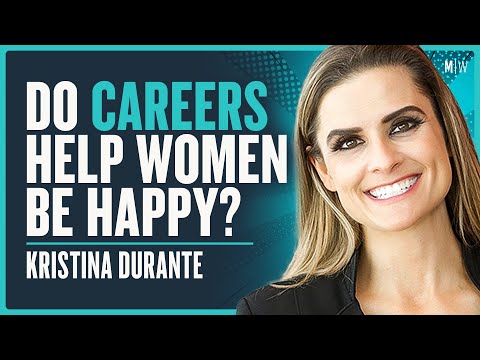
Can Women Have A Career And A Family? - Kristina Durante
Kristina Durante (guest), Chris Williamson (host)
In this episode of Modern Wisdom, featuring Kristina Durante and Chris Williamson, Can Women Have A Career And A Family? - Kristina Durante explores modern Women, Ancient Instincts: Careers, Mating, and Unavoidable Trade‑offs Chris Williamson and evolutionary psychologist Kristina Durante explore whether women can realistically 'have it all' in terms of high-powered careers and fulfilling family lives, arguing that deep evolutionary wiring and modern structures create hard trade‑offs rather than easy win‑wins.
Modern Women, Ancient Instincts: Careers, Mating, and Unavoidable Trade‑offs
Chris Williamson and evolutionary psychologist Kristina Durante explore whether women can realistically 'have it all' in terms of high-powered careers and fulfilling family lives, arguing that deep evolutionary wiring and modern structures create hard trade‑offs rather than easy win‑wins.
They discuss how female status and income gains often destabilize relationships, how unpaid domestic labor and motherhood biology remain asymmetrical, and why many women still prefer higher‑status male partners despite empowerment narratives.
Durante explains hormonal and mating-market influences on women’s desires for sex, children, careers, consumption, and even political attitudes, emphasizing that choice overload and dating-app abundance can undermine satisfaction.
They conclude that understanding evolutionary drivers doesn’t remove agency but gives people a clearer 'map' of constraints, helping women and men make more informed decisions about careers, partners, and family timing.
Key Takeaways
Women’s rising earnings and status often strain relationships instead of stabilizing them.
Studies show that when wives out‑earn husbands, marital satisfaction decreases for both partners and divorce rates rise; women who climb corporate or political ladders are more likely to divorce than comparable men, suggesting current relationship norms haven’t adapted to female status gains.
Get the full analysis with uListen AI
Biology makes the career–family trade-off structurally harder for women than for men.
Pregnancy windows, childbirth risks, and powerful post‑birth hormonal shifts create a strong caregiving drive in mothers that men don’t experience to the same degree, meaning women face more intense internal conflict between status pursuits and nurturing demands.
Get the full analysis with uListen AI
Unpaid domestic labor remains highly feminized, even for working women.
Research shows employed women do more housework than stay‑at‑home mothers and more than their male partners, partly due to guilt, intensive parenting norms, and gendered division of chores—leading to burnout, resentment, and 'unpaid labor' conflicts in dual‑career marriages.
Get the full analysis with uListen AI
Women’s preferences for mates, careers, and even politics are context‑ and hormone‑sensitive.
Ovulation and hormonal phases shift sexual desire, interest in children, religiosity, political attitudes, and even clothing/makeup choices, while local sex ratios (e. ...
Get the full analysis with uListen AI
Hypergamy and status preferences persist despite empowerment narratives.
Many women still strongly prefer partners who earn at least as much as they do and often underreport when they are the primary breadwinner, reflecting deep‑seated preferences for higher‑status mates that coexist uneasily with cultural messages of 'have it all' equality.
Get the full analysis with uListen AI
Modern abundance of choice and dating options can erode satisfaction.
Consumer and mating research suggests that more options increase regret and reduce contentment; dating apps and global sexual marketplaces keep opportunity costs salient, making people less satisfied with the partners they choose compared to more 'serendipitous' or constrained environments.
Get the full analysis with uListen AI
Understanding evolutionary psychology can increase agency rather than fatalism.
Durante argues that recognizing how ancient mating and status drives shape modern behavior lets people design better 'workarounds'—e. ...
Get the full analysis with uListen AI
Notable Quotes
“As women start earning more, marital satisfaction goes down for men and for women.”
— Kristina Durante
“The more women gain status, the more discord happens in their marriage.”
— Kristina Durante
“Having it all is not possible. Everybody has to make trade-offs.”
— Chris Williamson
“Marriage is set up; it highly benefits men.”
— Kristina Durante
“The only way that you can transcend your programming is by understanding it.”
— Chris Williamson
Questions Answered in This Episode
If rising female status reliably destabilizes traditional relationships, how should men and women consciously redesign relationship expectations and roles?
Chris Williamson and evolutionary psychologist Kristina Durante explore whether women can realistically 'have it all' in terms of high-powered careers and fulfilling family lives, arguing that deep evolutionary wiring and modern structures create hard trade‑offs rather than easy win‑wins.
Get the full analysis with uListen AI
What practical strategies can dual‑career couples use to rebalance unpaid domestic labor so that both partners feel fairly treated?
They discuss how female status and income gains often destabilize relationships, how unpaid domestic labor and motherhood biology remain asymmetrical, and why many women still prefer higher‑status male partners despite empowerment narratives.
Get the full analysis with uListen AI
How should women factor in biological fertility windows and the maternal 'hormonal cascade' when planning education, career progression, and family timing?
Durante explains hormonal and mating-market influences on women’s desires for sex, children, careers, consumption, and even political attitudes, emphasizing that choice overload and dating-app abundance can undermine satisfaction.
Get the full analysis with uListen AI
Can society realistically shift female mate preferences away from hypergamy and male status, or are we better off adapting institutions to those persistent instincts?
They conclude that understanding evolutionary drivers doesn’t remove agency but gives people a clearer 'map' of constraints, helping women and men make more informed decisions about careers, partners, and family timing.
Get the full analysis with uListen AI
Given that choice overload seems to lower satisfaction in both consumer and romantic decisions, how can individuals structure constraints (e.g., on apps or careers) to protect their long‑term wellbeing?
Get the full analysis with uListen AI
Transcript Preview
As women start earning more, marital sa- satisfaction goes down for men and for women. As women move up the corporate ladder, they're more likely to become divorced, but that's not true for men. If women win political office, they're more likely to get d- divorce than their women counterparts who lost their political (laughs) office. The more women gain status, the more discord happens in their marriage.
Did you see the Serena Williams article in Vogue?
I did not.
Oh, well, let me tell you about it. So-
Please do.
... her issue, uh, th- the article is about the fact she's now 41, she's still a top flight tennis player, and she's got one child, I think Olympia, and, uh, is now, was aware that she would have a limited window perhaps to have more children, uh, so is having to leave the sport. She had some complications medically after the last child, um, perhaps slightly brought on by being an elite athlete. I don't know the sort of stresses that that puts your body under, the kind of internal changes or external changes. Um, and then there's a couple of sections here. "So believe me, I never wanted to have to choose between tennis and a family," she wrote. "I don't think it's fair if I were a guy, I wouldn't be writing this because I'd be out there playing and winning while my wife was doing the physical labor of expanding our family." I have to presume that she means the literal physical labor of expanding the family. "'Maybe I'd be more of a Tom Brady if I had that opportunity,' Williams wrote, pointing that the football legend Brady, 45, who has three children and played in the NFL for 22 seasons before announcing his retirement in February, before changing his mind and announcing that he would return for a 23rd season just one month later."
Yeah.
"Ahead of her 41st birthday, Williams realized she had a narrow window to get pregnant again. 'I definitely don't want to be pregnant again as an athlete,' she said. 'These days, if I have to choose between building my tennis resume and building a family, I'd choose the latter.'" I thought that was very interesting.
Yeah, that is interesting, uh, especially since I think Tom Brady's, um, unretirement is causing discord in his own marriage from, you know, at least the, what the gossip is, right? Uh, but, you know, there is something to that. Women do often have to make a trade-off that men, you know, typically don't have to. This is kind of a new thing with, you know, women being able to, you know, ha- be the Serena Williams of the world, or, you know, um, the, uh, um, blanking on the name of, you know, CEO of a company, um, and we kind of have to figure out, like, what are we gonna excel at? Are we gonna excel at our careers? Are we gonna excel as a parent? 'Cause it's really hard to do both very well at the same time. Um, and so, you know, historically, that has sort of been the, the contract that we used to enter into through marriage, is, you know, the, the, the male works and the female stays at home and runs the household, which is a lot of work. And what f- I find really interesting is now that women have made tremendous strides into the workplace, they're finding themselves no better off in terms of household, uh, you know, th- running of the household and things that they have to do to make, you know, the household run. All of that unpaid labor isn't going away. It's, uh, it's still there. And what we find through the research is that women who, working women actually do more housework than women who are stay-at-home moms.
Install uListen to search the full transcript and get AI-powered insights
Get Full TranscriptGet more from every podcast
AI summaries, searchable transcripts, and fact-checking. Free forever.
Add to Chrome