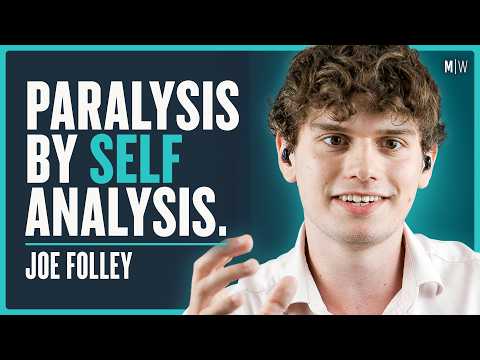
Existential Philosophy, Nietzsche, Suffering & Self-Awareness - Joe Folley
Joe Folley (guest), Chris Williamson (host)
In this episode of Modern Wisdom, featuring Joe Folley and Chris Williamson, Existential Philosophy, Nietzsche, Suffering & Self-Awareness - Joe Folley explores nietzsche, Dostoevsky, and Camus: Suffering, Meaning, and Many Selves The conversation explores existential philosophy through Nietzsche, Dostoevsky, and Camus, focusing on suffering, meaning, resentment, and self-awareness. Joe Folley explains Nietzsche’s picture of the mind as competing drives, his idea of organizing the will, and his attempt to make suffering meaningful via the will to power. They contrast abstract philosophy with down‑to‑earth psychological insights, showing how fiction and narrative often teach existential lessons more deeply than theory. The discussion closes by examining hyperconsciousness, overthinking, and why personalized, story‑driven wisdom can be more useful than one‑size‑fits‑all advice.
Nietzsche, Dostoevsky, and Camus: Suffering, Meaning, and Many Selves
The conversation explores existential philosophy through Nietzsche, Dostoevsky, and Camus, focusing on suffering, meaning, resentment, and self-awareness. Joe Folley explains Nietzsche’s picture of the mind as competing drives, his idea of organizing the will, and his attempt to make suffering meaningful via the will to power. They contrast abstract philosophy with down‑to‑earth psychological insights, showing how fiction and narrative often teach existential lessons more deeply than theory. The discussion closes by examining hyperconsciousness, overthinking, and why personalized, story‑driven wisdom can be more useful than one‑size‑fits‑all advice.
Key Takeaways
See your mind as many drives, not one unified self.
Drawing on Nietzsche, Folley describes the mind as a bundle of semi‑autonomous drives rather than a single inner ‘driver’; some people manage to align these drives (an organized will), while others are scattered and paralyzed.
Get the full analysis with uListen AI
Treat resistance and struggle as sources of meaning, not errors.
Nietzsche links existential fulfillment to overcoming resistance; difficulty is not a defect but a key ingredient in deep satisfaction, which suggests we should sometimes seek and even celebrate hard challenges rather than avoid them.
Get the full analysis with uListen AI
Beware resentment disguised as morality or self‑protection.
Nietzsche’s idea of ressentiment shows how powerlessness can breed moral systems and personal narratives that rationalize weakness (e. ...
Get the full analysis with uListen AI
Too much meaning can be as suffocating as too little.
Camus and Folley note that lives or ideologies overloaded with ‘ultimate meaning’ can justify extreme sacrifice or unbearable pressure; a workable life often needs enough meaning for direction, but enough looseness for free choice.
Get the full analysis with uListen AI
Use fiction and narrative to make insights ‘sink below the neck.’
Dostoevsky’s characters (like the Underground Man) let readers feel the cost of resentment, self‑deception, and lovelessness in their bones; stories often change behavior more effectively than abstract arguments or data.
Get the full analysis with uListen AI
Recognize when reflection turns into crippling hyperconsciousness.
Dostoevsky’s ‘disease of hyperconsciousness’ captures living as if viewed from outside all the time; over‑thinking and constant self‑monitoring can block spontaneous action, motivation, and genuine engagement with life.
Get the full analysis with uListen AI
Filter popular advice through your own temperament and deficits.
They argue that mass advice (e. ...
Get the full analysis with uListen AI
Notable Quotes
“The resistance is the point, and the overcoming of the resistance is the thing that's being aimed at.”
— Joe Folley (summarizing Nietzsche)
“You absolutely won't learn anything about humankind, but you might learn something about a few people and one of them might be you.”
— Joe Folley
“It’s very easy to love mankind in general, and it's very hard to love people in particular.”
— Joe Folley (quoting Dostoevsky’s doctor in *The Brothers Karamazov*)
“Advice which is made and works for most people will be widely distributed… but some people already have too much of the thing it's pushing them to do more of.”
— Chris Williamson
“Part of the reason why Nietzsche really appeals to people is that that's a very abstract way of putting things. It's also very applicable to your everyday life.”
— Joe Folley
Questions Answered in This Episode
How can I practically ‘organize my will’—aligning competing drives—without becoming rigid or hypercontrolled?
The conversation explores existential philosophy through Nietzsche, Dostoevsky, and Camus, focusing on suffering, meaning, resentment, and self-awareness. ...
Get the full analysis with uListen AI
Where in my life might resentment or ‘sour grapes’ be secretly shaping my values or moral judgments?
Get the full analysis with uListen AI
What forms of resistance or suffering in my current life could be reframed as meaningful challenges rather than meaningless pain?
Get the full analysis with uListen AI
Am I more threatened by life feeling ‘devastatingly meaningless’ or ‘excruciatingly meaningful,’ and what does that reveal about my priorities?
Get the full analysis with uListen AI
Which novels or stories seem to mirror my own psychological struggles, and what lessons might they offer that theory alone has not?
Get the full analysis with uListen AI
Transcript Preview
So, one of the things that, uh, in some ways, Nietzsche really comes up with a very naturalistic view of what it means to be a human, which I think kind of, uh, jives relatively well, um, with the kind of spirit of a lot of modern empirical research into, well, into- into psychology. I mean, Nietzsche is, um, considered by, uh, people, like, kinda... He- he was a huge influence on people like Freud and- and Jung and stuff like that. I mean, I wouldn't, I wouldn't go so far as to say that Nietzsche was an evolutionary psychologist, but I think that he might be worth reading if you're interested in evolutionary psychology. It's kind of a very different perspective. The thing that Nietzsche has, as- as I say, a kind of picture of the human, which ends up really influencing the psychologists immediately after him, but also just kind of... It's still a- a- a broad view of the human that, um, still is around today, is, uh, that Nietzsche conceives of the mind as basically a collection of drives, or the will as basically a collection of drives. And so it's- it... As opposed to a lot of thinkers before him who sort of conceived of the will as, like, one object, so they're kind of... I don't know, if you want an image, it's like the little man driving our bodies, if that makes sense. Nietzsche kind of throws out this- this picture and he says, "No, they're kind of... If I think about how a human being works, they tend not to work quite like that." They tend to think, okay, I've got this kind of quite chaotic series of drives, and it's very difficult to pinpoint exactly what the me drive is in there. And so he comes up with this image of human psychology which is of, we all have... We... Our mind just is a series of drives, and some people have those drives kind of roughly pointing in one direction. Other people are kind of completely scattered to the, to the four winds, and, you know, the drives are pulling them this way and that way, and they- they can't act, they can't get anything done, they can't prioritize. And so this is kind of the view of the mind that I would say is kind of... then ends up in a lot of, in a lot of late 19th century and right through the 20th century in terms of, in terms of psychological ideas and theorizing and- and research. 'Cause, you know, if you think about, um, how a therapist might conceive of the- the human will today, um, they tend to talk roughly in terms of- of different drives, different facets of the mind, but this kind of fragmentary view of the human will, where it's not just kind of one set thing, it's this collection of different ideas and drives and- and- and desires, and that- that kind of comes from Nietzsche. I mean, he's building off earlier thinkers, but that, for instance, is- is where a lot of early psychoanalysts kind of credit where their view of the mind has come from. And then this, as I say, ends up filtering through right, right, even to, e- even to today. I mean, you know, I- I know you've mentioned before that you- you're kind of in... You- you have had therapy and stuff. So I- I think that, you know, I don't know how similar that was to- to how some of the therapy that you've undergone has conceived of the human mind.
Install uListen to search the full transcript and get AI-powered insights
Get Full TranscriptGet more from every podcast
AI summaries, searchable transcripts, and fact-checking. Free forever.
Add to Chrome