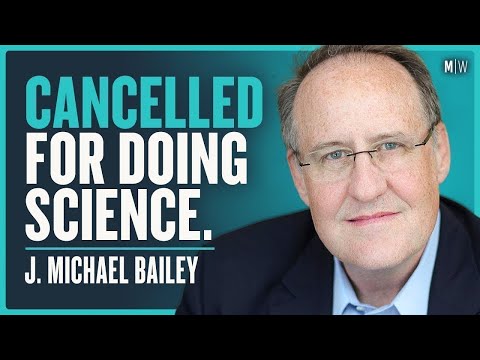
The Shocking Research On Sexuality They're Trying To Hide - Michael Bailey
Chris Williamson (host), J. Michael Bailey (guest)
In this episode of Modern Wisdom, featuring Chris Williamson and J. Michael Bailey, The Shocking Research On Sexuality They're Trying To Hide - Michael Bailey explores retracted Gender Dysphoria Study, Sexuality Science, And Censorship Wars Michael Bailey discusses the retraction of his rapid onset gender dysphoria (ROGD) paper, arguing it was driven by activist pressure and publisher cowardice rather than genuine ethical or methodological failings.
Retracted Gender Dysphoria Study, Sexuality Science, And Censorship Wars
Michael Bailey discusses the retraction of his rapid onset gender dysphoria (ROGD) paper, arguing it was driven by activist pressure and publisher cowardice rather than genuine ethical or methodological failings.
He outlines the study’s findings on adolescent gender dysphoria, mental health comorbidities, and clinician influence, and contrasts social-contagion explanations with the “left-handedness”/social-acceptance model for rising trans identification.
The conversation broadens into Bailey’s wider research on sexual orientation, paraphilias (including autogynephilia, gynandromorphophilia, acrotomophilia, and autopaedophilia), and sex differences in the rigidity and fluidity of male vs. female sexuality.
They end by touching on cultural shifts in mating, mate value, and the limits of how much environment can reshape sexual orientation, while highlighting the chilling effects of politicization on sex research.
Key Takeaways
The ROGD paper’s retraction was political, not scientific, according to Bailey.
He maintains the study was methodologically sound, retracted on a technical informed-consent pretext after transgender activists pressured Springer Nature; he argues downloads and media coverage soared post-retraction, creating a Streisand effect.
Get the full analysis with uListen AI
Rapid onset gender dysphoria appears tied to social contagion and preexisting mental health issues.
In a survey of 1,655 parents, most affected youth were adolescent girls with prior anxiety/depression, no childhood gender dysphoria, high social and ideological influence, and worsening well-being after social transition; parents often felt pressured by “gender specialists” to affirm transition.
Get the full analysis with uListen AI
Both increased tolerance and social contagion likely contribute to rising trans identification.
Bailey accepts that a more accepting culture lets genuinely dysphoric people come forward, but he also argues that adolescent girls’ social sensitivity, peer dynamics, and the valorization of victim status amplify identity contagion in ways activists resist acknowledging.
Get the full analysis with uListen AI
Male sexuality is more fixed and paraphilia-prone, female sexuality more fluid and context-sensitive.
He emphasizes strong biological underpinnings for male orientations and paraphilias (e. ...
Get the full analysis with uListen AI
Autogynephilia and related sexual variants are under-studied because activism censors uncomfortable truths.
Bailey argues that activists’ efforts to deny or suppress autogynephilia and other paraphilias in trans populations have impeded research that could actually help those individuals decide if, when, and how to transition or structure their lives.
Get the full analysis with uListen AI
Male bisexuality does exist, but many self-identified bisexual men are in transition to identifying as gay.
Lab measures of genital arousal now show a subset of men clearly aroused by both male and female stimuli, yet Bailey notes many gay men report previously calling themselves bisexual without truly being bi, complicating identity labels.
Get the full analysis with uListen AI
Ethics bureaucracy can be weaponized to suppress controversial science.
The publisher justified retraction because the non-academic survey originator lacked conventional IRB-style consent language, despite participants being clearly informed and eager for publication; Bailey’s future studies are now over-engineered for IRB compliance to prevent similar attacks.
Get the full analysis with uListen AI
Notable Quotes
“The retraction was a sham. Our article was retracted because of the ideas and the evidence it presented that angered transgender activists and their allies.”
— Michael Bailey
“Rapid onset gender dysphoria is the explanation of the surge in cases of gender dysphoria that has happened over the past decade and especially the past five years.”
— Michael Bailey
“Instead of trying to silence our research, it would have been better if the skeptical had done their own studies to try to clarify what they thought was going on.”
— Michael Bailey
“Autogynephilia is very controversial because trans activists have tried to sweep it under the rug. They're embarrassed by it. I'm not. I don't judge these people.”
— Michael Bailey
“Why is everyone not a sex researcher? Why is everyone not doing paraphilia sex research?”
— Chris Williamson
Questions Answered in This Episode
How should clinicians and parents distinguish between persistent, early-onset gender dysphoria and socially influenced rapid onset cases in adolescents?
Michael Bailey discusses the retraction of his rapid onset gender dysphoria (ROGD) paper, arguing it was driven by activist pressure and publisher cowardice rather than genuine ethical or methodological failings.
Get the full analysis with uListen AI
What safeguards or standards of evidence should journals and publishers use before retracting politically sensitive research?
He outlines the study’s findings on adolescent gender dysphoria, mental health comorbidities, and clinician influence, and contrasts social-contagion explanations with the “left-handedness”/social-acceptance model for rising trans identification.
Get the full analysis with uListen AI
If activist pressure can reshape what is publishable in sex research, how can the field maintain academic freedom while still protecting vulnerable groups?
The conversation broadens into Bailey’s wider research on sexual orientation, paraphilias (including autogynephilia, gynandromorphophilia, acrotomophilia, and autopaedophilia), and sex differences in the rigidity and fluidity of male vs. ...
Get the full analysis with uListen AI
What kinds of long-term outcome data (on happiness, regret, mental health) should be collected before endorsing medical transition for minors?
They end by touching on cultural shifts in mating, mate value, and the limits of how much environment can reshape sexual orientation, while highlighting the chilling effects of politicization on sex research.
Get the full analysis with uListen AI
How might acknowledging phenomena like autogynephilia and paraphilias change therapeutic approaches for trans-identified or sexually nonconforming individuals?
Get the full analysis with uListen AI
Transcript Preview
What happened with your recent article?
So the short answer is that our recent article has been retracted by the publisher of the journal Archives of Sexual Behavior, where it was published. Retraction is something, uh, I've never had an article retracted before and it's something that I've associated with terrible, uh, things like fraud, plagiarism, grievous mistakes. None of that is true about our article. Uh, frankly and honestly, our article was retracted because of the ideas and the evidence it pred- presented that angered transgender activists and their allies who pressured the publisher, who either agreed with them, uh, based on politics or chickened out or were worried about business concerns. I can't read their mind, obviously. But I will say that the retraction was a sham. Um, I, I would also say that the retraction has backfired entirely from their perspective. Our article has gotten far more attention than it ever would have. The publisher, Springer Nature Group, keeps metrics on this. Our article has been downloaded almost 100,000 times which is, you know, uh, that's not perhaps a big deal for mainstream media, but for an academic article, that is extreme. Uh, we have received more news coverage. We're, we're about, um, 40, ranked 40 out of 400,000 articles of about the same age in terms of media coverage. Uh, here we are talking, you know, I'm on a big co- podcast with you, uh, and, uh, there have been articles and so on. So I'm not hurting. Uh, I just want people to download and read our article and don't pay attention to the retac- retraction notice. It, it's meaningless.
If people wanna get a hold of the now forbidden article, where are they, where should they go?
Same place they ever did. Our article was published open access. That means we actually had, um, funding from, uh, Society for Eviden- Evidence-Based Gender Medicine, uh, SEGM, to, um, uh, publish the article for free reading. You know, most articles, academic articles have a pay wall that non-academics can't get through easily. There's no pay wall. The retraction simply means, (laughs) uh, uh, for practical purposes, that Springer stamped the words "retracted article" on every single page of the article which you c- it doesn't affect your ability to read it. And frankly, I, uh, wear those words as a badge of honor now.
That makes it kinda sexy. It makes, it-
(laughs)
It feels like it's a top secret seal. So what's the, there's someone that's listening that wants to go and search, what should, what should they search for on the internet in order to get this article up in the right form?
Uh, you know, so what I search (laughs) in order to go to the site to keep track on our current metrics, you know, I'm really waiting for when we get $100,000 view, I'm sorry, 100,000 views. Uh, Diaz, D-I-A-Z, Bailey, B-A-I-L-E-Y, ROGD for rapid onset gender dysphoria which is what it's about. And then you'll have, uh, links to choose from. Choose the one that says Springer and that'll take you right to the site. You can read the article right there.
Install uListen to search the full transcript and get AI-powered insights
Get Full TranscriptGet more from every podcast
AI summaries, searchable transcripts, and fact-checking. Free forever.
Add to Chrome