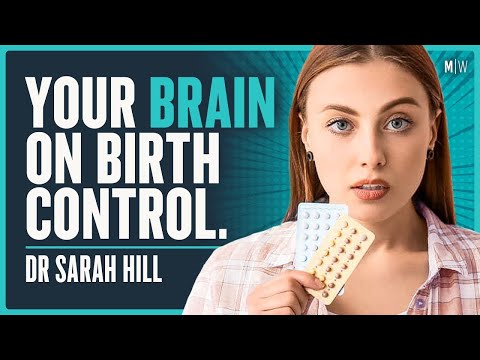
The Psychological Impact Of Hormonal Birth Control - Dr Sarah Hill
Dr Sarah Hill (guest), Chris Williamson (host)
In this episode of Modern Wisdom, featuring Dr Sarah Hill and Chris Williamson, The Psychological Impact Of Hormonal Birth Control - Dr Sarah Hill explores how Hormonal Birth Control Quietly Rewires Female Desire, Mood, Relationships Dr. Sarah Hill explains how natural ovarian hormone cycles shape women’s brains, libido, preferences for masculinity, energy, and social behavior across the month, and how the pill flattens this pattern by simulating a constant post‑ovulation state.
How Hormonal Birth Control Quietly Rewires Female Desire, Mood, Relationships
Dr. Sarah Hill explains how natural ovarian hormone cycles shape women’s brains, libido, preferences for masculinity, energy, and social behavior across the month, and how the pill flattens this pattern by simulating a constant post‑ovulation state.
She reviews evidence that hormonal birth control can lower sexual desire, shift women’s mate preferences toward less masculine but more materially reliable men, and alter relationship satisfaction when women later come off the pill.
The conversation explores broader cultural knock‑on effects: a possible role of widespread pill use in the ‘mating crisis,’ declining male motivation and testosterone, changing patterns of female sexuality, and how easy access to casual sex changes what men must do to gain sexual access.
Hill also raises concerns about adolescent use of the pill, including increased risks of anxiety, depression, and potentially long‑term mental health issues, and argues for urgent innovation in non‑hormonal contraceptives while still recognizing the pill’s enormous benefits for female autonomy and achievement.
Key Takeaways
Natural cycles create predictable psychological and behavioral shifts.
In naturally cycling women, rising estradiol around ovulation increases energy, libido, interest in men, preference for masculine traits, and even interest in music and dress; progesterone in the luteal phase instead promotes sleepiness, hunger, safety‑seeking, and lower sexual interest.
Get the full analysis with uListen AI
The pill flattens estrogen-driven sexuality and can dampen desire.
Hormonal contraceptives mimic a continuous luteal phase (high progestin, low estrogen), shutting down ovulation and the body’s own sex hormone production, which often leads to reduced libido and a ‘muted’ experience of sexual motivation and reward.
Get the full analysis with uListen AI
Hormonal birth control can subtly redirect women’s mate choices.
Studies show pill users tend to prefer less masculinized male faces and, when choosing partners on the pill, often end up with men rated as less facially masculine but better on tangible traits like financial provisioning, with implications for attraction once they discontinue the pill.
Get the full analysis with uListen AI
Coming off the pill can destabilize relationship satisfaction—depending on partner attractiveness.
Longitudinal data on married couples indicate that when women stop the pill, attraction and sexual satisfaction increase if the husband is highly attractive, but decrease if he is less attractive, suggesting estrogen’s return amplifies underlying mate‑value perceptions.
Get the full analysis with uListen AI
Adolescent pill use is linked to elevated anxiety, depression, and possibly lifelong risk.
Large studies associate teen hormonal contraceptive use with higher rates of antidepressant prescriptions, anxiety, depression, and even increased suicide risk—often far higher than in adult users—and some evidence suggests an enduring elevated risk of major depressive disorder even after discontinuation.
Get the full analysis with uListen AI
Widespread pill use may contribute to a broader mating and motivation crisis.
Hill and Williamson speculate that suppressed female ovulation reduces environmental fertility cues that normally boost male testosterone and achievement motivation, while easy access to casual sex lowers the behavioral standards men must meet, potentially reinforcing underachievement and passivity.
Get the full analysis with uListen AI
We urgently need non-hormonal contraceptives that don’t hijack the brain.
Despite the pill’s enormous role in women’s autonomy and education, its side effects—hair loss, mood shifts, libido loss, partner preference changes—are so common that Hill argues research should pivot toward non‑hormonal methods (e. ...
Get the full analysis with uListen AI
Notable Quotes
“For me, it felt like I woke up.”
— Dr. Sarah Hill (on coming off the pill)
“The idea that women are more hormonal than men is just absolutely not true. We’re all hormonal.”
— Dr. Sarah Hill
“If you can get laid while you're living in your mom's basement and eating Cheetos, why would you ever do anything different?”
— Dr. Sarah Hill
“When women don’t require a lot of men in order to get sexual access, men will sink to whatever low standard is set.”
— Dr. Sarah Hill
“It seems criminal to me that they prescribe it as frequently as they do to really young women for things like acne.”
— Dr. Sarah Hill
Questions Answered in This Episode
How should women weigh the psychological and relational trade‑offs of hormonal birth control against its benefits for planning education, careers, and fertility?
Dr. ...
Get the full analysis with uListen AI
If the pill shifts mate preferences, what practical advice would you give couples who met while the woman was on hormonal contraception and are considering her coming off it?
She reviews evidence that hormonal birth control can lower sexual desire, shift women’s mate preferences toward less masculine but more materially reliable men, and alter relationship satisfaction when women later come off the pill.
Get the full analysis with uListen AI
What safeguards or alternative strategies should parents and clinicians consider before putting adolescent girls on hormonal birth control for non‑contraceptive reasons?
The conversation explores broader cultural knock‑on effects: a possible role of widespread pill use in the ‘mating crisis,’ declining male motivation and testosterone, changing patterns of female sexuality, and how easy access to casual sex changes what men must do to gain sexual access.
Get the full analysis with uListen AI
How plausible is the idea that widespread suppression of female ovulation contributes meaningfully to declining male testosterone and motivation compared with other factors like obesity and environmental toxins?
Hill also raises concerns about adolescent use of the pill, including increased risks of anxiety, depression, and potentially long‑term mental health issues, and argues for urgent innovation in non‑hormonal contraceptives while still recognizing the pill’s enormous benefits for female autonomy and achievement.
Get the full analysis with uListen AI
What non‑hormonal contraceptive innovations (for men or women) seem most promising, and what cultural or economic barriers are slowing their development and adoption?
Get the full analysis with uListen AI
Transcript Preview
More recently, researchers have begun to explore the idea that women who are on hormonal birth control, this might be associated with a decreased preference for masculinity, and there is some evidence that is consistent with this. There's been research showing that women who are on hormonal birth control prefer a less masculinized male face relative to what's preferred by the exact same women when they are naturally cycling. (air whooshing)
How did you get interested in studying birth control?
Um, well, I spent most of my career, uh, studying women's sexual behavior and, uh, and mate attraction and partner choice, um, and, uh, and I'd even done some work looking at women's sex hormones and the way that influences, uh, women's motivation and choice of dress and other things to that effect. Um, and so I've always had an interest in women's psychology and the different sort of biological components that contribute to, like, sort of what it means to be a contemporary female. Um, but it was really going off of the birth control pill that got me interested in studying its effects on, uh, human psychology.
What is the way that you would describe to a, uh, non-birth control-taking person like myself the difference in your subjective experience of the world?
Um, for me, it felt like I woke up. So about three months after I discontinued using hormonal birth control, I started to notice that I was just- had been feeling different recently. I had more energy than I had before. I was going to the gym again. I was, like, noticing men and I was interested in sex in- in a way that I hadn't been in a really long time. I started downloading new music on my playlist for, like, the first time in de- uh, like, in, like, more than a decade. And, um, and I thought to myself, this is... Like, I- I just felt like I woke up and I thought, well, this is a crazy way to respond, um, to going off of the birth control pill. And so I kind of chalked it up to just being me, you know? Oh, it just must be something else that's going on in my life that's making me feel this way. Um, but then I started to really start to dig down into the research and it turned out that my experiences weren't all that unique and that there's been research that's been done now for several decades, um, detailing the different ways that hormonal birth control can influence women's psychology, um, in ways that are very much consistent with the experiences that I had.
Okay, so before we get into how the pill affects behavior-
Mm-hmm.
... what do we need to know about hormonal changes and how that influences behavior normally across a woman's ovulatory cycle?
Right. Well, I think- yeah, and I think that having some background in that can be really useful. And, you know, there's been research that's been done now for, I don't know, three or four decades that's really, um, looked at- at women's ovarian hormones having a really profound role, um, on the way that women, um, experience the world and- and even, you know, the- the activity and structure of the brain. So, you know, research in neuroscience, for example, has shown that as, uh, ovarian hormones change across the cycle, that actually changes the amount of functional connectivity in the brain. It changes, um, the number of dendritic spines on our neurons. So our brain is this very plastic organism within our body that, um, w- you know, sort of changes its structure and function over the course of the cycle. And, uh, behaviorally, what the research finds is that, you know, during the time in the cycle when estradiol is high and the dominant sex hormone, there's a lot of research indicating that, um, you know, women have an increased preference for, um... or an increased desire for sex. They tend to engage in more sexual behavior at this time. They tend to exhibit a heightened preference for cues related to men's masculinity at this time. And so during the- the phase in the cycle which is, um, what researchers usually characterize or- or call the- the periovulatory phase of the cycle, which happens usually between days like 9 to 14, um, on average if you're talking about a 28-day ovulatory cycle. You know, the 28-
Install uListen to search the full transcript and get AI-powered insights
Get Full TranscriptGet more from every podcast
AI summaries, searchable transcripts, and fact-checking. Free forever.
Add to Chrome