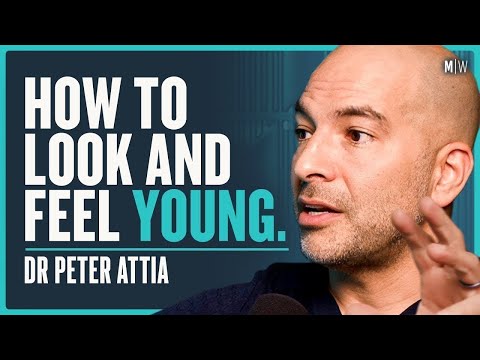
Simple Habits That Could Add Decades To Your Life - Dr Peter Attia
Dr Peter Attia (guest), Chris Williamson (host)
In this episode of Modern Wisdom, featuring Dr Peter Attia and Chris Williamson, Simple Habits That Could Add Decades To Your Life - Dr Peter Attia explores dr. Peter Attia Reveals Low-Tech Habits For Extreme Longevity Gains Dr. Peter Attia argues that the biggest levers for lifespan and healthspan are low‑tech fundamentals—cardiorespiratory fitness, strength, sleep, metabolic health, and emotional wellbeing—rather than exotic biohacks or future tech. He explains how his risk‑management background drives a framework of moving from clear objectives (your ‘marginal decade’) to strategy, then to tactics across five domains: exercise, nutrition, sleep, pharmacology, and emotional health. The discussion covers practical protocols for VO2 max, zone 2 training, strength and stability work, protein intake, fasting, blood pressure and lipid management, plus nuanced views on sweeteners, nicotine, alcohol, vaping, and social connection. Underneath the science is a psychological message: define the life you want at 80–90, then reverse‑engineer sustainable habits now, prioritizing consistency and purpose over perfection or ego.
Dr. Peter Attia Reveals Low-Tech Habits For Extreme Longevity Gains
Dr. Peter Attia argues that the biggest levers for lifespan and healthspan are low‑tech fundamentals—cardiorespiratory fitness, strength, sleep, metabolic health, and emotional wellbeing—rather than exotic biohacks or future tech. He explains how his risk‑management background drives a framework of moving from clear objectives (your ‘marginal decade’) to strategy, then to tactics across five domains: exercise, nutrition, sleep, pharmacology, and emotional health. The discussion covers practical protocols for VO2 max, zone 2 training, strength and stability work, protein intake, fasting, blood pressure and lipid management, plus nuanced views on sweeteners, nicotine, alcohol, vaping, and social connection. Underneath the science is a psychological message: define the life you want at 80–90, then reverse‑engineer sustainable habits now, prioritizing consistency and purpose over perfection or ego.
Key Takeaways
Start with your ‘marginal decade’ and work backward.
Define what you want to physically and cognitively do in your last 10 years of life (e. ...
Get the full analysis with uListen AI
Cardiorespiratory fitness and strength dwarf most other longevity interventions.
VO2 max and muscular strength have hazard ratios (risk reductions) that outperform smoking cessation and blood pressure control alone. ...
Get the full analysis with uListen AI
Prioritize consistency over perfection in diet and training.
You’re better off being “7 out of 10” every day than 10/10 some days and 0/10 others. ...
Get the full analysis with uListen AI
Hit sufficient daily protein in multiple doses, especially if you time‑restrict.
Most people benefit from ~1. ...
Get the full analysis with uListen AI
Measure and manage key risks: blood pressure, apoB, VO2 max, and muscle mass.
A simple home blood pressure protocol, apoB blood test, VO2 max/zone 2 assessments, and DEXA for lean mass provide a powerful longevity risk snapshot. ...
Get the full analysis with uListen AI
Train stability and movement quality, not just muscles and numbers.
Energy ‘leaks’ from poor joint control and faulty patterns drive chronic pain and injury, limiting training over decades. ...
Get the full analysis with uListen AI
Guard your brain with the same rigor as your heart and muscles.
Family history plus limited genetic testing (e. ...
Get the full analysis with uListen AI
Notable Quotes
““Having a very high VO2 max, being incredibly strong, that's going to do more for your lifespan and health span than any piece of technology or biohacking… It's just not even within the same zip code.””
— Peter Attia
““You're better off being seven out of ten in performance, but doing it every single day, than being ten out of ten some days, zero out of ten other days.””
— Peter Attia
““We’ve effectively doubled human lifespan… by treating fast death. The problem is, we haven't really made much progress against slow death.””
— Peter Attia
““If you don't smoke, if you maintain a blood pressure at or below 120 over 80, and if your apoB is maintained at the physiologic level that kids have, you can't get atherosclerosis.””
— Peter Attia
““I think what we have an epidemic of is people who don't know what they're training for.””
— Peter Attia
Questions Answered in This Episode
How would my current exercise and nutrition habits need to change if I took the ‘marginal decade’ thought experiment seriously?
Dr. ...
Get the full analysis with uListen AI
What is the most realistic way for me personally to reach top‑quartile VO2 max and strength while fitting into my schedule?
Get the full analysis with uListen AI
Which calorie‑reduction method (macro tracking, dietary restriction, or time restriction) aligns best with my psychology and lifestyle for long‑term adherence?
Get the full analysis with uListen AI
What would a basic annual risk‑assessment panel for me look like, and how should I interpret apoB, blood pressure patterns, VO2 max, and muscle mass results?
Get the full analysis with uListen AI
How can I systematically improve my emotional health and social connections so they support, rather than sabotage, my long‑term longevity plan?
Get the full analysis with uListen AI
Transcript Preview
The reality of it is, having a very high VO2 max, being incredibly strong, that's going to do more for your lifespan and health span than any piece of technology or biohacking, manipulation of gut biome, or any other thing that people are talking about. I mean, it- it's just not even within the same zip code. And you don't need a lot of technology to do those things. You just need to put in the work. (wind blows)
Pete Shirey, welcome to the show.
Thank you very much, Chris.
Would you say that you have a unique or different perspective when it comes to longevity?
Uh, I don't know. That's an interesting question. Uh, yeah, maybe in some ways I do, I suppose.
It seems to me that you're focusing on not just lifespan, but also health span as well, not just physical health, emotional health, mental health. That more holistic view, uh, seems to be different to me.
Yeah, and also, uh, I think kind of a somewhat low-tech approach as well. Um, and I'm completely interested in, you know, fascinated by, obsessed with all the high-tech stuff and the, you know, the science that hopefully will come through in the, in the coming decades, but I, you know, maybe going back to my background in, in risk management, I really think everyone should always be hedging everything they're doing. So, you know, to just assume that we're going to come up with some amazing technological breakthrough that's going to, you know, start to defy aging while not doing all of the things that we can do with the technology that exists today strikes me as unwise.
What's that background in risk management?
Um, I, after I left my first stint in medicine in 2006, I went to work for the consulting firm McKinsey & Company, and, uh, though I was recruited there to do healthcare, I ultimately, uh, wound up in the risk practice because of my background in math. So, uh, I, yeah, I was doing, you know, credit risk and, uh, cool stuff like that.
All right. And how does that inform the way that you show up for your work now?
Um, I think it's essential, right? I think, I think everybody should be trained in some understanding of, of risk. Everyone should be trained in probability statistics. Uh, you know, that's, to me, the much more important stuff in mathematics, um, and I, I think that understanding how to think about, uh, symmetric and asymmetric risk, understanding expected value, uh, thinking about how to hedge risk, all those things are, you know, important not just in, you know, thinking through financial instruments, where banks are constantly making mistakes anyway, but as you think about your own life. So I'll give you an- a very silly example. So, uh, uh, two weeks ago, a friend said, "Hey, you want to come, you know, skiing?" You know, he's gonna go to this amazing place and ski, and I said, "No." He's like, "How do you not want to do this?" And I was like, "Well, I don't personally get enough pleasure from skiing to justify the downside," right? "So the upside for me to go skiing with you is this much. The downside is this much. But that's my decision. That doesn't mean you shouldn't go skiing, right?" Because for him, the upside is probably much larger-
Install uListen to search the full transcript and get AI-powered insights
Get Full TranscriptGet more from every podcast
AI summaries, searchable transcripts, and fact-checking. Free forever.
Add to Chrome