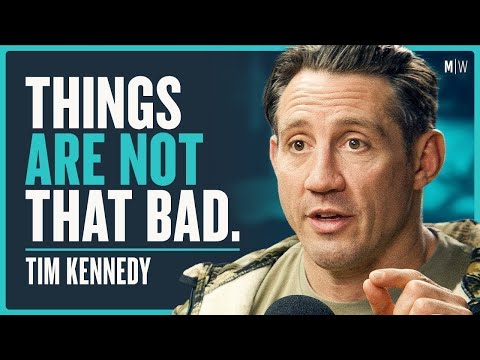
Harsh Truths From A Special Forces Master Sergeant - Tim Kennedy (4K)
Chris Williamson (host), Tim Kennedy (guest), Chris Williamson (host), Chris Williamson (host), Chris Williamson (host)
In this episode of Modern Wisdom, featuring Chris Williamson and Tim Kennedy, Harsh Truths From A Special Forces Master Sergeant - Tim Kennedy (4K) explores special Forces Veteran Warns Of Cultural Decay And Lost Purpose Tim Kennedy, a Special Forces Master Sergeant and former UFC fighter, discusses the declining fitness, resilience, and competence of young Americans and how that undermines national security and special operations recruiting. He links this decay to cultural shifts: breakdown of the family, loss of intergenerational wisdom, ultra-processed food, addictive technology, and an education system that produces consumers, not capable adults.
Special Forces Veteran Warns Of Cultural Decay And Lost Purpose
Tim Kennedy, a Special Forces Master Sergeant and former UFC fighter, discusses the declining fitness, resilience, and competence of young Americans and how that undermines national security and special operations recruiting. He links this decay to cultural shifts: breakdown of the family, loss of intergenerational wisdom, ultra-processed food, addictive technology, and an education system that produces consumers, not capable adults.
Kennedy defends military service and interventionism as vehicles for meaning, protection of human rights, and spreading better cultural norms, arguing that many modern critiques are naive, entitled, or propaganda-driven. He also explores border security failures, the realities and moral burdens of combat, and the mental health crisis among veterans and youth, emphasizing purpose, responsibility, and sovereignty as antidotes.
The conversation closes with his efforts to reform education through learner‑driven, family‑centered schools, his critique of American politics and media incentives, and his belief that strong families and individually sovereign citizens—not government—are the foundation for a healthy society and free country.
Key Takeaways
National security is collapsing from the bottom of the talent pipeline.
With 77% of 17–24 year olds unfit for service, the pool that feeds regular forces, special operations, and elite units is shrinking. ...
Get the full analysis with uListen AI
Cultural narratives are undermining respect for family, elders, and service.
Modern media often portrays parents as idiots and heroes as broken anti‑heroes, eroding respect for authority and intergenerational guidance. ...
Get the full analysis with uListen AI
Purpose is a powerful antidote to hopelessness and violence.
Kennedy contrasts purposeless, angry young men who become mass shooters with purposeful young men who stormed beaches in WWII or pushed technological frontiers in the space race. ...
Get the full analysis with uListen AI
The U.S.–Mexico border problem is a coordinated, cartel‑driven proxy war.
He describes how cartels use migrant surges to overwhelm limited U. ...
Get the full analysis with uListen AI
Combat is chaotic, morally complex, and leaves deep psychological scars.
Kennedy’s accounts of firefights, civilian casualties, and near‑death experiences illustrate the sensory overload and ‘fog of war. ...
Get the full analysis with uListen AI
Health, discipline, and daily habits are central to mental resilience.
He argues there is no pill that replaces sleep, clean food, hard training, and intentional family life. ...
Get the full analysis with uListen AI
Education must shift from standardized consumption to real‑world creation.
Through his Apogee schools, Kennedy promotes Socratic, project‑based learning where children build businesses, run P&Ls, and give presentations from a young age. ...
Get the full analysis with uListen AI
Notable Quotes
“We’re gonna lose to everybody if this trend continues. We just can’t win wars with the bodies that we have.”
— Tim Kennedy
“There’s nothing more dangerous than a young man without purpose, and nothing more beautiful than a young man with purpose.”
— Tim Kennedy
“If you send your children to Caesar, you will be given back Romans.”
— Tim Kennedy
“Responsibility is where freedom comes from. You can’t be free unless you are self‑sufficient.”
— Tim Kennedy
“If you were born in America, you won the lottery.”
— Tim Kennedy
Questions Answered in This Episode
How fair is Kennedy’s critique of younger generations, and what structural factors (economy, housing, tech) might he underplay when he emphasizes personal responsibility?
Tim Kennedy, a Special Forces Master Sergeant and former UFC fighter, discusses the declining fitness, resilience, and competence of young Americans and how that undermines national security and special operations recruiting. ...
Get the full analysis with uListen AI
Where is the line between ‘spreading better cultures’ and unjustifiable colonialism, and who gets to decide which cultures are ‘better’?
Kennedy defends military service and interventionism as vehicles for meaning, protection of human rights, and spreading better cultural norms, arguing that many modern critiques are naive, entitled, or propaganda-driven. ...
Get the full analysis with uListen AI
If purpose is such a potent antidote to despair, how can societies practically help young people discover and commit to meaningful missions without coercion?
The conversation closes with his efforts to reform education through learner‑driven, family‑centered schools, his critique of American politics and media incentives, and his belief that strong families and individually sovereign citizens—not government—are the foundation for a healthy society and free country.
Get the full analysis with uListen AI
What would a politically realistic but effective U.S. border and immigration policy look like if you took Kennedy’s operational concerns and human rights obligations seriously?
Get the full analysis with uListen AI
Can decentralized, family‑centric education models like Apogee scale without leaving behind children from broken families or low‑resource communities?
Get the full analysis with uListen AI
Transcript Preview
77% of US 17 to 24 year olds could not join the military. The American Department of Defense recently did an analysis of 17 to 24 year olds and found that 77% were unqualified to serve in the military due mostly to obesity, drug abuse, physical health or mental health. Almost half were disqualified for more than one of those reasons.
Yeah. It, uh, th- th- this is, um... When we talk about strategic level issues like national security problems, anybody looking at that number from, from the SEAL teams, to the Green Berets, to Ranger, those all are- those select their populations from a larger general population from Combat Arms. Combat Arms gets their people from this larger population of people. So like, as the, as the, the arrowhead gets a little bit more narrow, the availability of people to fund these small groups, to these middle-sized groups, to these potentially larger groups are just shrinking and shrinking and shrinking. This is, um... We're gonna lose to everybody if this trend continues. We just can't, we can't win wars with the bodies that we have.
Because the catchment area of the normal people feeds into the catchment area of the normal soldiers, feeds into the catchment area of the semi-elite, into the absolutely elite. And if the bottom rung of the ladder, which is population is bad, that trickles all the way up to the very top.
Yeah. And the Department of Defense is always, um, a parallel... It- it's just a reflection of what society is at a large, right? When you look at society at large right now, they are just that. They are very large. They're, they're obese. They're gelatinous blobs of broken minds. Um, they don't know if they're a boy or a girl. They definitely have never jumped out of a tree before. So when they go to airborne school and they land on a static line jump and they break both their legs, it's because they've never done it before. You know, you and I grew up chasing kids and like smacking each other with sticks, you know, and this generation hasn't done that. So they're just weaker in every form of the word. I know every generation says this, but right now, statistically, we've never had a data point to point to, to show like that ha- has ever been this bad. So now I, I know like the, the World War II guys were like, "Oh, those Vietnam guys are a bunch of pussies." You know, and the Vietnam guys are like, "Oh man, those GWOT guys are a bunch of pussies." And the GWOT guys are like, "Man, all these millennials and Gen Zs are a bunch of like..." But they really are. (laughs) You know, like, but this is a real big problem and we don't know how to fix it.
How much do you lay at the feet of the population with this? Because lots of people probably would like to be fitter if they knew what that would feel like. They would like to have better mental health. If they knew what that would feel like, they would... But they weren't aware, they weren't given the tools, there are distractions and, and environmental issues. Technology, screens, social media, porn, video games, all of these things are relatively new inventions that didn't have to be contended with by World War II or Vietnam or even early millennials. So how, how do you think about it sort of individual agency versus environmental, uh, stimulus and restrictions and stuff?
Install uListen to search the full transcript and get AI-powered insights
Get Full TranscriptGet more from every podcast
AI summaries, searchable transcripts, and fact-checking. Free forever.
Add to Chrome