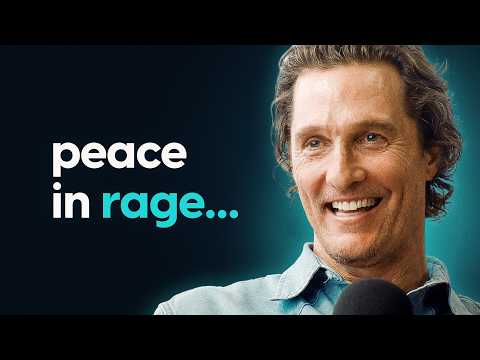
The Art of Living a Courageous Life - Matthew McConaughey (4K)
Chris Williamson (host), Matthew McConaughey (guest), Narrator, Narrator, Narrator, Matthew McConaughey (guest)
In this episode of Modern Wisdom, featuring Chris Williamson and Matthew McConaughey, The Art of Living a Courageous Life - Matthew McConaughey (4K) explores matthew McConaughey Maps Courage, Faith, and Modern Masculinity’s Makeover Matthew McConaughey joins Chris Williamson to explore belief, courage, and what it means to live a life that you can respect in the mirror. Using stories from his career, family, and new book of poems and prayers, he contrasts self-reliance with faith, nice guys with good men, and balance with the productive chaos of ambition. They dig into forgiveness, betrayal, overthinking, Me Too and masculinity, and how rage, risk, and humor can all serve the pursuit of peace and character. Throughout, McConaughey argues that cultivating belief—in God, in the future, or simply in a better self—is essential to avoiding cynicism and living courageously rather than safely.
Matthew McConaughey Maps Courage, Faith, and Modern Masculinity’s Makeover
Matthew McConaughey joins Chris Williamson to explore belief, courage, and what it means to live a life that you can respect in the mirror. Using stories from his career, family, and new book of poems and prayers, he contrasts self-reliance with faith, nice guys with good men, and balance with the productive chaos of ambition. They dig into forgiveness, betrayal, overthinking, Me Too and masculinity, and how rage, risk, and humor can all serve the pursuit of peace and character. Throughout, McConaughey argues that cultivating belief—in God, in the future, or simply in a better self—is essential to avoiding cynicism and living courageously rather than safely.
Key Takeaways
Belief is necessary even if you’re unsure what to believe in.
McConaughey argues that belief—whether in God, your kids, your future, or simply your better self—is essential; total nihilism guarantees you remain stuck where you are, while any genuine hope at least gives you a chance to move forward.
Get the full analysis with uListen AI
Forgiveness demands you stop being a repeat offender.
He stresses that asking for forgiveness isn’t a reset button; the person who offended has a responsibility to change their behavior so they don’t have to keep saying “I’m sorry” for the same thing, whether with others or with themselves.
Get the full analysis with uListen AI
Model how successful people rose, not how they live now.
Picking up Chris’s phrase, McConaughey notes that you shouldn’t copy Warren Buffett’s or any icon’s current lifestyle; instead, study what they did during the grind phase, because those early hustling behaviors are what got them where they are.
Get the full analysis with uListen AI
Courage isn’t just persistence; it’s pausing to change course.
He distinguishes between blindly “getting back up” and having the courage to stop, analyze why you keep stepping in the same pothole, and make a riskier, more authentic change—like walking away from lucrative rom-com roles or finally committing to marriage.
Get the full analysis with uListen AI
A ‘good man’ stands for and against things, not just ‘nice.’
McConaughey contrasts the agreeable, boundary-less “nice guy” with the ‘good man’ who has clear values, can say no, protects what matters, and is willing to confront or impose consequences when lines are crossed.
Get the full analysis with uListen AI
Overthinking dilutes meaning; slow your brain to add depth.
He describes listening back to his own rambling thoughts and realizing that when everything feels significant, nothing is; intentionally calming his mind leads to “half the thoughts, twice the power,” and clearer, more useful stories.
Get the full analysis with uListen AI
Risk and imbalance are required for real growth and greatness.
Through Icarus and Sisyphus metaphors, he suggests most people turn back long before the ‘sun’ is actually hot; a full life demands taking enough risks to fail and ‘sin,’ embracing emotional exposure, and accepting that peace may require rage and punk-rock energy, not just calm equanimity.
Get the full analysis with uListen AI
Notable Quotes
“If you don’t have hope or faith in something, you’re gonna remain where you are, forever.”
— Matthew McConaughey
“Forgive me, Father, for I know what I do.”
— Matthew McConaughey
“Model the rise, not the result.”
— Chris Williamson
“I wish people were more involved with themselves instead of self‑involved.”
— Matthew McConaughey
“A truly masculine man is not an oppressor, he’s not macho, he’s not chauvinist, but he’s damn sure masculine.”
— Matthew McConaughey
Questions Answered in This Episode
How do you personally distinguish between healthy self-reliance and an ego-driven refusal to rely on faith, luck, or other people?
Matthew McConaughey joins Chris Williamson to explore belief, courage, and what it means to live a life that you can respect in the mirror. ...
Get the full analysis with uListen AI
When you realize you’ve been a ‘repeat offender’ in some area of your life, what concrete steps would you take to break that cycle rather than just apologizing again?
Get the full analysis with uListen AI
In your own ambitions, where are you currently turning back at ‘45 degrees with a beanie on’ instead of flying closer to the sun?
Get the full analysis with uListen AI
How could redefining humility as “admitting you have more to learn” or vulnerability as “speaking truth despite consequences” change how you show up in relationships?
Get the full analysis with uListen AI
What does being a ‘good man’ (or good person) look like in your life right now, and where are you still just being ‘nice’ to avoid conflict or disapproval?
Get the full analysis with uListen AI
Transcript Preview
So I mentioned to you that this is Episode 1000.
Yeah.
It's been seven and a half years. Uh, we just crossed a billion views the other day as well.
Congrats, man.
And as a little surprise to you, we wanted to take you back to an environment that you probably know at least a little bit well.
Ah, Cooper's place, Alberta, Canada, where we shot it. We planted, production planted all those cornfields too. They were as far as the eye could see. And this is the road Cooper drives up on the way out, and that's that Hans Zimmer countdown, 10, 9, 8, leaving children to follow dream, tsh, lift off.
I love how quick that is, that transition from-
Yeah.
... from leaving to going.
Yeah.
I think that's so cool.
Yeah. I think it was, you know, Chris's version of tying the human drama of what would you do, a father leaving children to go do what they know they were meant to do-
Mm-hmm.
... and leave this earth, and then from there on time changes and, yeah. At the end of this shoot, when it was wrapped and it was clear we had no more shots, no more scenes on this location, my family and I were in my Airstream on the set, it's where we lived, we got, uh, um, at the edge of base camp, we turned our Airstream to face out to the mountains, and right behind us is your medical and your food, whatever you need from production, but we stayed extra few days and just hiked it and stuff, and one of the things that was fun is I let my son, probably, I don't know what Levi was, seven, eight at the time. We got in my truck and I let him drive through these cornfields as fast as he wanted to.
He replicated the...
Just, and he was going 360 all around 'cause I checked, I was like, e- they go, "No-"
Nothing to hit.
"... it's for as far as you can see."
Yeah, yeah, yeah, yeah.
"It's just like the salt flats. Hit it." And then I've got some video of that and some pictures. It was top. Yeah.
Unreal. Why do you say life rhymes?
I think Mark Twain said that first, didn't he? A version of that? History rhymes. Um, seems for as much as we go our generation's so different than the last one, and there's never been anything like this, the ebbs and the flows, the debits and the assets, and for every new technology, an old, there's a debit in an old culture and, uh, it seems like it always is right there somewhat equalized and balanced. And then, then there's a rhyme in that, that sort of ecclesiastical, you know? There's a time for everything, and for everything you reap that what you'll sow. There's a time to kill, there's a time to live. There's a time to plant, there's a time to gather. There's a time to spread. It's very Emersonian too, you know? And, uh, for every new technology, we lose an old culture, you know, and these, these things that we think are contradictory, heaven and hell, hate and love, that we think are like this, an imbalance for the truth of them, I think is (whistles) in that third eye where they overlap, and they all do overlap. They all sort of balance themselves out, and I don't know how much new under the sun we actually are doing. I think we call it different names. I think we change the labels. I think you get some things that are extra strength and some things that are unleaded.
Install uListen to search the full transcript and get AI-powered insights
Get Full TranscriptGet more from every podcast
AI summaries, searchable transcripts, and fact-checking. Free forever.
Add to Chrome