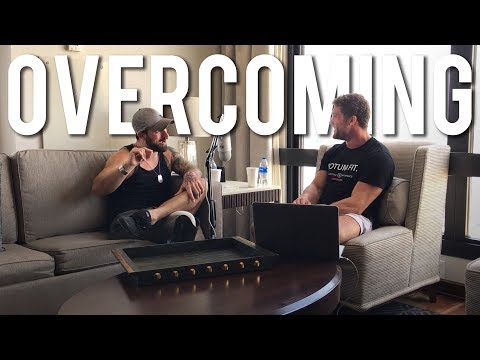
Overcoming War, PTSD & Elective Amputation | BT Urruela
Chris Williamson (host), BT Urruela (guest)
In this episode of Modern Wisdom, featuring Chris Williamson and BT Urruela, Overcoming War, PTSD & Elective Amputation | BT Urruela explores from Battlefield Trauma To Healing Others Through Sport And Storytelling BT Urruela recounts his journey from an abusive childhood to enlisting in the U.S. Army infantry, serving in Iraq during its deadliest year, and surviving a devastating IED attack that led to multiple surgeries, near-fatal blood loss, and eventually an elective leg amputation.
From Battlefield Trauma To Healing Others Through Sport And Storytelling
BT Urruela recounts his journey from an abusive childhood to enlisting in the U.S. Army infantry, serving in Iraq during its deadliest year, and surviving a devastating IED attack that led to multiple surgeries, near-fatal blood loss, and eventually an elective leg amputation.
He describes the brutal realities of combat, the long and painful physical rehabilitation, and the complex psychological fallout of PTSD layered on top of earlier childhood trauma.
BT explains how choosing amputation transformed his physical capabilities, enabling him to run and train again, and how reintegration into civilian life exposed the lack of community support for veterans.
He found renewed purpose by co‑founding VetSports to help veterans reintegrate through team sports and by building a second career as a romance author, supported by intensive therapies like Accelerated Resolution Therapy to process his trauma.
Key Takeaways
Processing trauma requires dedicated time and space, not just survival.
BT emphasizes that in combat you suppress grief and fear to function, but afterward you face an overwhelming backlog of unprocessed experiences that can fuel PTSD unless you deliberately create room to reflect and heal.
Get the full analysis with uListen AI
Elective amputation can sometimes improve quality of life over limb salvage.
After years dragging a non-functional, painful leg, BT chose a below‑knee amputation, which—though terrifying—ultimately restored his ability to walk, run, and train, highlighting that 'saving' a limb isn’t always the best functional outcome.
Get the full analysis with uListen AI
Reintegration support often collapses once veterans leave military medical systems.
BT notes the stark contrast between the comprehensive care at Walter Reed and the near-absence of structured support in civilian communities, which leaves many veterans isolated and vulnerable despite surviving their injuries.
Get the full analysis with uListen AI
Peer community and team-based activities are powerful tools against isolation.
Founding VetSports showed him that local, sports-focused veteran clubs recreate a sense of family, purpose, and shared mission, providing social connection and structure that significantly aid mental and emotional recovery.
Get the full analysis with uListen AI
PTSD filters all new experiences until you dismantle the underlying memories.
Through Accelerated Resolution Therapy, BT learned that traumatic events act like a mental filter coloring everything that follows; targeted therapies that reprocess these memories can reopen access to emotions like love, joy, and compassion.
Get the full analysis with uListen AI
Decisive commitment beats living in “what if” limbo.
Whether enlisting, amputating his leg, changing majors, or co-founding a nonprofit, BT’s pattern is to research deeply, choose, and fully commit—arguing that fear of hypothetical outcomes often traps people more than the hard path of a clear decision.
Get the full analysis with uListen AI
Creative work can be both expression and rehabilitation.
Returning to writing and eventually publishing romance novels gave BT a way to process emotion, reclaim an identity beyond ‘wounded veteran,’ and build a meaningful career that leverages his lived experience and creative drive.
Get the full analysis with uListen AI
Notable Quotes
“Basic training for me was life changing. I went in a boy, came out a man.”
— BT Urruela
“You spend this time in combat where you turn all those emotions off that are necessary to be human, and the only ones you really focus on are aggression and anger.”
— BT Urruela
“I’m 22 years old, I’m young, and I’m looking at these guys with prosthetics doing crazy shit and I’m like, ‘That should be me.’”
— BT Urruela
“Cutting my leg off was the best decision I ever made.”
— BT Urruela
“I don’t like living in that world of ‘what if.’ When you make that decision, stick with it. Commit to it.”
— BT Urruela
Questions Answered in This Episode
How can civilian communities practically replicate some of the support structures veterans receive at military medical centers like Walter Reed?
BT Urruela recounts his journey from an abusive childhood to enlisting in the U. ...
Get the full analysis with uListen AI
In what ways could healthcare systems better guide patients through profound choices like elective amputation, including long‑term quality-of-life outcomes?
He describes the brutal realities of combat, the long and painful physical rehabilitation, and the complex psychological fallout of PTSD layered on top of earlier childhood trauma.
Get the full analysis with uListen AI
How might therapies like Accelerated Resolution Therapy be adapted or scaled to help non-military trauma survivors who also experience ‘filtered’ lives through past events?
BT explains how choosing amputation transformed his physical capabilities, enabling him to run and train again, and how reintegration into civilian life exposed the lack of community support for veterans.
Get the full analysis with uListen AI
What are the risks and rewards of turning one’s trauma into public storytelling—through speeches, nonprofits, or books—and how do you protect yourself while doing it?
He found renewed purpose by co‑founding VetSports to help veterans reintegrate through team sports and by building a second career as a romance author, supported by intensive therapies like Accelerated Resolution Therapy to process his trauma.
Get the full analysis with uListen AI
How can other countries learn from or partner with initiatives like VetSports to improve reintegration for their own wounded service members?
Get the full analysis with uListen AI
Transcript Preview
(music plays) BT, man.
Yes.
Thank you very much for coming on. I, I really appreciate it.
My pleasure, Chris. Absolutely.
Um, it's probably been two years since I've wanted to get you to sit down and, and have a discussion. So-
And here we are. (laughs)
Here we are, in the same, in the same hotel, on the same week.
I know, right?
Um, bit of poetic justice there, right?
Yes.
So yeah, I, I got to hear you, um... I turned up late. My luggage arrived a day late. I had to run upstairs and come downstairs to this black tie ball thing that we had two years ago here. And then kind of burst into the room and sat down as this guy got up and stood up, and it was you, and you were about to give this big speech. And I was, like, totally unprepared, like wholly unprepared.
(laughs)
And I guess, like... 'Cause that was just after you'd done your TV thing as well, right?
Yep. Mm-hmm.
And so I... Your notoriety was probably riding moderately high and then, uh, being in this community of authors, everyone would have had an idea of what was gonna be said. And then you just unloaded this story-
Yeah.
And I was like, totally... You know, like s- you... Someone racks a bar with weights that you don't know what it is, you step underneath it and you're like, "Oh my God, this is really fucking heavy."
Yeah, "What did I do?" (laughs)
"Yeah... No, no, no, too much, too much." And, uh, yeah, man, I got, I got blown away by that.
Well, and the weird part was that at that part two years ago, you know, I had told my story w- with Vet Sports I had co-founded in 2012, so telling my story had become a thing over the years. But by that point within the community, it hadn't been a thing yet, you know?
Okay.
People knew the basis of my story. They knew I was a combat wounded veteran, stuff like that. But they never knew the eccentricities of my entire life and so that's what I wanted to do with that speech, was just kind of lay it all out there.
Mm-hmm.
And then kind of just give them the whole narrative, and...
How, how different does it feel giving the speech to the industry that you're in now, which is authors, versus the industry that you were in or that you, you're associated with, which is veterans?
I... Well, so that's actually different than what I usually do. I don't talk to a lot of veterans, unfortunately. I talk to veterans, but it's more c- c- conversationally.
Got you.
It's not giving them, you know, a speech or whatever.
Yeah.
So the difference is, where I'm at is, that speech was for my peers in the romance community, right?
Install uListen to search the full transcript and get AI-powered insights
Get Full TranscriptGet more from every podcast
AI summaries, searchable transcripts, and fact-checking. Free forever.
Add to Chrome