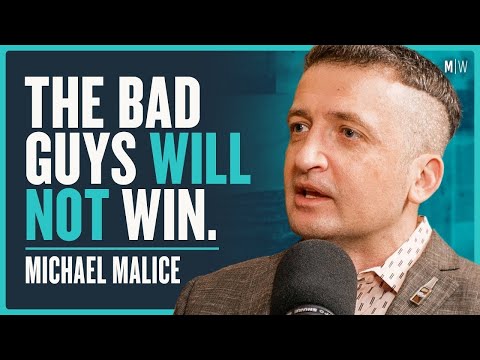
Why You Should Take The White Pill - Michael Malice
Michael Malice (guest), Chris Williamson (host)
In this episode of Modern Wisdom, featuring Michael Malice and Chris Williamson, Why You Should Take The White Pill - Michael Malice explores from Soviet Nightmares To White-Pill Hope In Dark Times Chris Williamson interviews Michael Malice about his book *The White Pill*, using the horrors of Soviet communism to argue against cynicism and for realistic hope. Malice explains why the Cold War and communist atrocities are strangely neglected in modern memory, and details how totalitarian systems pervaded every aspect of life, from famine to secret police to neighbors informing on each other. They explore the nature of evil, the limits of rationalism, and how ideological experiments turned entire populations into guinea pigs. Despite the darkness, the conversation highlights stunning moments of courage, resistance, and moral restraint—culminating in the peaceful collapse of the Soviet system as the core "white pill" of the book.
From Soviet Nightmares To White-Pill Hope In Dark Times
Chris Williamson interviews Michael Malice about his book *The White Pill*, using the horrors of Soviet communism to argue against cynicism and for realistic hope. Malice explains why the Cold War and communist atrocities are strangely neglected in modern memory, and details how totalitarian systems pervaded every aspect of life, from famine to secret police to neighbors informing on each other. They explore the nature of evil, the limits of rationalism, and how ideological experiments turned entire populations into guinea pigs. Despite the darkness, the conversation highlights stunning moments of courage, resistance, and moral restraint—culminating in the peaceful collapse of the Soviet system as the core "white pill" of the book.
Key Takeaways
Cynicism is intellectually weak because a single genuine counter-example disproves it.
Malice argues that the stance that “everything sucks” collapses as soon as you admit that one book, film, relationship, or life improvement was genuinely worthwhile—revealing cynicism as a defensive emotional posture masquerading as realism.
Get the full analysis with uListen AI
Totalitarianism is not just harsh laws; it’s total life saturation.
In the Soviet sphere, politics infiltrated every movie, song, job, friendship, and private conversation, with constant fear of surveillance and denunciation—far beyond the sporadic culture-war frictions in contemporary Western democracies.
Get the full analysis with uListen AI
Central planning fails not only morally but informationally.
Without market prices, planners cannot know real demand or relative scarcity, so they misallocate resources catastrophically—a structural flaw that helps explain chronic shortages and famines under communism.
Get the full analysis with uListen AI
Evil often looks ordinary and hides inside systems, not caricatures.
From Stasi informants who volunteered to snitch, to Western journalists denying famines for status, much of the damage came from mundane people fitting into incentives and hierarchies, not just cartoonish dictators.
Get the full analysis with uListen AI
History shows that brutal regimes can collapse far faster than expected.
The Berlin Wall’s fall and the rapid unraveling of the Eastern Bloc—often without large-scale massacres—demonstrate that seemingly permanent systems can suddenly give way when internal contradictions and moral limits are reached.
Get the full analysis with uListen AI
Moral restraint by powerful individuals can decisively shape history.
Gorbachev’s repeated refusals to “send in the tanks,” despite intense pressure and personal risk, illustrate how leaders choosing not to use violence can prevent bloodbaths and open paths to peaceful change.
Get the full analysis with uListen AI
Remembering complex, inconvenient history is a safeguard against repetition.
Malice contends that the relative silence around the Cold War and Soviet crimes leaves societies vulnerable to repeating ideological experiments; studying these stories equips people to recognize and resist similar patterns.
Get the full analysis with uListen AI
Notable Quotes
““Why is it that the bad guys always get what they want? What, I can’t get what I want once?””
— Michael Malice
““It’s almost impossible to convey to a free people what it’s like to live in a totalitarian dictatorship.””
— Ayn Rand (quoted by Michael Malice)
““Hope doesn’t mean nothing bad happens. Hope doesn’t mean the bad guys aren’t really that bad.””
— Michael Malice
““You don’t need another Stalin; the system itself selects for people like Stalin.””
— Paraphrased idea from Michael Malice
““It is possible that those of us who fight for the dignity of mankind will lose our fight. It is not possible that we must lose our fight.””
— Michael Malice (final line of *The White Pill*)
Questions Answered in This Episode
How accurate is Malice’s portrayal of Soviet life compared to mainstream academic histories of the USSR?
Chris Williamson interviews Michael Malice about his book *The White Pill*, using the horrors of Soviet communism to argue against cynicism and for realistic hope. ...
Get the full analysis with uListen AI
What psychological mechanisms make people volunteer as informants or propagandists within oppressive systems?
Get the full analysis with uListen AI
Could contemporary Western institutions be drifting toward softer forms of the same totalizing control Malice describes, or are the differences decisive?
Get the full analysis with uListen AI
To what extent did individual moral choices—by Gorbachev, generals, or ordinary citizens—versus structural economic failure drive the Soviet collapse?
Get the full analysis with uListen AI
How can someone practically cultivate ‘white pill’ hope without sliding into naïveté or downplaying genuine threats?
Get the full analysis with uListen AI
Transcript Preview
We can't imagine what it's like as Westerners to live in a country where every aspect of your life has to be run through a politically correct filter. People here complain about wokeism or they hate Trump. And we can sit here and talk about how much we hate Trump or we hate wokeism, whatever, and there's no consequences. But to live in a country where even your friends are turning and spying on you, and you have to watch what you say, and at work, everything's in this context, in every movie, every song, every TV show, every newspaper, how it encompasses and affects you, we can't wrap our heads around it. (wind blows)
Michael Malice, welcome to the show.
I'm so nervous.
Why?
Kidding, you idiot. (laughs)
Is it... is, is it because of all of the cameras and lights?
(laughs) Yeah, yes.
I'll be gentle with you. (laughs)
(laughs) I don't want gentle.
Uh, yeah, I've... I've heard that. So, uh, you were about to have an argument with me, or you'd planned to have a potential argument with me.
No, no, I had an imaginary argument.
Okay.
So, do you ever get imaginary arguments with your friends?
I fantasize about them all the time.
(laughs) Right.
Yeah, yeah, yeah, yeah.
So this is the imaginary argument. I've been working on this book as long as we've been friends, uh, two and a half years, as you would say. And you texted me over the weekend about Lewis Ling, right? And he's chapter two.
Mm-hmm.
And I'm like, "This f-" Can I curse?
Curse away.
"This Brit (laughs) this bloody Brit."
(laughs) That's the worst word that you could have used.
(laughs) This... Well, I could have called you an Irishman.
Yeah.
"This bloody Brit has had all this time to read this book. He's not gonna have it done for the interview. He's just gonna talk about it cursorily when he knows how much I worked on it-"
Mm-hmm.
"... and how much it meant to me, and how much I wanted to hear his perspective as an Englishman." 'Cause, um, Lady Thatcher is on the cover and she's a main figure in the book.
Mm-hmm.
And I was all prepared to come in huffing and puffing, and-
I'm afraid-
... Chris, Chris did his homework.
I'm afraid that there's nothing for you to huff and puff about. So that was-
That's not true. (laughs)
That was resurfaced by Readwise, which is a highlighting app.
Oh, okay.
So it had given it back to me, because it's a relatively new recent highlight. Now, the Lewis Ling thing, it turns out I actually did miss him because he was on the front cover of a previous book of yours.
Yes.
Install uListen to search the full transcript and get AI-powered insights
Get Full TranscriptGet more from every podcast
AI summaries, searchable transcripts, and fact-checking. Free forever.
Add to Chrome