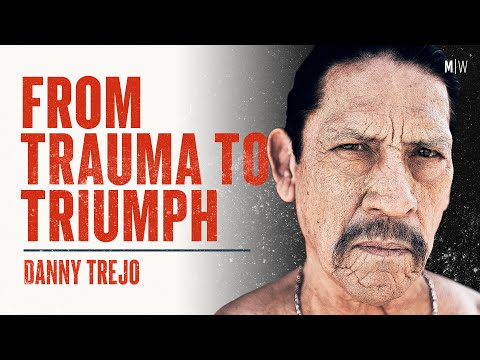
The Most Killed Man In Hollywood - Danny Trejo | Modern Wisdom Podcast 347
Danny Trejo (guest), Chris Williamson (host)
In this episode of Modern Wisdom, featuring Danny Trejo and Chris Williamson, The Most Killed Man In Hollywood - Danny Trejo | Modern Wisdom Podcast 347 explores from San Quentin to Stardom: Danny Trejo’s Redemption in Hollywood Danny Trejo recounts his journey from violent crime, addiction, and multiple stints in some of America’s toughest prisons to becoming one of Hollywood’s most recognizable tough-guy actors. He explains how prison culture, near-death experiences, and facing the gas chamber reshaped his understanding of violence, dignity, and faith. Central to his transformation are 12-step recovery programs, a spiritual commitment to helping others, and a refusal to join prison gangs despite heavy influence. The conversation also explores his unconventional entry into acting, his many on-screen deaths, and how he now channels his past into positive work in film, music, food, and community support.
From San Quentin to Stardom: Danny Trejo’s Redemption in Hollywood
Danny Trejo recounts his journey from violent crime, addiction, and multiple stints in some of America’s toughest prisons to becoming one of Hollywood’s most recognizable tough-guy actors. He explains how prison culture, near-death experiences, and facing the gas chamber reshaped his understanding of violence, dignity, and faith. Central to his transformation are 12-step recovery programs, a spiritual commitment to helping others, and a refusal to join prison gangs despite heavy influence. The conversation also explores his unconventional entry into acting, his many on-screen deaths, and how he now channels his past into positive work in film, music, food, and community support.
Key Takeaways
Understanding the true cost of violence changes how you handle conflict.
Trejo explains that in prison the ‘bottom line’ of an argument is often murder, so he avoids arguments entirely, recognizing that ego battles can easily escalate into life-or-death situations.
Get the full analysis with uListen AI
Faith plus structure is more effective than willpower alone for recovery.
He emphasizes that his 53 years of sobriety were only possible through ongoing participation in 12-step programs and community support, not just a private promise to God or sheer determination.
Get the full analysis with uListen AI
Refusing to join destructive groups can literally save your life.
Following his uncle’s advice never to join prison gangs, Trejo avoided long-term entanglement with organizations like the Mexican Mafia, which he says often amount to dedicating your life to incarceration.
Get the full analysis with uListen AI
Your worst experiences can become your best professional training.
Trejo’s authentic prison background and real-life robberies, fights, and toughness became the ‘character study’ that made him invaluable on set, allowing him to improvise believable dialogue and behavior that directors loved.
Get the full analysis with uListen AI
Serve others first, and opportunities tend to follow.
He repeatedly notes that every good thing in his life—from getting his first movie job while helping a sponsee, to later successes—came as a direct result of helping someone else rather than chasing the benefit for himself.
Get the full analysis with uListen AI
Ego and resentment are dangerous, even after you “fix” the surface problem.
Trejo warns that people who quit drugs without dealing with underlying anger and resentment stay trapped; he likens resentment to drinking poison and expecting the other person to die, stressing the importance of emotional work.
Get the full analysis with uListen AI
Staying grounded in success requires seeing yourself as a worker, not a star.
Mentor Eddie Bunker taught him that the world can see you as a movie star but you can’t believe your own hype; Trejo’s rule is to leave every situation better than he found it, rather than chasing adoration.
Get the full analysis with uListen AI
Notable Quotes
“Everything good that has ever happened to me has happened as a direct result of helping someone else.”
— Danny Trejo
“I’ve been on God’s time since 1968… this is extra time.”
— Danny Trejo
“The bottom line to an argument is a murder.”
— Danny Trejo
“Resentment is like me taking poison hoping you die.”
— Danny Trejo
“The first half of your life was a character study.”
— Eddie Bunker (as recounted by Danny Trejo)
Questions Answered in This Episode
How did nearly facing the gas chamber permanently change Trejo’s view of life, dignity, and faith?
Danny Trejo recounts his journey from violent crime, addiction, and multiple stints in some of America’s toughest prisons to becoming one of Hollywood’s most recognizable tough-guy actors. ...
Get the full analysis with uListen AI
What specific practices from 12-step programs does he still rely on after more than 50 years clean?
Get the full analysis with uListen AI
How does Trejo balance using his violent past for authentic roles without glorifying the lifestyle he escaped?
Get the full analysis with uListen AI
In what ways does he maintain respect simultaneously from criminal circles and Hollywood elites, and where do those worlds clash?
Get the full analysis with uListen AI
How can someone without such extreme experiences apply Trejo’s principles on service, humility, and avoiding resentment in everyday life?
Get the full analysis with uListen AI
Transcript Preview
I remember not wanting to die screaming and yelling and begging and peeing my pants. I said, "Dear Heavenly Father, just let me die with dignity. I'll say Your name every day and I will do whatever I can for my fellow inmate." And I said, "Inmate?" I never thought I was getting out of jail. And by the grace of God, he said, "Okay, punk, I'm gonna give you a chance here."
Danny Bloody Trejo in the building. How are you doing, man?
Great. Thank you.
Pleasure to have you here. Are you the most killed actor in Hollywood history?
Yeah, they've got me. Yeah, I'm at... I, I, I was... The last time I counted, I was 68. I think I'm about 90 now.
(laughs) But it's kind of ironic, right? 'Cause you've been killed on screen a lot, but somehow managed to make it out of your life so far alive.
Yeah. (laughs) That, that's what everybody says. (laughs) They didn't... I remember when the pandemic, everybody was scared of the... Not the pandemic. Everybody was scared of the millennium. "Oh, the millennium 2000. The millennium, the millennium." And they asked me, "What do you think about the millennium?" I said, "I wasn't get... I wasn't supposed to get out of the '60s. I don't care." (laughs)
(laughs)
I'm on, I'm on God's time. I've been on God's time since 1968, you know?
Borrowed time, man. Yeah, this is extra time. It's weird, right? Because most people's impression of what, like a tough guy or a, a hard lad or a guy from the streets is, it comes from movies, you know? Not everybody gets to see-
Yeah.
... those people in the flesh, but then most of the people that play those roles aren't from the streets.
(laughs)
So it's different for you 'cause you've sort of earned your stripes. You are, and then you get to display it as well, right?
You know, it's really funny, uh, what you just said. When I was trying to write my book, I, I, I kept getting people that were, like, English literature majors. They just... It... They would change a few words and it didn't sound, sound like me. It sounded like a, like a, like an English lesson. And so, so, uh, uh, Donald Logue, who is a friend of mine... We've been fri- friends since 1991. And, uh, uh, he was, he was raised in Calexico, uh, uh, right by the Mexican border, okay? His, his, his, uh, his town crosses the Mexican border, you know? And so, so, uh, uh, uh, it was like when we started talking as friends, he not only knew that... He was, like, a, an English literature major, but he, he knew the streets. In fact, his whole town had nothing but alleys. So, so it was like we understood each other. And we started writing it, and it just flowed. I gave it to my, uh, kids' mom, Maeve, (clears throat) "Read this," and she goes, "It sounds like I'm talking to you." And I thought, "Okay, cool. Then that's what we wanted," yeah.
Install uListen to search the full transcript and get AI-powered insights
Get Full TranscriptGet more from every podcast
AI summaries, searchable transcripts, and fact-checking. Free forever.
Add to Chrome