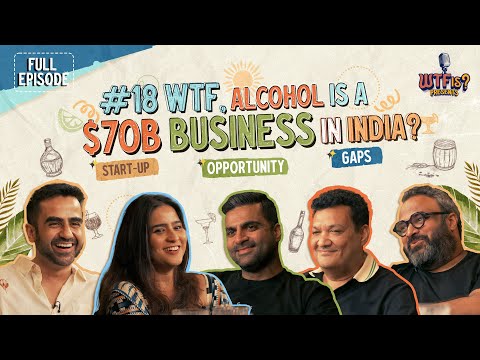
Ep #18 | WTF, Alcohol is a $70B Business in India? | Nikhil Kamath explores Gaps & Opportunities
Nikhil Kamath (host), Minakshi Singh (guest), Shuchir Suri (guest), Suraj Shenai (guest), Suraj Shenai (guest), Suraj Shenai (guest), Nikhil Kamath (host), Abhishek Khaitan (guest), Abhishek Khaitan (guest), Nikhil Kamath (host), Nikhil Kamath (host), Nikhil Kamath (host), Shuchir Suri (guest)
In this episode of Nikhil Kamath, featuring Nikhil Kamath and Minakshi Singh, Ep #18 | WTF, Alcohol is a $70B Business in India? | Nikhil Kamath explores Gaps & Opportunities explores inside India’s $70B alcohol ecosystem: bars, brands, regulation, growth bets The episode brings together four insiders—Minakshi Singh (SideCar/Cocktails & Dreams), Suraj Shenai (Goa Brewing Co.), Shuchir Suri (Gin Explorers Club/Anthem), and Abhishek Khaitan (Radico Khaitan)—to explain how India’s alcohol market works and where entrepreneurs can build careers or companies.
Inside India’s $70B alcohol ecosystem: bars, brands, regulation, growth bets
The episode brings together four insiders—Minakshi Singh (SideCar/Cocktails & Dreams), Suraj Shenai (Goa Brewing Co.), Shuchir Suri (Gin Explorers Club/Anthem), and Abhishek Khaitan (Radico Khaitan)—to explain how India’s alcohol market works and where entrepreneurs can build careers or companies.
They break down India’s unusual consumption skew toward hard liquor (and small “nip/pauwa” pack sizes), the role of premiumisation, and why brands must win on product quality, packaging, and on-ground advocacy rather than pure ad spend.
A major theme is execution under fragmented state-wise excise rules: listing fees, label registration, pricing constraints, distribution layers (primary/secondary/tertiary), and why Goa is often the easiest launchpad.
They close by discussing celebrity/influencer effectiveness, RTDs and mixers, import-duty dynamics, and a commitment to pool seed capital for a young founder in the alcobev ecosystem.
Key Takeaways
India is over-indexed on hard liquor because of time-and-price-driven drinking occasions.
The panel links urban stress and short “break windows” after work to fast consumption patterns—especially 180ml nips at ahatas/permit rooms—making spirits disproportionately large versus beer in India compared with similar-climate markets like Vietnam.
Get the full analysis with uListen AI
To build an alcohol brand, obsess over tertiary sale—not just pushing inventory into the channel.
Abhishek emphasizes that primary sales (to distributors) and secondary (to retail/on-trade) can look good on paper, but brands die if consumers don’t pull the product at the outlet level; payment and repeat are tied to tertiary offtake.
Get the full analysis with uListen AI
Co-packing is the practical entry route; ₹10 crore rarely builds a distillery.
Multiple speakers note ₹10 crore is insufficient for a distillery, while co-packers plus a consultant/master distiller is the common path—sometimes even placing your own still at a licensed facility to reduce licensing burden.
Get the full analysis with uListen AI
Start in ‘low-friction’ states (often Goa) before attacking high-cost markets like Mumbai/Delhi.
Goa is described as an open market with easier listing and distribution setup; Mumbai is repeatedly called the most expensive due to entry barriers, K-form/taxes, limited shelf space, and higher activation costs.
Get the full analysis with uListen AI
Premiumisation works, but only when supported by authentic differentiation (product + story + packaging).
Radico’s playbook (design-led bottles, cask stories, Indian provenance) and SideCar’s cocktail-led demand illustrate that higher prices can succeed if the consumer can ‘feel’ the value—otherwise premium pricing becomes a credibility problem.
Get the full analysis with uListen AI
In India’s ‘dark market’ (ad restrictions), experiences and advocacy are your marketing engine.
Because direct advertising is constrained, bars, festivals (e. ...
Get the full analysis with uListen AI
Category opportunities exist, but winning requires matching India’s palate and purchasing context.
Ideas surfaced include: upgrading premium beer drinkers (KF → Bud/Heineken → ‘destination’ quality), an India-made bourbon-style whiskey for cocktails (₹1200–1400), premium/flavored rum as the ‘next gin’ for bartenders, and indigenous/heritage spirits (e. ...
Get the full analysis with uListen AI
Notable Quotes
“Women are not legally allowed to serve… in certain states in India.”
— Minakshi Singh
“We don’t sponsor… bars keep our product for the product quality, but we don’t pay for entry into any bar.”
— Suraj Shenai
“To get the first 10,000 consumer is the toughest.”
— Abhishek Khaitan
“In alcohol, you cannot push sales. You have to win sales.”
— Abhishek Khaitan
“Make a friend a day… [go] bar to bar… offer a little sampler.”
— Suraj Shenai
Questions Answered in This Episode
Minakshi mentioned women can’t legally bartend in some states—exactly which states and what statutes/rules govern that today?
The episode brings together four insiders—Minakshi Singh (SideCar/Cocktails & Dreams), Suraj Shenai (Goa Brewing Co. ...
Get the full analysis with uListen AI
Can you map the typical end-to-end cost stack for a new gin/whiskey launch in one state (listing fee, label registration, excise, distributor margin, retailer margin, promotions) using real example numbers?
They break down India’s unusual consumption skew toward hard liquor (and small “nip/pauwa” pack sizes), the role of premiumisation, and why brands must win on product quality, packaging, and on-ground advocacy rather than pure ad spend.
Get the full analysis with uListen AI
Suraj, you said ‘category building is absolutely not possible in beer’—what would have to change (distribution, refrigeration, pricing, consumer education) to make category creation viable?
A major theme is execution under fragmented state-wise excise rules: listing fees, label registration, pricing constraints, distribution layers (primary/secondary/tertiary), and why Goa is often the easiest launchpad.
Get the full analysis with uListen AI
Abhishek, you stressed tertiary offtake—what are the best practical ways for a startup to measure outlet-level repeat when distributors control much of the reporting?
They close by discussing celebrity/influencer effectiveness, RTDs and mixers, import-duty dynamics, and a commitment to pool seed capital for a young founder in the alcobev ecosystem.
Get the full analysis with uListen AI
Shuchir’s ‘1-9-90’ activation framework is compelling—what would a sample 12-month calendar look like for launching a ₹1,200 bourbon-style Indian whiskey in Delhi+Gurgaon?
Get the full analysis with uListen AI
Transcript Preview
the intent is to find young people out there and tell them how they can get a job in owning a bar, starting a liquor company, working in a liquor company, doing advertising for liquor companies, because you guys are experts in this. [upbeat music] Okay, you guys ready? [music] Welcome, each and every one of you. Uh, thank you for coming. The very first thing we do when we begin this off is introduce ourselves. Uh, I know Abhishek very well already, but I haven't spent time with the other three of you. So maybe you start by giving us five minutes about yourself, starting with you.
Okay. We start?
Yeah, go, Meenakshi.
Amazing. So, um, okay, maybe start from the beginning. Um-
You're a bar owner-
Yeah
... so you're already a very cool person.
Yeah, I know that.
Like I said, I will pull your leg. Feel free to-
No, I'll do the, I'll do the same [chuckles] -
Yeah. [chuckles]
... trust me. We need some alcohol, and then we'll start. No, so yeah, so I, I started, um, my journey into this industry, uh, right from hotel management days. So I did my hotel management from IH&M Pusa, New Delhi. Um, and from there on, uh, uh, in the second year of college, just like most of us, we needed pocket money for the pizza and beers. [chuckles] And so we-
Where did you do college?
IH&M Pusa, New Delhi. So, uh, and finished my schooling and college from Delhi.
Mm.
And since then, I've been in Delhi.
Mm. Okay, so you went to college, then?
Uh, yeah, so, uh, I started bartending in the second year of college as a, as a, almost like a, you know, there's something called ODCs, which are out- outdoor catering.
Do you have pictures from back then?
Yeah, yeah.
Yeah.
Of course.
Meghna, we should put that up. Okay, then? [chuckles]
Okay, so that was my first experience behind the bar.
Mm.
Um, I, I also think that was also a very big turning point for me. I was really lucky to have experienced really good, uh, s- you know, space of work. For the first time when you go, um, it was, it was not a pa-- it was just a part-time job, uh, and, you know, you were just doing it for fun, mostly for money. And, uh, when I went behind the bar, I started really enjoying it, and I, I felt like... I don't know if there's a word for this. I really felt like this is my calling, and I got-
What element of bartending?
Actual bartending. So I loved making drinks. I loved serving drinks. I loved the part of hosting and talking to new people, getting to know their stories.
Was it the social element more-
Yeah
... or was it the mixing of the drink?
Absolutely. Absolutely. So bartending is a mix of many things. Of course, the technical art of it, of making drinks is, is, is primary, but after that, it's layer on layer on your personality and how sociable you are and how open you are to knowing new people, talking to strangers, and how, you know, what your personality is. And I think bartending can bring that personality out in you. It's very-- it's a very good, comfortable space because you are also already in a space of enjoyment. You're mostly there to relax, so you also come with your guards down a little bit. So I think from a consumer point of view, it works really well, and I had a great, uh, time in that second and third year of college.
Install uListen to search the full transcript and get AI-powered insights
Get Full TranscriptGet more from every podcast
AI summaries, searchable transcripts, and fact-checking. Free forever.
Add to Chrome