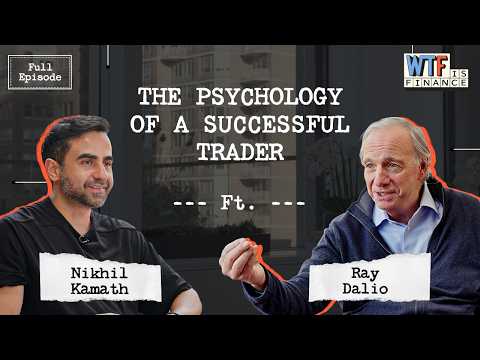
WTF Is Wealth? Ray Dalio Breaks It Down w/ Nikhil Kamath | WTF is Finance Ep 2
Ray Dalio (guest), Nikhil Kamath (host)
In this episode of Nikhil Kamath, featuring Ray Dalio and Nikhil Kamath, WTF Is Wealth? Ray Dalio Breaks It Down w/ Nikhil Kamath | WTF is Finance Ep 2 explores ray Dalio explains wealth, money, bubbles, and investing for Indians Ray Dalio traces his early market education—from caddying and a lucky first stock win to learning leverage via futures—and uses those experiences to stress rules-based decision-making over emotion.
Ray Dalio explains wealth, money, bubbles, and investing for Indians
Ray Dalio traces his early market education—from caddying and a lucky first stock win to learning leverage via futures—and uses those experiences to stress rules-based decision-making over emotion.
He explains money as both a medium of exchange and a store of wealth, contrasting fiat “promises” (debt) with assets like gold that aren’t someone else’s liability, and warns about the historical “interest-rate trap” of preferring promises over the real thing.
Dalio frames portfolio choices around total return (yield + price change), liquidity, leverage, and diversification—arguing most people should start with a diversified portfolio assuming they can’t beat or time markets, with ~5–15% in gold/alternative money as a diversifier.
He distinguishes “wealth” from “money” to explain bubbles (paper wealth can’t be spent unless converted to money) and ties this to debt cycles, political conflict, changing world order, climate shocks, and technology—ending with career advice: play a game you love, learn by proximity, and invest first in yourself.
Key Takeaways
Early luck reinforces market participation—don’t confuse it with skill.
Dalio and Kamath both describe first trades that tripled, creating “positive reinforcement. ...
Get the full analysis with uListen AI
Write decision rules to reduce emotion-driven errors.
Dalio says markets are “unemotional” while people aren’t, so he learned to write down criteria for decisions and test how those rules would have worked historically. ...
Get the full analysis with uListen AI
Leverage is continuous risk, not a yes/no choice—manage it like an engineering problem.
He was drawn to futures because margin creates leverage, but emphasizes leverage decisions should be framed as spreads between higher- and lower-returning assets. ...
Get the full analysis with uListen AI
Money’s hidden fragility is that most ‘money’ is someone else’s promise.
Dalio distinguishes gold (not a liability) from fiat and credit instruments that depend on repayment and policy. ...
Get the full analysis with uListen AI
The ‘interest-rate trap’ recurs across centuries: promises seem superior until convertibility breaks.
Dalio describes the temptation to hold claims on gold (or today, debt money) because they pay interest—until the system can’t meet redemptions. ...
Get the full analysis with uListen AI
Compare all assets on total return and adjust for liquidity and taxation realities.
Dalio evaluates assets as yield + price change, with illiquid assets needing higher expected return to compensate for lack of flexibility. ...
Get the full analysis with uListen AI
For most people, start with diversification assuming you can’t beat or time markets.
Dalio separates strategic asset allocation (robust diversified mix) from tactical market timing (hard, responsibility-laden). ...
Get the full analysis with uListen AI
Bitcoin is ‘a form of money’ but has adoption and control risks; stablecoins are mainly transactional.
Dalio credits Bitcoin’s limited supply and “perception as money,” but worries about traceability, government interference, and technical/security risks—making it less attractive than gold to him. ...
Get the full analysis with uListen AI
Bubbles form when measured ‘wealth’ rises without enough money to cash out.
Dalio explains how headline wealth can be created by marking assets at optimistic valuations (e. ...
Get the full analysis with uListen AI
Use the ‘five big forces’ as a macro map; technology competition is the key arena now.
Dalio’s framework: (1) debt/money markets, (2) internal politics, (3) geopolitical order, (4) climate/nature shocks, (5) technology. ...
Get the full analysis with uListen AI
For a 25-year-old, the highest-return investment is often self-investment and game selection.
Dalio’s practical answer to ‘where would you invest $100? ...
Get the full analysis with uListen AI
Notable Quotes
“I think it's unemotional. We are emotional.”
— Ray Dalio
“Gold is the only money that you can have, and nobody has to give you anything to have it.”
— Ray Dalio
“That's the great trick through history... hold the promise to get the gold and get an interest rate... And that was the trap.”
— Ray Dalio
“Wealth isn't worth anything unless you can convert it into money and spend it... that's how bubbles are created.”
— Ray Dalio
“Droughts, floods, and pandemics have killed more people than wars and changed more orders.”
— Ray Dalio
Questions Answered in This Episode
When you say “money is debt and debt is money,” what specific instruments count as ‘money’ in your framework—bank deposits, T-bills, repos, stablecoins?
Ray Dalio traces his early market education—from caddying and a lucky first stock win to learning leverage via futures—and uses those experiences to stress rules-based decision-making over emotion.
Get the full analysis with uListen AI
You mentioned the US wealth-to-money ratio is ~8.5:1 and equities ~3:1. How exactly are you defining ‘wealth’ and ‘money’ in those calculations, and what thresholds historically signal danger?
He explains money as both a medium of exchange and a store of wealth, contrasting fiat “promises” (debt) with assets like gold that aren’t someone else’s liability, and warns about the historical “interest-rate trap” of preferring promises over the real thing.
Get the full analysis with uListen AI
If gold’s long-run real return is ~1.2%, what conditions justify being at the high end (15%) vs low end (5%) of your suggested allocation?
Dalio frames portfolio choices around total return (yield + price change), liquidity, leverage, and diversification—arguing most people should start with a diversified portfolio assuming they can’t beat or time markets, with ~5–15% in gold/alternative money as a diversifier.
Get the full analysis with uListen AI
You argue Bitcoin can be monitored and interfered with. Do you see meaningful differences in censorship resistance between self-custody Bitcoin, ETFs, and other chains?
He distinguishes “wealth” from “money” to explain bubbles (paper wealth can’t be spent unless converted to money) and ties this to debt cycles, political conflict, changing world order, climate shocks, and technology—ending with career advice: play a game you love, learn by proximity, and invest first in yourself.
Get the full analysis with uListen AI
What would change your mind about stablecoins becoming a true store of wealth—interest-bearing models, full-reserve transparency, or sovereign issuance?
Get the full analysis with uListen AI
Transcript Preview
[upbeat music] [laughing]
... Hello, everyone!
Hello. [laughing]
Amazing. I've created a leading indicators of what countries have their ingredients project the next ten years' growth rate. India is best. I think India, over the next ten years, has all the ingredients to really be the strongest growth rate and, and an improvement.
[upbeat music] A youngster in India who's twenty-five years old, how does he make money?
Uh, two things I'd suggest. First, play the game. Find a game that you love, and then be around people who are pros at playing the game so you can chat about it. That's a good path.
[upbeat music] How do you view crypto and the world of Bitcoin? Or even, like, stablecoin. Tell me this, if you were to back-
You've gotta give me one question at a time. [laughing]
[laughing] Okay, let's do Bitcoin, and then we'll do stablecoin. [upbeat music] Hi, Ray. Uh, thank you for doing this. As a trader myself, I've been trading now a long time, about twenty-one years. I think there will be a lot I can learn from you, and many others back home in India, like me, can also learn from you. If I can contextualize the audience we are talking to today, they are young Indian wannabe entrepreneurs, uh, investors, wannabe traders, people who want to make a living in the stock markets, I would say between the ages of eighteen and thirty.
Wonderful.
[chuckles]
That's, that's exactly, um, the group that I would like to speak to at this stage in my life, because I've learned a lot, and I w- just wanna pass what I've learned along to those people. So thank you for allowing me to do that.
No, thank you for doing this. Everybody knows you, but if we could go through, like, the big events of your life and, very briefly, just to set context again, could you tell us how you look at your life from the very beginning, from when you were younger up until today?
Okay. Um, my dad was a jazz musician. My mom, uh, was a sort of stay-at-home mom. Uh, I was raised, and, uh, I didn't have any brothers or sisters. Um, it was a loving family. Um, it was, um, not poor, not... It was lower middle class. Um, I did jobs when I was young. Uh, I- one of those jobs was caddying for at a, at a golf course, and because I caddied at a golf course at the time when there was a stock market boom, the people I caddied with, I would have conversations with. And I took the money I earned, six dollars a bag, I carried two bags, twelve dollars for a round. When I got fifty dollars, I would put it in the stock market. And so I started, um, playing around in the stock market, much like you're describing our audience does. And, um, the first stock I bought, I bought only because it was the only company I ever heard of that was selling for less than five dollars a share, and I thought, "Well, then I can buy more shares, so if it goes up, I'll make more money," which of course, made no sense. But it was a company that, uh, was about to go bankrupt, but another company acquired it, and it tripled in value, and I thought, "This is easy." It's not easy, but I got hooked on the markets at twelve.
Install uListen to search the full transcript and get AI-powered insights
Get Full TranscriptGet more from every podcast
AI summaries, searchable transcripts, and fact-checking. Free forever.
Add to Chrome