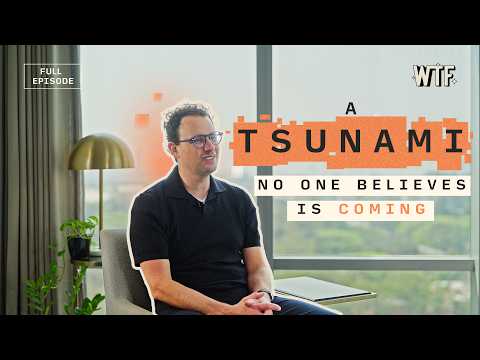
The AI Tsunami is Here & Society Isn't Ready | Dario Amodei x Nikhil Kamath | People by WTF
Nikhil Kamath (host), Dario Amodei (guest)
In this episode of Nikhil Kamath, featuring Nikhil Kamath and Dario Amodei, The AI Tsunami is Here & Society Isn't Ready | Dario Amodei x Nikhil Kamath | People by WTF explores aI’s rapid scaling brings power, risks, and readiness gaps worldwide Amodei explains AI “scaling laws” as a predictable recipe—more data, compute, and model size reliably yield higher capability across many cognitive tasks.
AI’s rapid scaling brings power, risks, and readiness gaps worldwide
Amodei explains AI “scaling laws” as a predictable recipe—more data, compute, and model size reliably yield higher capability across many cognitive tasks.
He argues society is underreacting to near-term human-level AI, likening the moment to a visible “tsunami” that people rationalize away, leaving risks insufficiently addressed.
The conversation probes trust and corporate incentives, with Amodei emphasizing judging companies by actions (governance structure, delayed releases, safety research, and pro-regulation stances) rather than rhetoric.
They explore how AI that “knows you” can become either an empowering personal assistant or a manipulative surveillance/advertising tool, making privacy and business models pivotal.
Practical implications span India’s IT/services ecosystem, youth career choices, open vs closed models, and a likely AI-driven renaissance in biotech (programmable therapies like peptides and cell therapies).
Key Takeaways
Scaling is the dominant driver of frontier AI capability.
Amodei frames scaling laws as a “chemical reaction” where data, compute, and model size combine to produce intelligence, with relatively minor additions beyond scaling.
Get the full analysis with uListen AI
Societal and governmental readiness is lagging behind technical progress.
He repeatedly stresses that human-level systems appear close while public awareness and policy action remain weak, increasing the chance of unmanaged harms.
Get the full analysis with uListen AI
Trust in AI labs should be evaluated by actions, not branding or humility narratives.
Amodei points to concrete choices—benefit-corporation structure, the Long‑Term Benefit Trust, interpretability/alignment work, and advocating regulation despite commercial downsides—as evidence-based signals.
Get the full analysis with uListen AI
Personalized AI is a fork: “angel on your shoulder” or manipulation engine.
As models infer sensitive traits from small amounts of data, the same personalization that improves guidance can enable exploitation, especially under ad-driven incentives.
Get the full analysis with uListen AI
India’s near-term opportunity is integration, enterprise deployment, and domain expertise—while preparing for deeper automation.
Amodei positions Anthropic as an enterprise partner to Indian IT/consulting firms, but acknowledges agent automation will expand, shifting moats toward relationships, implementation know-how, and other “Amdahl’s law” bottlenecks.
Get the full analysis with uListen AI
For founders, “wrappers” are fragile; moats must be domain, workflow, or regulatory depth.
He warns that thin UIs around models are easy to copy, but argues labs won’t efficiently verticalize into every regulated or specialized domain (e. ...
Get the full analysis with uListen AI
AI can de-skill users if used carelessly; critical thinking becomes more valuable, not less.
He cites evidence of de-skilling in coding depending on usage patterns and highlights a future of synthetic media where discerning truth, scams, and incentives is a core life skill.
Get the full analysis with uListen AI
Notable Quotes
“It’s as if this tsunami is coming at us… and yet people are coming up with these explanations for, ‘Oh, it’s not actually a tsunami.’”
— Dario Amodei
“The ingredients are data, compute, the size of the AI model… what you get out is intelligence.”
— Dario Amodei
“I’m at least somewhat uncomfortable with the amount of concentration of power that’s happening here… almost overnight, almost by accident.”
— Dario Amodei
“I wouldn’t look at what people say. I would look at what people do.”
— Dario Amodei
“From a relatively small amount of information, it can learn a lot about you.”
— Dario Amodei
Questions Answered in This Episode
When you say “human-level intelligence” is close, what concrete capability thresholds or evaluations would convince skeptics—especially outside benchmarks?
Amodei explains AI “scaling laws” as a predictable recipe—more data, compute, and model size reliably yield higher capability across many cognitive tasks.
Get the full analysis with uListen AI
You cited SB-53-style transparency rules; what is the minimum viable global regulatory framework that meaningfully reduces catastrophic risk without entrenching incumbents?
He argues society is underreacting to near-term human-level AI, likening the moment to a visible “tsunami” that people rationalize away, leaving risks insufficiently addressed.
Get the full analysis with uListen AI
How should users think about “connectors” (email/drive/calendar) risk—what privacy guarantees are technically enforceable versus policy promises?
The conversation probes trust and corporate incentives, with Amodei emphasizing judging companies by actions (governance structure, delayed releases, safety research, and pro-regulation stances) rather than rhetoric.
Get the full analysis with uListen AI
What are the strongest examples where interpretability has changed a safety decision (e.g., blocked a release, altered training, discovered a harmful circuit)?
They explore how AI that “knows you” can become either an empowering personal assistant or a manipulative surveillance/advertising tool, making privacy and business models pivotal.
Get the full analysis with uListen AI
For Indian IT services specifically, which workflows get automated first: QA/testing, documentation, support, integration, or client-facing consulting—and on what timeline?
Practical implications span India’s IT/services ecosystem, youth career choices, open vs closed models, and a likely AI-driven renaissance in biotech (programmable therapies like peptides and cell therapies).
Get the full analysis with uListen AI
Transcript Preview
[upbeat music] So I started playing with Claude. It's getting to that point where sometimes it surprises me by how much it knows me. I don't know if that makes sense.
It is surprising to me that we are, in my view, so close to these models reaching the level of human intelligence, and yet there doesn't seem to be a wider recognition in society of what's about to happen. It's as if this tsunami is coming at us, and, you know, it's so close, we can see it on the horizon, and yet people are coming up with these explanations for, "Oh, it's not actually a tsunami. It's just a trick of the light." Like, there hasn't been a public awareness of the risk.
[upbeat music] What is India's role in all this?
Many other companies come here as themselves, a consumer company, and they see, they see India as, as a market, right? A place to obtain consumers. We actually see things a little bit differently.
[upbeat music] What did you do before founding Anthropic?
Yeah. So I was, I was actually originally a biologist. Um, I, uh, you know, did my undergrad in physics, my, uh, PhD in biophysics, and, you know, I wanted to understand biological systems so that I could cure disease. Uh, and, uh, the, the, you know, the thing I noticed about studying biology was its incredible complexity. That, uh, you know, you know, for example, if you look at the, the protein mass spec work that I did, right? Trying to find protein biomarkers, it's, it's just really incredible how much complexity there is, right? You have a given protein, it's like, you know, the RNA gets spliced in a whole bunch of different ways, depending on where it is in the cell. Then it gets post-translationally modified, phosphorylated, complexed with a whole bunch of other proteins. And, and I was starting to despair that it was too complicated for humans to understand. And then as, as I was doing this work on biology, I noticed a lot of the early work around AlexNet, which is one of the first neural nets, like, you know, almost fifteen years ago now. Uh, and, and I said, "Wow, like, you know, AI is actually starting to work. It has some things in common with how the human brain works, but, you know, has the potential to be, be larger and scale better and learn tasks like biology. Maybe this is ultimately gonna be the solution to, uh, you know, to, to solving our problems of, of- solving our problems of biology." So, you know, I, I went to work with Andrew Ng at Baidu, then I was at Google for a year. Then I joined OpenAI a few months after it, uh, started and was, uh, you know, was, was basically led, led, um, all of research there for, for, for, for several years. But then eventually, you know, myself and a few other of the, of the employees just kind of had our own vision for, you know, how, how we wanted to, how we wanted to make AI and what we wanted the company to stand for, and so we went off and founded Anthropic.
Install uListen to search the full transcript and get AI-powered insights
Get Full TranscriptGet more from every podcast
AI summaries, searchable transcripts, and fact-checking. Free forever.
Add to Chrome