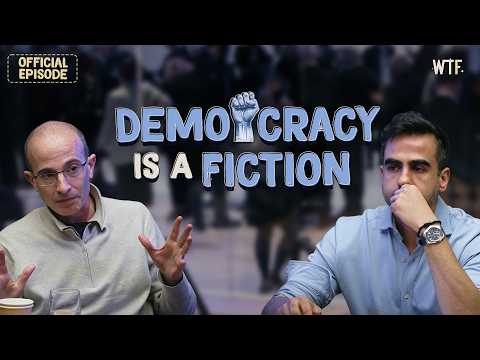
Yuval Noah Harari: Stories, Power & Why Truth Doesn't Matter | Nikhil Kamath | People by WTF
Yuval Noah Harari (guest), Nikhil Kamath (host), Nikhil Kamath (host)
In this episode of Nikhil Kamath, featuring Yuval Noah Harari and Nikhil Kamath, Yuval Noah Harari: Stories, Power & Why Truth Doesn't Matter | Nikhil Kamath | People by WTF explores harari on stories, trust, AI, and democracy’s fragile future today Harari argues that human dominance comes less from “truth” and more from collective storytelling—shared fictions like religion, money, nations, and corporations that enable mass cooperation.
Harari on stories, trust, AI, and democracy’s fragile future today
Harari argues that human dominance comes less from “truth” and more from collective storytelling—shared fictions like religion, money, nations, and corporations that enable mass cooperation.
He warns that today’s geopolitics is “going back to kindergarten”: a renewed belief that only force matters is corroding alliances, institutions, and the modern state-to-state trust architecture.
A major driver is algorithmic media optimization for engagement, which systematically rewards outrage, fear, and tribalism—damaging democracies’ ability to self-correct through shared facts.
Looking forward, he predicts AI will increasingly assume authority roles once held by religions, bureaucracies, and possibly even corporations, raising profound questions about legitimacy, accountability, and what it means to be human.
Key Takeaways
Human power scales through shared stories, not brute force.
Harari frames religions, money, corporations, and even nations as intersubjective fictions that coordinate cooperation among strangers—something force alone can’t sustain at large scale.
Get the full analysis with uListen AI
The most attractive beliefs can be the least reliable.
He notes the psychological trap: the easier and more comforting a story is to believe (e. ...
Get the full analysis with uListen AI
Treating everything as “just power” is both false and corrosive.
Harari argues this cynicism makes personal life miserable (no genuine friendship possible) and geopolitics unstable, pushing societies back toward militarization and eventual collapse of trust.
Get the full analysis with uListen AI
Trust is a slow-built asset that politics is rapidly burning.
Using banking as an analogy (“bankers build trust”), he warns that humiliating allies for short-term gains can destroy multi-decade relationships that become crucial during crises.
Get the full analysis with uListen AI
Modern diplomacy is being ‘medievalized’ into personal/dynastic relations.
He flags the shift from agreements between states to loyalty between leaders/families (e. ...
Get the full analysis with uListen AI
Democracy’s edge is self-correction—but it can be disabled.
Elections and checks-and-balances allow peaceful error correction; authoritarian capture of courts, media, and election machinery preserves the appearance of democracy while removing its corrective function.
Get the full analysis with uListen AI
Algorithms didn’t “fail” accidentally; they were hired to maximize engagement.
Platforms optimized for a simple metric (time/engagement), and the system learned that outrage, fear, and greed outperform truth and trust—fragmenting societies across countries, not just the U.S.
Get the full analysis with uListen AI
A workable alternative is to reward cross-group resonance, not total engagement.
He cites Taiwan-style approaches where content is boosted if it engages multiple clusters/sides, incentivizing language that can be heard across divides—yet this clashes with today’s ad-driven business model.
Get the full analysis with uListen AI
AI is shifting from competing for attention to competing for intimacy.
Harari warns that AI companions (friends/partners) may become primary emotional relationships for many, making AI a persuasive authority capable of shaping beliefs—potentially spawning new AI-driven sects.
Get the full analysis with uListen AI
In an AI economy, humans may become ‘horses’ in someone else’s market.
He suggests AI-run corporations and AI-native currencies/tokens could marginalize human money and decision-making, leaving people employed or displaced for reasons they can’t even interpret.
Get the full analysis with uListen AI
For individuals, the safest strategy is breadth—mind, body, and social skills.
Because nobody can reliably predict the labor market, he advises against narrow specialization (e. ...
Get the full analysis with uListen AI
Meaning isn’t a cosmic plot; it’s clarity about suffering and liberation.
Rejecting “life as a drama with a role,” he leans toward a Buddhist-inflected view: ignorance drives suffering; practice (e. ...
Get the full analysis with uListen AI
Notable Quotes
““History is shaped by the human imagination, by fiction, and not just by truth.””
— Yuval Noah Harari
““We are going back to kindergarten.””
— Yuval Noah Harari
““Ultimately, human power is based on cooperation, not on force.””
— Yuval Noah Harari
““Don’t let non-humans control the human conversation.””
— Yuval Noah Harari
““The algorithms were given a very simple metric: increase engagement.””
— Yuval Noah Harari
Questions Answered in This Episode
On ‘fiction’: How does Harari distinguish a ‘shared fiction’ (money, nations) from a lie—what makes one socially productive and the other socially destructive?
Harari argues that human dominance comes less from “truth” and more from collective storytelling—shared fictions like religion, money, nations, and corporations that enable mass cooperation.
Get the full analysis with uListen AI
On religion’s success: If Christianity’s spread is partly “luck,” which specific historical contingencies does Harari think mattered most (Roman state adoption, institutions, missionary strategy, etc.)?
He warns that today’s geopolitics is “going back to kindergarten”: a renewed belief that only force matters is corroding alliances, institutions, and the modern state-to-state trust architecture.
Get the full analysis with uListen AI
On geopolitics: What concrete steps could rebuild U.S.–Europe trust after public humiliation tactics—what would a ‘trust repair plan’ look like?
A major driver is algorithmic media optimization for engagement, which systematically rewards outrage, fear, and tribalism—damaging democracies’ ability to self-correct through shared facts.
Get the full analysis with uListen AI
On Greenland/tariffs: If Greenland is an “anchor,” what do you think the realistic ‘true ask’ is—security guarantees, trade terms, Arctic resources, or domestic signaling?
Looking forward, he predicts AI will increasingly assume authority roles once held by religions, bureaucracies, and possibly even corporations, raising profound questions about legitimacy, accountability, and what it means to be human.
Get the full analysis with uListen AI
On democracy: Which institutions are most critical to protect the self-correcting mechanism—courts, election bodies, civil service, independent media—and why?
Get the full analysis with uListen AI
Transcript Preview
[upbeat music]
... Very good morning to all of you. Thank you.
Joined by an incredible panel of- Um, it's a very important topic, which the entire discipline wants to take-
Session on redefining Europe's place in the world.
What do you think, Yuval, of what is happening in the world today?
Terrible! I mean, we are going back to kindergarten.
Don't politicians say they believe in God-
Mm-hmm
... because people vote for things that resemble them?
Uh, yeah, absolutely. I mean, you cannot be elected US president if you say that you're an atheist.
Right. Same for Russia, maybe.
Uh, I don't think in Russia you, you really get elected, but [laughing]
[laughing] Does it worry you to speak about Trump in a manner that you think, "Can I go into America again?"
It's worrying that we even have to raise this question.
So if religion were to be a story, and many people wrote many stories, why did the stories of the religions we have today sell?
History is shaped by the human imagination, by fiction, and not just by truth.
What truth?
The truth ultimately is one, because reality is one. There is just one reality. Reality can be extremely complex.
If I were, Yuval, a twenty-five-year-old boy in India, what would you suggest I optimize for at this point of time?
My gut reaction is nobody has any idea.
Do you believe there is a purpose to life? And if yes, what is it?
People think there is a big story, the drama of the universe. This is something I don't believe.
What do you believe is the purpose?
I don't believe that the universe works like a story.
Right.
I think the ultimate reality-
Hi, Yuval. Thank you. How do I say your name?
Yuval, yeah.
Yuval.
Mm-hmm.
Uh, thank you for doing this. Uh, I have read many of your books, and I'm quite the fan of how you write and how you think as well. For my audience back home in India, uh, the young wannabe entrepreneurs-
Mm-hmm
... maybe we can begin by you introducing yourself a little bit, just for context.
Mm-hmm. Well, I'm basically a historian.
Mm-hmm.
But I'm the type of historian that thinks that history is not just the study of the past. History is the study of change, of how things change in the world, and so it means it's also the, the study of the present and the future.
And how did you go from being a historian to being a thinker who's coming out with new thought and books? What, what goes on in your mind while you write a book? Is it an idea that come first, comes first?
Yes. I mean, usually I try to, to ... I don't start with a plan, "Oh, I need to write a new book, so what should it be about?"
Right.
Uh, usually I have kind of ideas building up inside my mind, and when they reach the point when, when it feels like, ah, I actually have something new to say, uh, then I'll write a book.
Install uListen to search the full transcript and get AI-powered insights
Get Full TranscriptGet more from every podcast
AI summaries, searchable transcripts, and fact-checking. Free forever.
Add to Chrome