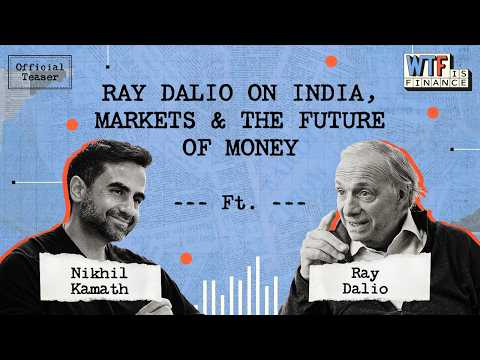
WTF are Ray Dalio’s Rules to Build a Real Portfolio? | Nikhil Kamath | WTF is Finance Ep 2 Teaser
Nikhil Kamath (host), Ray Dalio (guest), Ray Dalio (guest)
In this episode of Nikhil Kamath, featuring Nikhil Kamath and Ray Dalio, WTF are Ray Dalio’s Rules to Build a Real Portfolio? | Nikhil Kamath | WTF is Finance Ep 2 Teaser explores ray Dalio on building a real portfolio amid crypto questions Nikhil Kamath presses Ray Dalio with multiple crypto-related questions in quick succession (Bitcoin and stablecoins).
Ray Dalio on building a real portfolio amid crypto questions
Nikhil Kamath presses Ray Dalio with multiple crypto-related questions in quick succession (Bitcoin and stablecoins).
Dalio pauses the crypto discussion to enforce a structured approach—one question at a time—then pivots to foundational investing concepts.
He argues that wealth can rise on paper without being spendable, emphasizing the difference between asset values and actual money/liquidity.
Dalio starts to outline “two important ways to invest” and hints at a portfolio allocation guideline, noting most investors should hold roughly 5%–15% in an unspecified asset class (cut off in the teaser).
Key Takeaways
Paper wealth isn’t the same as usable wealth.
Dalio stresses that rising asset values can make people feel wealthy, but it only becomes real spending power when you sell and convert to money.
Get the full analysis with uListen AI
Liquidity matters more when wealth-to-money is high.
He points to a “very high ratio of wealth to money,” implying greater risk when many claims on value exist relative to available cash/liquidity.
Get the full analysis with uListen AI
Portfolio thinking should precede specific asset debates.
Instead of immediately answering rapid crypto prompts, Dalio redirects to first principles—starting with “what is my portfolio?”
Get the full analysis with uListen AI
Good investing requires structured questioning and clear decisions.
Dalio’s “one question at a time” pushback signals that investment conclusions depend on precise premises (asset, role in portfolio, risk, liquidity).
Get the full analysis with uListen AI
There are broad frameworks to investing beyond picking winners.
He begins describing “two important ways to invest,” suggesting a systematic approach (e. ...
Get the full analysis with uListen AI
Dalio implies a rule-of-thumb allocation band for most investors.
He mentions most investors should have “between 5% and 15%” in a particular bucket (not fully revealed in the teaser), hinting at disciplined sizing rather than all-in bets.
Get the full analysis with uListen AI
Notable Quotes
“You gotta give me one question at a time here.”
— Ray Dalio
“Wealth can easily be created.”
— Ray Dalio
“Wealth goes up, and people feel wealthy, but their wealth isn't worth anything if you don't sell it, convert it into money to spend.”
— Ray Dalio
“We have, right now, a very high ratio of wealth to money.”
— Ray Dalio
“There are two important ways to invest. The first is, what is my portfolio?”
— Ray Dalio
Questions Answered in This Episode
When Dalio says the wealth-to-money ratio is very high, what concrete risks does he think that creates for investors?
Nikhil Kamath presses Ray Dalio with multiple crypto-related questions in quick succession (Bitcoin and stablecoins).
Get the full analysis with uListen AI
What exact asset class was Dalio about to name for the 5%–15% allocation, and why that range?
Dalio pauses the crypto discussion to enforce a structured approach—one question at a time—then pivots to foundational investing concepts.
Get the full analysis with uListen AI
How would Dalio categorize Bitcoin or stablecoins within a portfolio framework—store of value, diversifier, liquidity tool, or speculation?
He argues that wealth can rise on paper without being spendable, emphasizing the difference between asset values and actual money/liquidity.
Get the full analysis with uListen AI
What does Dalio mean by “wealth can easily be created”—is he referring to asset price inflation, credit creation, or something else?
Dalio starts to outline “two important ways to invest” and hints at a portfolio allocation guideline, noting most investors should hold roughly 5%–15% in an unspecified asset class (cut off in the teaser).
Get the full analysis with uListen AI
If “wealth isn’t worth anything” until converted to spendable money, how should investors think about liquidity planning (cash buffers, rebalancing rules, exit strategy)?
Get the full analysis with uListen AI
Transcript Preview
How do you view crypto and the world of Bitcoin?
Hmm.
Or even like, uh, stablecoin?
From-
Tell me this, if you were to back-
You gotta give me one question at a time here. [laughing]
[upbeat jazz music] Wealth can easily be created. Wealth goes up, [chime] and people feel wealthy, but their wealth isn't worth anything if you don't sell it, [cash register dings] convert it into money to spend. We have, right now, a very high ratio of wealth to money. [upbeat jazz music] There are two important ways to invest. The first is, what is my portfolio? Most investors should have between 5% and 15% of their portfolio in- [upbeat jazz music]
Install uListen to search the full transcript and get AI-powered insights
Get Full TranscriptGet more from every podcast
AI summaries, searchable transcripts, and fact-checking. Free forever.
Add to Chrome