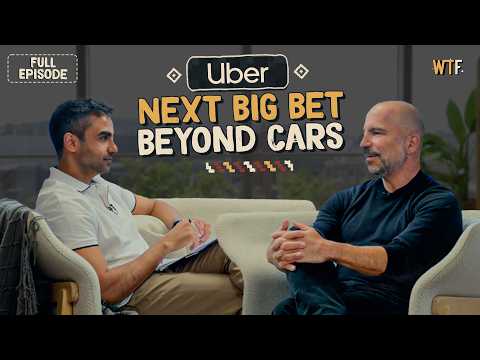
From Iran to Uber CEO | Nikhil Kamath x Dara Khosrowshahi | People by WTF | Ep. 14
Nikhil Kamath (host), Dara Khosrowshahi (guest)
In this episode of Nikhil Kamath, featuring Nikhil Kamath and Dara Khosrowshahi, From Iran to Uber CEO | Nikhil Kamath x Dara Khosrowshahi | People by WTF | Ep. 14 explores uber CEO Dara on leadership, markets, AI, and mobility’s future Dara Khosrowshahi traces his path from a privileged childhood in pre-revolution Iran to rebuilding life in the US, then rising from investment banking to leading Expedia and later Uber.
Uber CEO Dara on leadership, markets, AI, and mobility’s future
Dara Khosrowshahi traces his path from a privileged childhood in pre-revolution Iran to rebuilding life in the US, then rising from investment banking to leading Expedia and later Uber.
He contrasts collaborative leadership with decisive “wartime” execution, sharing lessons from Barry Diller about avoiding overly filtered information and staying close to ground truth.
On business strategy, Dara explains why network effects make ride-hailing and delivery hard to disrupt, argues founders should start with narrow wedges rather than over-modeling TAM, and describes Uber as an “operating system” for everyday life.
He outlines where AI can meaningfully reinvent travel and commerce (discovery, agentic booking, in-trip experience), discusses EV adoption headwinds and China’s EV dominance, and predicts autonomous vehicles will expand over the next decade with a longer timeline to broad displacement—especially in lower-cost markets like India.
Key Takeaways
In India, Uber’s toughest threat is now Rapido, not Ola.
Dara says Rapido gained share through a simple subscription/zero-commission approach that boosts driver earnings, especially in 2W/3W segments. ...
Get the full analysis with uListen AI
The most dangerous leadership blind spot is “edited reality.”
From Barry Diller, Dara learned that information gets smoothed as it rises in organizations. ...
Get the full analysis with uListen AI
LLMs can make people smarter—or lazier—depending on effort.
Dara agrees AI can provide an “easy version of reality,” similar to corporate packaging of information. ...
Get the full analysis with uListen AI
AI’s biggest near-term travel impact is discovery and agentic workflow—not inspiration monopolies.
He expects OpenAI/Google to dominate inspiration because of broad context and data. ...
Get the full analysis with uListen AI
Taste is real, but context is the true decision function.
Dara argues recommendations must incorporate trip goals (cheap/functional midweek vs experiential weekend). ...
Get the full analysis with uListen AI
Uber’s consumer promise is an “operating system” for daily life.
He frames Uber as a convenience layer across mobility, food, groceries, and retail—reducing time/effort. ...
Get the full analysis with uListen AI
Don’t over-model TAM; win a narrow wedge with sound unit economics.
Dara tells founders the big TAMs are usually already claimed by scaled players with network effects. ...
Get the full analysis with uListen AI
Internal rivalry can spark breakthroughs, but must be systematized to scale.
He says competition between teams helps “hack” toward the best solution quickly. ...
Get the full analysis with uListen AI
Quick commerce struggles in the US mainly because labor costs are too high.
He believes ultra-fast delivery is hard to profitably sustain in high-wage markets without heavy automation, which itself may not pay back for “small box” orders. ...
Get the full analysis with uListen AI
Autonomy must be superhuman-safe; lidar+camera stacks are pragmatic today.
Dara sets a higher bar than “better than humans” and favors multi-sensor systems (camera/radar/lidar), noting lidar cost declines. ...
Get the full analysis with uListen AI
Job disruption from autonomy/AI is societal; adaptation is likely but pace is uncertain.
He points to historical labor transitions where people moved to higher-value work and unemployment stayed low, but concedes AI could change faster than societies can retrain. ...
Get the full analysis with uListen AI
China’s EV lead comes from industrial policy plus intense internal competition.
Dara describes a “best of both worlds” dynamic: top-down strategic focus on EVs, then bottom-up competition across many OEMs and provinces that forces rapid innovation. ...
Get the full analysis with uListen AI
Restaurants will bifurcate: ‘utility food’ vs ‘hospitality/romance.’
He predicts the middle ground will be hardest. ...
Get the full analysis with uListen AI
Brand-building is shifting from intent-search to social distribution and creator storytelling.
Dara argues Google-style ads are more for scaling known brands than inventing new ones. ...
Get the full analysis with uListen AI
Notable Quotes
“The biggest mistakes that I see with businesses is not usually errors of judgment, but you just didn’t really know what was going on in the organization.”
— Dara Khosrowshahi
“If you rebuilt religions on Earth… the stories would be different. If you rebuilt science, the science will come out the same.”
— Dara Khosrowshahi
“I don’t think it works if you’re trying to be someone other than who you are… people will smell that a mile off if you’re not authentic.”
— Dara Khosrowshahi
“Sometimes… as a leader, you have to go from peacetime collaboration mode to wartime: ‘I am the leader… I’m gonna make a decision.’”
— Dara Khosrowshahi
“The big TAMs are gonna be taken… you should go after the small TAMs and then work your way into the adjacencies.”
— Dara Khosrowshahi
Questions Answered in This Episode
On India: What specific counter-moves can Uber use against Rapido’s subscription/zero-commission model without destroying Uber’s unit economics?
Dara Khosrowshahi traces his path from a privileged childhood in pre-revolution Iran to rebuilding life in the US, then rising from investment banking to leading Expedia and later Uber.
Get the full analysis with uListen AI
Network effects: In which India sub-segments (intercity, 2W/3W, airport, small towns) are network effects weakest—and therefore most attackable for a startup?
He contrasts collaborative leadership with decisive “wartime” execution, sharing lessons from Barry Diller about avoiding overly filtered information and staying close to ground truth.
Get the full analysis with uListen AI
Travel AI: What would an ‘in-market’ travel experience redesign look like if Uber had deeper integrations with hotels (check-in, keys, identity, loyalty)?
On business strategy, Dara explains why network effects make ride-hailing and delivery hard to disrupt, argues founders should start with narrow wedges rather than over-modeling TAM, and describes Uber as an “operating system” for everyday life.
Get the full analysis with uListen AI
Agents and trust: What conditions would need to be true for you to let an AI agent ‘book end-to-end’ travel without manual approval?
He outlines where AI can meaningfully reinvent travel and commerce (discovery, agentic booking, in-trip experience), discusses EV adoption headwinds and China’s EV dominance, and predicts autonomous vehicles will expand over the next decade with a longer timeline to broad displacement—especially in lower-cost markets like India.
Get the full analysis with uListen AI
Data + taste: How does Uber balance explore vs exploit today in Eats recommendations, and what metrics tell you you’re over-personalizing?
Get the full analysis with uListen AI
Transcript Preview
[upbeat music] Wow, that looks very dead!
... And the background. You got a good-
Mm.
You have a good day here.
It's hot though, right?
It's typical-
Yeah
... SF weather.
Uh-oh.
Yesterday was super, super cold. I haven't been outside, so I didn't know it was hot today.
You live here?
No, New York now.
Oh.
I moved to New York recently, sadly. I like it here more, but...
Do you?
Parents are in New York, so I wanted to-- They're getting older.
New York seems like a lot more fun.
The city's more fun.
Yeah.
But I l- SF is beautiful. [upbeat music] Where are you based?
Based out of India.
Okay. Where?
So I live between Bangalore, Mumbai, and Goa-
Okay.
-in India.
Okay.
Ha- have you been recently?
Uh, I go once a year. I don't remember... I, I was there earlier this year. Yeah, but-
Like it?
At least... Yeah, it's so, like, it's just... The energy is incredible, and the teams, you know, we got in, I think it's Hyderabad and Bangalore.
Mm.
We got teams there, and it's just a, like, a group who is super excited. The energy you get out of the teams when you go visit them is... It's pretty awesome. I like it a lot.
What's happening in India, Dara, with-- I know your main competition is Ola, who's also a really good friend of mine.
Yes.
We live in the same city.
Yes. Well, I... Uh, have we officially started?
Yeah! [chuckles]
All right, good. Okay. Um, Ola used to be our main competition.
Mm-hmm.
Uh, and, you know, we were always going head-to-head with O- Ola in terms of the category position in the marketplace. They were the local competitor. I think we had the better global tech, et cetera-
Yeah
... but they were always scrappy. Um, I think he got, uh, somewhat distracted-
Mm-hmm
... by other-
And things
... interesting areas, uh, for him. So I'd say now the, the, the tougher competition in India is Rapido.
Mm-hmm.
You know, they're the upstart.
Mm-hmm.
They got into two-wheelers and three-wheelers really aggressively. Super simple model, just kind of the subscription, zero commission model. Very scrappy as well, and they have gained a good amount of category position. I think Ola's now kind of a distant third.
Mm-hmm.
They're trying to get into four-wheelers now. So we- when we talk about India, other than the talent that we have there and building there and really building on our talent base, but when we, when we talk about the business in India, and it's the third largest country in terms of mobility trips, so India is really important to us. The competition that we talk about is really Rapido, and what they're doing-
What do you think Rapido is getting right that the others are not?
Um, [exhales] you know, I'm not on the ground, but I think Rapido, uh, built a really simple model, which is basically, you know, the subscription model. You pay a certain amount, and for the rest of the day, you operate on what's essentially zero commission.
Install uListen to search the full transcript and get AI-powered insights
Get Full TranscriptGet more from every podcast
AI summaries, searchable transcripts, and fact-checking. Free forever.
Add to Chrome