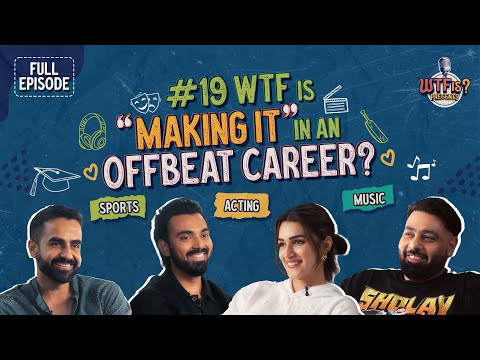
Ep. #19 | WTF is “Making it” in an Offbeat Career? Nikhil Kamath Ft. Kriti Sanon, Badshah & KL Rahul
Nikhil Kamath (host), Kriti Sanon (guest), KL Rahul (guest), Badshah (guest), Badshah (guest), Nikhil Kamath (host), Kriti Sanon (guest), Nikhil Kamath (host), Kriti Sanon (guest)
In this episode of Nikhil Kamath, featuring Nikhil Kamath and Kriti Sanon, Ep. #19 | WTF is “Making it” in an Offbeat Career? Nikhil Kamath Ft. Kriti Sanon, Badshah & KL Rahul explores defining “making it” across acting, cricket, music, and business realities Nikhil Kamath hosts Kriti Sanon, KL Rahul, and Badshah to unpack how outsiders break into highly aspirational fields and what actually separates those who “make it.” Kriti describes a childhood shaped by academic pressure, perfectionism, and stage fright—then explains how repeated exposure, curiosity, and asking questions built her confidence and craft. Rahul traces a sports-first upbringing, argues for innate athletic talent (especially hand-eye coordination), and explains how mindset management, spirituality, and reducing social media consumption helped him handle pressure and trolling.
Defining “making it” across acting, cricket, music, and business realities
Nikhil Kamath hosts Kriti Sanon, KL Rahul, and Badshah to unpack how outsiders break into highly aspirational fields and what actually separates those who “make it.” Kriti describes a childhood shaped by academic pressure, perfectionism, and stage fright—then explains how repeated exposure, curiosity, and asking questions built her confidence and craft. Rahul traces a sports-first upbringing, argues for innate athletic talent (especially hand-eye coordination), and explains how mindset management, spirituality, and reducing social media consumption helped him handle pressure and trolling.
Badshah shares his path from writing as self-expression to producing music with minimal resources, his early collaboration with Honey Singh, and why originality, conviction, and patience matter more than chasing fame. Across industries, the group debates the limits of “data-driven” creativity, the need to adapt faster than the times, and how career shelf-life drives anxiety and planning—especially for athletes.
Key Takeaways
Confidence is often trained, not discovered.
Kriti describes stage fright and early breakdowns after her first ramp show and photo shoot, but says repeated exposure to scary situations built real confidence. ...
Get the full analysis with uListen AI
Ask “too many” questions—curiosity compounds into craft.
Kriti credits her growth to being willing to look “stupid” on set and ask constant questions about character and scene approach. ...
Get the full analysis with uListen AI
In sport, some ceilings are biological—but training still matters.
Rahul strongly believes innate traits (especially hand-eye coordination and visual judgment) differentiate those who reach elite levels, though practice can improve performance. ...
Get the full analysis with uListen AI
Play more matches (or do more reps) than your competition.
Rahul emphasizes the value of volume and variety of competitive exposure: school/academy structures that offer more games accelerate learning, error-correction, and resilience. ...
Get the full analysis with uListen AI
Pressure management is a performance skill, not a personality trait.
Rahul says his best performances come when he’s not chasing outcomes; trying to “jump from 5 to 10” makes him fall to “0. ...
Get the full analysis with uListen AI
Reduce your surface area to trolling by controlling access.
Rahul describes being ‘massively scarred’ by a controversial interview and subsequent trolling, leading him to largely exit Instagram consumption. ...
Get the full analysis with uListen AI
Data can inform decisions, but it can’t guarantee wins in art or sport.
Nikhil argues Bollywood should adopt Moneyball-like analytics; Rahul and Badshah counter that even data-picked ‘best’ teams fail due to form variance and randomness, and that art’s “beauty can’t be quantized. ...
Get the full analysis with uListen AI
Relevance decays when audiences change—your job is to evolve.
Badshah cites Gurdas Maan: your work may not change, but people’s eyes and ears do. ...
Get the full analysis with uListen AI
Don’t enter a business just because it’s ‘cool’; choose tailwinds.
Nikhil advises entrepreneurs to pick sectors likely to be much larger in 10 years (e. ...
Get the full analysis with uListen AI
Fail fast in business; time is the only truly finite asset.
Nikhil claims most ventures either show traction early or won’t work; if there’s no meaningful traction in ~1–2 years, reconsider and redeploy. ...
Get the full analysis with uListen AI
Notable Quotes
““I gained confidence with work, while working.””
— Kriti Sanon
““Scary and exciting is the same emotion… Work-wise.””
— Kriti Sanon
““There are some abilities that you’re gifted with—that can’t be taught.””
— KL Rahul
““I got trolled if I sat, I got trolled if I stood… that interview scarred me massively.””
— KL Rahul
““Wo beauty jo hai na, wo quantize nahi ho sakti.””
— Badshah
Questions Answered in This Episode
Kriti: Can you give a concrete example of a ‘big film’ choice you later realized didn’t excite you—what did you learn and what would you do differently now?
Nikhil Kamath hosts Kriti Sanon, KL Rahul, and Badshah to unpack how outsiders break into highly aspirational fields and what actually separates those who “make it. ...
Get the full analysis with uListen AI
Kriti: You mention validation repeatedly—what practices help you separate external praise from internal peace on days a film/performance is criticized?
Badshah shares his path from writing as self-expression to producing music with minimal resources, his early collaboration with Honey Singh, and why originality, conviction, and patience matter more than chasing fame. ...
Get the full analysis with uListen AI
Rahul: What does a realistic 5-year roadmap look like for a 15-year-old in India (academy → district/state → age-group → Ranji/IPL)? What are the key gatekeeping moments?
Get the full analysis with uListen AI
Rahul: You argue hand-eye coordination is largely innate—what drills or diagnostics would you use to identify ‘ceiling’ early without discouraging kids?
Get the full analysis with uListen AI
Badshah: You said ‘originality’ is the hardest part—what’s your process to check whether a hook/flow is inspired vs subconsciously copied?
Get the full analysis with uListen AI
Transcript Preview
Okay, so what I wanted to get at by the end of today is the three of you have made it in careers which are unconventional. So I wanna know what you did, how you grew up, and along the way, we'll try and find nuances of what you did differently that worked for you.
Oh, God, this is like a long question. [laughing]
[upbeat music] Okay, we can start rolling again. Hi. [laughing]
Hi. [laughing]
What's up?
Okay, so this is very informal.
Uh-huh.
It's a bunch of us, four friends sitting and chatting.
Fourth one is here.
Yeah.
Hi!
Almost building friends, yeah.
Yeah. He's from Delhi, so he's late.
He's a little shy, quiet.
Yeah.
Do not say things about Delhi! [chuckles] I'm also from Delhi.
Why did you leave Delhi if you like it so much?
No, I love Delhi, but I love Mumbai also.
Which do you like more?
So has anybody said that you can't like one city more than-
No, but like is a very relative word. Which do you like more?
So I think my core is still Delhi.
Mm-hmm.
But I love living in Mumbai because I feel like the city has given me a lot.
Mm.
There's a lot, uh, of also freedom in general. Um, I can come home at 4:00 a.m., 3:00 a.m. from shoot, not feel worried traveling alone.
Mm.
And, uh, I miss Delhi food. I miss Delhi roads.
Mm.
Uh, I miss the space that you don't have in Mumbai.
Mm.
Uh, I don't miss Delhi winters.
Mm.
I'm not a winter person at all.
So you're okay in this weather? You're not feeling hot today.
I'm okay.
Mm.
I mean, I expected it to be colder, which is why I wore, like, a sweatshirt in this heat of Mumbai.
[chuckles]
But, but I feel I can take heat more than I can take cold.
Yeah. So I remember Rahul from back in the day.
Mm.
Uh, we would catch up once in a while, no?
We did, I mean-
Yeah
... but we also met very, very late.
Yeah.
Like, I mean, um, I don't think you came out as often earlier in your-
Mm, yeah
... early twenties.
I still don't go out very often.
Yeah. No, but later, later, I mean, when we were 27, 28, I did see you a lot more.
Yeah.
But early stages when, you know, I used to go out a lot in Bangalore. Like you said, Bombay gives you that freedom.
Mm.
Bangalore gave us that freedom to just go out. There's no, you know, paparazzi culture or, like, no one ever, like, bothered us or disturbed us, or we didn't feel like, oh, we need to behave a certain way because there are cameras in our faces. So we just-- we would chill, but I met him-
Yeah
... uh, quite a lot later, later on. But then, as we hung out two or three times, I think then I moved to Bombay, and-
Install uListen to search the full transcript and get AI-powered insights
Get Full TranscriptGet more from every podcast
AI summaries, searchable transcripts, and fact-checking. Free forever.
Add to Chrome