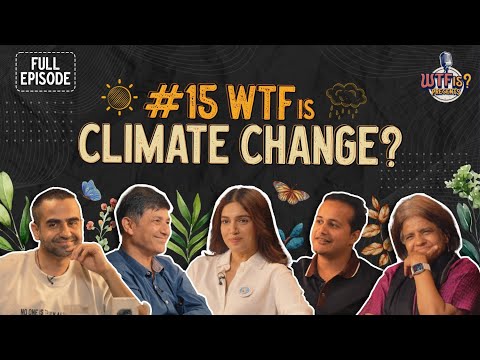
Ep# 15 | WTF is Climate Change? Nikhil ft. Sunita, Bhumi, Navroz and Mirik
Nikhil Kamath (host), Navroz K Dubash (guest), Bhumi Pednekar (guest), Mirik Gogri (guest), Bhumi Pednekar (guest), Sunita Narain (guest), Nikhil Kamath (host), Bhumi Pednekar (guest), Nikhil Kamath (host)
In this episode of Nikhil Kamath, featuring Nikhil Kamath and Navroz K Dubash, Ep# 15 | WTF is Climate Change? Nikhil ft. Sunita, Bhumi, Navroz and Mirik explores climate change explained: science, politics, India’s energy transition, action pathways Nikhil Kamath hosts Sunita Narain, Navroz K. Dubash, actor Bhumi Pednekar, and industrialist Mirik Gogri to explain climate change in simple terms and make it tangible for young Indians.
Climate change explained: science, politics, India’s energy transition, action pathways
Nikhil Kamath hosts Sunita Narain, Navroz K. Dubash, actor Bhumi Pednekar, and industrialist Mirik Gogri to explain climate change in simple terms and make it tangible for young Indians.
They connect the basic science (greenhouse gases trapping heat; rapid warming) with real-world impacts (extreme weather, ocean heat, air pollution) and emphasize climate change as a social-political reality—not just an abstract environmental issue.
A major throughline is India’s energy transition: renewables, storage, grid/distribution-company (DISCOM) reform, and demand-side solutions (public transport, efficient services) alongside debates on nuclear, carbon capture, offsets, and geoengineering.
They repeatedly stress “scale and integrity”: meaningful implementation over optics, avoiding greenwashing (especially in offsets), and designing solutions that align climate goals with development and equity—within India and the Global South.
Key Takeaways
Climate change is now a governance problem, not just a science lesson.
Beyond greenhouse-gas physics, the panel frames climate change as something that will force system-level changes in how societies organize energy, cities, consumption, and risk management—through both mitigation and adaptation.
Get the full analysis with uListen AI
IPCC credibility comes from exhaustive review and government line-by-line approval—also making it slow.
Navroz describes the IPCC as a synthesis body, not a creator of new science, with multiple review rounds and negotiated summaries. ...
Get the full analysis with uListen AI
Extreme weather ‘lived experience’ is the best entry point for public engagement.
Rather than apocalyptic narratives, the group suggests stories about heatwaves, floods, and local resilience actions—because climate harms are already visible and relatable, especially to farmers and people who depend on land.
Get the full analysis with uListen AI
India’s biggest climate lever is the energy transition—but grid/distribution reform is the bottleneck.
Renewables are increasingly cost-competitive, but scaling them depends on fixing DISCOM incentives, losses/theft, and planning rules built for centralized coal-era systems. ...
Get the full analysis with uListen AI
Storage is the key technology gap for scaling solar and wind.
Mirik highlights grid storage as a massive entrepreneurial opportunity, arguing that renewables’ next cost-curve breakthrough must be storage (likely beyond lithium-ion for grid scale) to stabilize supply at high penetration.
Get the full analysis with uListen AI
Decentralized ‘energy-as-a-service’ can combine development gains with climate gains.
Navroz advocates shifting from selling “electrons” to enabling productive uses (cold chains, processing, rural enterprise). ...
Get the full analysis with uListen AI
Offsets/carbon credits are currently plagued by low integrity; regulation is essential.
Sunita calls much of the voluntary carbon market “a scam,” arguing prices are too cheap and projects often let polluters continue emissions while claiming reductions elsewhere. ...
Get the full analysis with uListen AI
The ozone ‘success’ model doesn’t translate to climate—and may have distorted climate thinking.
Sunita argues ozone was solved by swapping a niche chemical with substitutes controlled by a few firms, funded by public money and enforced via trade pressure—very different from fossil fuels embedded across economies. ...
Get the full analysis with uListen AI
Nuclear fission may help, but timing, execution capacity, and system-fit matter.
Mirik is optimistic about small modular/Gen IV concepts and factory-built deployment; Navroz and Sunita doubt India can scale quickly given historic under-delivery and long gestation times, stressing renewables and demand-side changes as faster wins.
Get the full analysis with uListen AI
Diet debates are context-dependent; the bigger issues are industrial farming, consumption, and waste.
Sunita rejects simplistic ‘vegan = environmentalist’ framing in India, emphasizing how food is produced (chemicals/antibiotics, deforestation), how much is consumed, and how integrated livestock supports farmer resilience and soil fertility.
Get the full analysis with uListen AI
Notable Quotes
“Climate change is now a social and political reality that is going to have to change the way in which human beings organize our economies and our societies.”
— Navroz K. Dubash
“We want climate change sorted out… but we want to do that at no cost. No cost to us… and that’s not gonna happen.”
— Sunita Narain
“It’s one extreme weather event a day… in India, as defined by IMD.”
— Sunita Narain
“I am tired of small solutions, pilots, nice ideas… I get a high from seeing things scaled up.”
— Sunita Narain
“If you don’t get your excreta story right, you cannot fix your water pollution.”
— Sunita Narain
Questions Answered in This Episode
On IPCC process: What does ‘government line-by-line approval’ change in the final wording—does it weaken conclusions or strengthen legitimacy?
Nikhil Kamath hosts Sunita Narain, Navroz K. ...
Get the full analysis with uListen AI
On India awareness: If farmers ‘know climate change’ through experience, what are the best channels to convert that lived knowledge into political demand and local adaptation programs?
They connect the basic science (greenhouse gases trapping heat; rapid warming) with real-world impacts (extreme weather, ocean heat, air pollution) and emphasize climate change as a social-political reality—not just an abstract environmental issue.
Get the full analysis with uListen AI
On EVs in India: If India’s EV imperative is mainly clean air (not just CO2), what policies should prioritize e-buses and public transport over private e-cars?
A major throughline is India’s energy transition: renewables, storage, grid/distribution-company (DISCOM) reform, and demand-side solutions (public transport, efficient services) alongside debates on nuclear, carbon capture, offsets, and geoengineering.
Get the full analysis with uListen AI
On DISCOM reform: Which single incentive change (tariff reform, metering, direct benefit transfers, loss reduction targets, privatization, etc.) has the highest chance of working politically?
They repeatedly stress “scale and integrity”: meaningful implementation over optics, avoiding greenwashing (especially in offsets), and designing solutions that align climate goals with development and equity—within India and the Global South.
Get the full analysis with uListen AI
On storage entrepreneurship: Which non–lithium-ion grid storage pathways (sodium-ion, iron-air, flow batteries, thermal, pumped hydro) look most viable for India’s geography and supply chains?
Get the full analysis with uListen AI
Transcript Preview
Everybody has heard of the word climate change, but when I ask them to describe it to me or tell me what it is, uh, not many are able to. [upbeat music] Ready, Meghna? Start. [chuckles] Hi, guys. Welcome, everyone. Uh, I've not done this for a while. We took a break of sorts. The very first thing we do when we begin is introduce each one of you. Uh, who would like to go first?
Sure.
So tell us a bit about you, where you grew up, how did you get into the domain that you are in right now, uh, and just highlights and low points in your life so far.
Okay.
Okay.
Well, for those of us who've been around for a little bit longer, it may take a little longer, but we'll-- I'll try and keep it, keep it brief. You know, I, um, followed the standard South Asian path, as especially as a South Asian male. I started out as an engineer, but I really didn't enjoy it. I started enjoying my political science, politics, history, all this stuff, much more. And so I started getting interested in development and, uh, and I had the opportunity when I was studying. It was, uh, the late nineteen eighties. There was, there was sort of emergence of discussions around the environment, and I took myself off, uh, to the Narmada Valley, and I introduced, and I interviewed people who were associated with the Narmada Bachao Andolan, and many people from my generation actually got into environmentalism through that. It was a very high-profile movement.
Mm.
Do you actually, uh, uh, you know, do you have to break eggs to make omelets? Is that inevitable consequence of development, or can you do it in a way where you actually don't harm poor people, where you don't dam rivers, where you don't despoil the environment? And I thought this was fascinating. So this was my first kind of entry point, and I wrote a thesis about this and so on and so forth. And then when I graduated from college, and this was in the US, I've had this, uh, uh... I was just in the right place at the right moment. Uh, I'd also done some work on climate change. It was nineteen ninety, and there were preparations to start negotiating a climate change convention. So I got in touch with an organization who was, uh, involved, uh, in the periphery of the Narmada movement, and I said, "Look, I'm looking for a job." And they said, "Well, as it happens, we need somebody to help build a global network on climate change called the Climate Action Network, and are you interested? We don't have very much money." So I was fresh out of college, and I was like, "Well, yeah, sure." Uh, and so I called up, uh, Sunita and Anil Agarwal at CSE. I called up people in Latin America. It was the old days. It was fax machines, photocopiers. I didn't really know what to do in an office. You know, I had a filing cabinet, and I had two files, faxes in and faxes out. I didn't really know what I was doing. You know, I used to read the newspaper under the table because I, I, I'd had never been in an office before. But over the next couple of years, we built up this network, and, uh, uh, civil society organizations from Africa, Asia, Latin America, all showed up, and that organization exists today. It's called the Global Climate Action Network. It's now hundreds, uh, of people. Uh, and the key part was that it brought representatives from the developing world to this global process, because until then, it had only been Americans and Europeans, right? So development issues emerge as part of the conversation, and I'll just give you one anecdote from that period. Very early on, we sat around the table with the Americans, Europeans, people from Malaysia, India, everywhere else, and the Americans, who'd been at this for a while, said, "Okay, we need to come up with a common lobbying position. So what we should say is that we, the richer countries, have caused most of this problem. So we should reduce, you know, say, uh, fifty percent by the year two thousand." This was in nineteen ninety. Very ambitious, right?
Install uListen to search the full transcript and get AI-powered insights
Get Full TranscriptGet more from every podcast
AI summaries, searchable transcripts, and fact-checking. Free forever.
Add to Chrome