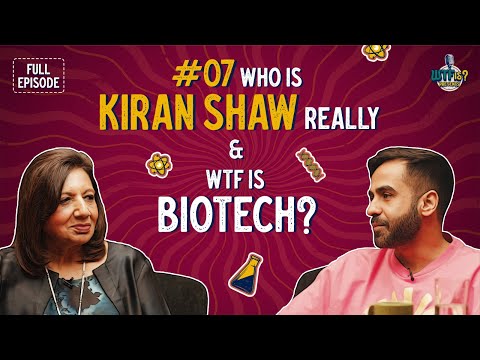
Ep #7 | Who is Kiran Mazumdar Shaw Really? And WTF is Biotech?
Nikhil Kamath (host), Kiran Mazumdar Shaw (guest), Nikhil Kamath (host), Nikhil Kamath (host), Nikhil Kamath (host)
In this episode of Nikhil Kamath, featuring Nikhil Kamath and Kiran Mazumdar Shaw, Ep #7 | Who is Kiran Mazumdar Shaw Really? And WTF is Biotech? explores kiran Mazumdar-Shaw on Biocon’s origin, biotech basics, and purpose-driven growth Kiran Mazumdar-Shaw recounts her Bangalore upbringing, early aspiration for medicine, and unexpected pivot into brewing—framed as “the oldest biotechnology”—before confronting gender bias in India’s brewery industry.
Kiran Mazumdar-Shaw on Biocon’s origin, biotech basics, and purpose-driven growth
Kiran Mazumdar-Shaw recounts her Bangalore upbringing, early aspiration for medicine, and unexpected pivot into brewing—framed as “the oldest biotechnology”—before confronting gender bias in India’s brewery industry.
A chance meeting with an Irish biotech entrepreneur redirected her from a Scotland job to launching Biocon at 25 with minimal capital, building enzyme technologies and early “green” industrial applications despite skepticism from banks and customers.
She explains biotech concepts clearly—enzymes as catalysts, fermentation-based production, recombinant DNA “plug-and-play,” and the complexity of biosimilars—then details Biocon’s evolution from enzymes to statins, immunosuppressants, insulin, and global biologics.
The conversation broadens into entrepreneurship (teams, equity, recognizing failure, divestment), India’s policy needs (R&D incentives, infrastructure, innovation), women in the workforce, and a strong commitment to philanthropy (Giving Pledge, institutional funding).
Key Takeaways
Biotech careers can start from ‘non-biotech’ roots if you understand the underlying science.
Kiran frames brewing/fermentation as foundational biotechnology, showing how microbiology and process know-how can transfer into enzymes, pharma fermentation, and recombinant products.
Get the full analysis with uListen AI
Early-stage risk is often misunderstood—credibility can matter more than collateral.
Despite a buyback guarantee and an advance draft, most banks refused her; one banker took a conviction-based bet, illustrating how narrative clarity and trust can unlock first financing.
Get the full analysis with uListen AI
‘Green’ innovation often fails initially because customers underprice externalities.
Companies resisted enzyme-based processes because chemicals looked cheaper until effluent-treatment and sustainability costs became unavoidable—validating long-horizon, regulation-shaped bets.
Get the full analysis with uListen AI
Build a leadership team early and share responsibility (and equity) to scale faster.
Kiran credits growth to attracting top engineers/scientists and delegating rather than running an authoritarian model; she advocates equity-sharing while preserving founder control long enough to steer direction.
Get the full analysis with uListen AI
Know when persistence becomes denial—pull the plug when warning signs compound.
From Vijay Mallya’s airline story, her lesson is not ‘ego’ but refusal to accept failure signals; entrepreneurs should downsize, cut losses, and avoid mounting debt on a non-viable model.
Get the full analysis with uListen AI
Platform thinking enables pivots: be ‘agnostic’ about what your technology produces.
Biocon leveraged fermentation/enzyme capabilities into statins, then recombinant insulin and biologics—demonstrating that core process capabilities can unlock higher-value adjacencies.
Get the full analysis with uListen AI
IP ownership is a durable value multiplier and can justify divest-or-double-down decisions.
Unilever’s global benchmarks taught her IP discipline; later, selling the enzyme business to Novozymes delivered strong returns largely because proprietary IP made the asset strategically valuable.
Get the full analysis with uListen AI
IPO can be a strategic tool, not just an exit—valuation becomes growth currency.
Kiran rejects the ‘IPO regret’ narrative, arguing public-market valuation enables acquisitions and monetization (e. ...
Get the full analysis with uListen AI
Biosimilars are ‘generic-like’ in intent but ‘new-drug-like’ in execution.
She emphasizes the complexity of matching biologics (cell lines, immunogenicity risk, clinical trials), positioning Biocon as uniquely capable among Indian firms to compete in US/EU markets.
Get the full analysis with uListen AI
India’s next leap requires research intensity and incentives, not only manufacturing push.
She supports production-linked incentives but argues India must add research-linked incentives and increase R&D spend (from <1% GDP toward ~2%+) to move from follower to innovator.
Get the full analysis with uListen AI
Notable Quotes
““Enzymes… are what we call organic catalysts. They’re proteins.””
— Kiran Mazumdar Shaw
““When I finally decided to start Biocon… it was foolish courage.””
— Kiran Mazumdar Shaw
““Don’t be wedded to a historic business. If that business can be monetized… divest it.””
— Kiran Mazumdar Shaw
““Wealth has never been about money. Wealth has been about value creation.””
— Kiran Mazumdar Shaw
““If you try to be what you’re not, I think you’ll trip up.””
— Kiran Mazumdar Shaw
Questions Answered in This Episode
On enzymes: In Biocon’s early years, which enzyme product line (papain vs solid-state fermentation) became the first real commercial winner, and why?
Kiran Mazumdar-Shaw recounts her Bangalore upbringing, early aspiration for medicine, and unexpected pivot into brewing—framed as “the oldest biotechnology”—before confronting gender bias in India’s brewery industry.
Get the full analysis with uListen AI
On financing: What specifically did you say or show to the Canara Bank banker that shifted him from ‘no’ to issuing a credit line?
A chance meeting with an Irish biotech entrepreneur redirected her from a Scotland job to launching Biocon at 25 with minimal capital, building enzyme technologies and early “green” industrial applications despite skepticism from banks and customers.
Get the full analysis with uListen AI
On adoption barriers: If you were selling ‘green enzymes’ today to reluctant factories, what would your pricing/contracting model look like to make ROI undeniable?
She explains biotech concepts clearly—enzymes as catalysts, fermentation-based production, recombinant DNA “plug-and-play,” and the complexity of biosimilars—then details Biocon’s evolution from enzymes to statins, immunosuppressants, insulin, and global biologics.
Get the full analysis with uListen AI
On gender bias: Which single policy or operational change (night-shift rules, childcare, safety, transportation) would most increase women’s participation in Indian manufacturing?
The conversation broadens into entrepreneurship (teams, equity, recognizing failure, divestment), India’s policy needs (R&D incentives, infrastructure, innovation), women in the workforce, and a strong commitment to philanthropy (Giving Pledge, institutional funding).
Get the full analysis with uListen AI
On pivots: What internal metric or ‘warning sign’ tells you a business has reached its ceiling and it’s time to pivot (revenue concentration, TAM limits, margin compression, tech obsolescence)?
Get the full analysis with uListen AI
Transcript Preview
what does money really mean?
Wealth has been about value creation. I didn't have any money either. You've got to have hunger in your belly, and you've got to have an idea which you think is exciting. When I finally decided to start Biocon, it was foolish courage, and I was high risk in the eyes of everyone. I mean, I suddenly was launched into fame as India's richest woman.
Which is self-made woman-
Right
... which is even b- better and bigger in my opinion.
Absolutely.
You still are as passionate talking about work today as you were at any other point, and what is that, that keeps you going? [upbeat music] Hi, Kiran. Uh, thank you for doing this, and I know you've been on a trip recently, and you just got back. Uh, would you like to tell us a little bit about where you went and what you did?
Well, first and foremost, Nikhil, thanks for having me on this, uh, show. It's always going to be exciting talking to you about entrepreneurship. Well, I just came back from Istanbul, uh, where I actually went to see the Champions League finals, which was, um, exciting, but I think predictable.
Mm-hmm.
You know, Man- Man City won.
Mm-hmm. Are you a football fan?
I do enjoy football-
Yeah
... and I have been watching football over the years.
Right.
My late husband, John, was a-
Mm
... great football aficionado, and he got me kind of interested in the game, and it is a wonderful game, right? Um, but anyway, I, I also combined it with a little bit of business because Turkey is a big market for me.
Right.
So I didn't feel that guilty-
Right [chuckles]
... just going to spoil myself with a match, so.
Right. Right.
But anyway-
Yeah
... I'm looking forward to our conversation.
Yeah. So for, uh, people watching, me and Kiran are really close friends who kind of hang out a lot. Uh, so this is a little bit different because we have a camera, but we hang out here, like [chuckles] -
And it's great to hang out with young friends like Nikhil.
Yeah, and we have all the same friends, and we do dinners and, uh, Sunday lunches, and, uh, I think we know each other very well. But this conversation, I thought, would be interesting because we can really get into the backstory of how you grew up, where you grew up. Uh, how did you become Kiran Mazumdar-Shaw from Kiran, who began in Bangalore many, many years ago? So if I could ask you, uh, to throw some light on the very beginning, uh, growing up, school, parents. Uh, maybe we can start there.
Okay. Well, I'm- I was born in Bangalore, and, uh, I grew up... I did my schooling at Bishop Cotton Girls' School. I then went to Mount Carmel College for my, uh, pre-university. Um, I joined, uh, Central College at Bangalore University for my bachelor's degree in Zoology Honors.
Install uListen to search the full transcript and get AI-powered insights
Get Full TranscriptGet more from every podcast
AI summaries, searchable transcripts, and fact-checking. Free forever.
Add to Chrome