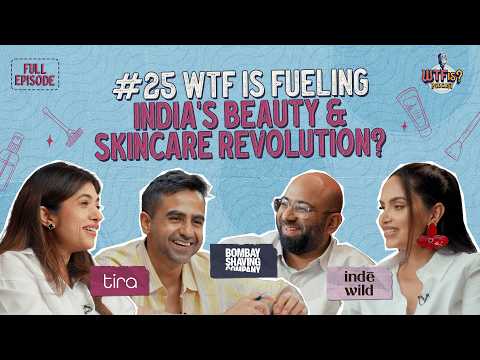
Tira, Bombay Shaving Co., Inde Wild | WTF is Fueling India’s Beauty & Skincare Revolution? | Ep. 25
Bhakti Modi (guest), Diipa Khosla (guest), Shantanu Deshpande (guest), Nikhil Kamath (host), Diipa Khosla (guest), Nikhil Kamath (host), Shantanu Deshpande (guest), Bhakti Modi (guest), Diipa Khosla (guest), Shantanu Deshpande (guest), Nikhil Kamath (host), Diipa Khosla (guest)
In this episode of Nikhil Kamath, featuring Bhakti Modi and Diipa Khosla, Tira, Bombay Shaving Co., Inde Wild | WTF is Fueling India’s Beauty & Skincare Revolution? | Ep. 25 explores beauty boom decoded: community, nostalgia, omnichannel, and premiumization in India The episode brings together Bhakti Modi (Tira), Diipa Khosla (Inde Wild), and Shantanu Deshpande (Bombay Shaving Company) to unpack why India’s beauty and skincare sector is accelerating—across skincare, haircare, fragrance, and makeup.
Beauty boom decoded: community, nostalgia, omnichannel, and premiumization in India
The episode brings together Bhakti Modi (Tira), Diipa Khosla (Inde Wild), and Shantanu Deshpande (Bombay Shaving Company) to unpack why India’s beauty and skincare sector is accelerating—across skincare, haircare, fragrance, and makeup.
They argue that product quality is table-stakes, but winning brands pair a hero product with sharp storytelling, community-building, and modern distribution (D2C + marketplaces + retail/omnichannel).
Key growth forces include premiumization (especially premium-to-prestige), Gen Z behavior shifts (influencers as “experts,” at-home salon-grade routines), and the reimagining of cultural rituals like champi into aspirational lifestyles.
The conversation also covers influencer marketing mechanics, sampling/minis, salon channels, global expansion for Indian brands (Ayurveda/hair as India’s advantage), and emerging waves like skinimalism and “hybrid” clean+clinical formulations.
Key Takeaways
India’s beauty market is growing faster than forecasts predicted.
They cite India BPC at ~$21B in 2024, already surpassing earlier forecasts of $20B by 2025, with beauty (skincare/makeup/hair/fragrance) a large and accelerating subset.
Get the full analysis with uListen AI
A hero product is the simplest path to breakout distribution and recall.
Inde Wild’s Champi Hair Oil reportedly contributes ~50–55% of sales; the group stresses starting with one “problem-solver” SKU and building narrative, community, and repeats before expanding.
Get the full analysis with uListen AI
Community is a defensible asset—harder to copy than product or branding.
Diipa describes co-creation via 16,000 surveys and focus groups pre-launch, and “bestie-style” customer service; Bhakti frames community as people united by shared values and identity, not just followers.
Get the full analysis with uListen AI
Beauty brands increasingly behave like media companies.
Content is positioned as the growth engine (especially with limited budgets vs incumbents). ...
Get the full analysis with uListen AI
Premiumization is real, but uneven—prestige grows fast from a small base.
They define mass <₹1,000, premium ~₹1,000–₹1,500, prestige/luxury ~₹2,300–₹2,500+. ...
Get the full analysis with uListen AI
Omnichannel is becoming non-negotiable for scale, especially in beauty.
They argue D2C alone caps growth; platforms like Tira provide captive demand and discovery. ...
Get the full analysis with uListen AI
Fragrance is exploding due to a mid-market gap and new usage behaviors.
They highlight a white space between cheap dupes (~₹599–₹799) and luxury (₹10k+). ...
Get the full analysis with uListen AI
Salon distribution is trust-based, but Gen Z is shifting ‘expert’ authority to influencers.
Salon brands win via exclusivity deals, treatment menus, stylist training, and sampling. ...
Get the full analysis with uListen AI
Influencer marketing works best bottom-up: nano/micro creators + strong unboxing experience.
Shantanu estimates ~10–12k PR sends yielded ~500 organic posts (~5%), while Diipa claims ~50% posting from ~500–600 influencer boxes per launch—driven by brand heat + creator incentives (reposts, content value). ...
Get the full analysis with uListen AI
Sampling and minis are major conversion levers in value-conscious India.
They call India a ‘mini capital’ where paid minis bridge consumers from masstige to premium. ...
Get the full analysis with uListen AI
Notable Quotes
“I always say that having a community of 2.5 million was the trampoline jump.”
— Diipa Khosla
“You can copy product… you cannot copy a community.”
— Diipa Khosla
“Beauty has moved… from external validation… to self-expression.”
— Bhakti Modi
“This entire segment between 1,000 to 10,000 [in fragrance] is for the grabs.”
— Diipa Khosla
“Men are hard to engage, easy to please. Women are easy to engage, hard to please.”
— Shantanu Deshpande
Questions Answered in This Episode
The market sizing got confusing (beauty vs BPC). What’s the cleanest, founder-usable framework for defining category TAMs and deciding where a new brand ‘belongs’ (skincare vs personal care vs beauty)?
The episode brings together Bhakti Modi (Tira), Diipa Khosla (Inde Wild), and Shantanu Deshpande (Bombay Shaving Company) to unpack why India’s beauty and skincare sector is accelerating—across skincare, haircare, fragrance, and makeup.
Get the full analysis with uListen AI
Inde Wild’s Champi oil is a hero SKU. What were the 3–5 specific product decisions (formula, texture, claims, packaging, price, usage ritual) that made champi feel premium and ‘cool’ rather than nostalgic-but-cringe?
They argue that product quality is table-stakes, but winning brands pair a hero product with sharp storytelling, community-building, and modern distribution (D2C + marketplaces + retail/omnichannel).
Get the full analysis with uListen AI
Bhakti said color cosmetics is historically the largest, but skincare is the ‘dark horse.’ What signals would make you bet the next 5 years will be skincare-led vs makeup-led in India?
Key growth forces include premiumization (especially premium-to-prestige), Gen Z behavior shifts (influencers as “experts,” at-home salon-grade routines), and the reimagining of cultural rituals like champi into aspirational lifestyles.
Get the full analysis with uListen AI
On salons: what are the practical economics of cracking a salon channel (training costs, margins, exclusivity, distributor cuts), and when should a young brand avoid it entirely?
The conversation also covers influencer marketing mechanics, sampling/minis, salon channels, global expansion for Indian brands (Ayurveda/hair as India’s advantage), and emerging waves like skinimalism and “hybrid” clean+clinical formulations.
Get the full analysis with uListen AI
For fragrance: how would you design a brand to own the ₹1,000–₹2,000 “entry premium” gap without becoming just another dupe player—what defensible edge would you build?
Get the full analysis with uListen AI
Transcript Preview
hair care as personal care.
Yeah, you're talking personal care-
Personal care.
Yeah.
So now, so now this is the- so, so now the hair care is seven billion-
We play in the other hair care. [laughing]
The skincare.
Ah, so hair care is seven to eight billion.
[laughing]
Of which majority is oiled by-
[laughing] You're confusing us.
You confused about personal care.
You're personal care, hair care.
No, these-
I want to know the breakup of skincare, makeup, hair, fragrance. [upbeat music] Ready? Start.
I thought you would've done a bunch of interviews by now. No, not too many. Few you have done.
Actually-
Yeah, few, but- The typical CNBC. I've actually never done any CNB... I've never done any, like, news things. Yeah. I've never done any, like, mm, just like, um, we just did, like, Vogue Beauty honors right now, so- Uh. Like, I'll show up there. That's my... That's the extent.
Ah. I think we just have to wait for Deepa. [laughing]
Deepa will arrive. [laughing]
You know her already?
Yeah, yeah.
Very well?
Decently well.
We made a plan to catch up last week, but we couldn't, so I've never met her. Yeah. I've never met her. Actually, I've never met Shantanu also.
No, we only interact on WhatsApp.
Her brand is doing really well, no?
Doing well, yes.
Like, crazy well?
She is just launching, if I'm not wrong, in Sephora US. She's doing very well in Sephora UK. She's doing very well in India. So she's got in the right markets, I think. Her strategy for, like, and I think which is, uh, like, great for, like, any new founder also is, like, she focused very clearly on, like, one product, and-
Which is?
... which is her Champi hair oil, which I think is easily, like, 50 to 55% of her sales. Um-
What's the price point?
I think it's about 1,200 to 1,300 rupees, the big one. Um, the big, the, the big size, I think the 100 ml, and then it's about, I think, 900 for the smaller one.
Oil is a tricky market.
You know, but she-
Hair oil is a tricky market
... her storytelling also has been really, really good.
Ready? Start.
Is it the crew I know?
Yeah.
Where are they? No, never mind. No, all good. Mm.
Yeah? So I know Bhakti a bit already because of Bangalore, Bangalore.
Yeah, the Bangalore connection. [laughing]
Yeah. Her husband is also a friend.
Okay.
Uh, he's also a very talented musician, by the way.
Yes. [laughing]
And he's in a band which practices-
[laughing]
... like, 200 meters away from my apartment in Bangalore.
Oh, God. [laughing]
And I've been to their jamming sessions.
No way!
Yeah.
What's his name? What does he do?
Tejas, Tejas Goenka, and, uh, he is, um, currently managing director of Tally Solutions-
Okay
... so it's a family-run, uh, family-founded company. His granddad and, um, his father founded it, and it's a software company, so s- I think India's, uh, any, any, any mo- small and medium business in India will, you know, do all their invoicing, all their inventory on Tally, right? So I think-
Install uListen to search the full transcript and get AI-powered insights
Get Full TranscriptGet more from every podcast
AI summaries, searchable transcripts, and fact-checking. Free forever.
Add to Chrome