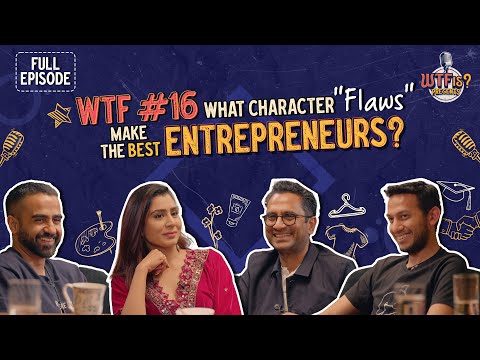
WTF Ep# 16 | What character "flaws" make the best entrepreneurs? Nikhil ft.Ritesh, Ghazal and Manish
Nikhil Kamath (host), Nikhil Kamath (host), Ghazal Alagh (guest), Ritesh Agarwal (guest), Nikhil Kamath (host), Manish Poddar (guest), Nikhil Kamath (host), Ghazal Alagh (guest), Nikhil Kamath (host), Ghazal Alagh (guest), Nikhil Kamath (host), Ritesh Agarwal (guest), Ghazal Alagh (guest), Ritesh Agarwal (guest)
In this episode of Nikhil Kamath, featuring Nikhil Kamath and Nikhil Kamath, WTF Ep# 16 | What character "flaws" make the best entrepreneurs? Nikhil ft.Ritesh, Ghazal and Manish explores three founders reveal hidden flaws and traits behind entrepreneurial success Nikhil Kamath interviews Ghazal Alagh (Mamaearth), Manish Poddar (Rare Rabbit), and Ritesh Agarwal (OYO) with an explicit goal: skip rehearsed advice and uncover the deeper “character flaws” and formative experiences that actually drive entrepreneurial outcomes.
Three founders reveal hidden flaws and traits behind entrepreneurial success
Nikhil Kamath interviews Ghazal Alagh (Mamaearth), Manish Poddar (Rare Rabbit), and Ritesh Agarwal (OYO) with an explicit goal: skip rehearsed advice and uncover the deeper “character flaws” and formative experiences that actually drive entrepreneurial outcomes.
Ghazal traces her entrepreneurial engine to childhood financial instability, loyalty scars, and confidence-building—then breaks down how she built Mamaearth with minimal capital using shared labs, cold outreach, and marketplace trust (Amazon Launchpad).
Manish explains how early exposure to Bombay’s textile ecosystem and European fashion culture (especially Inditex/Zara speed) shaped his obsession with detail, profitability, and brand “rigidity,” culminating in Rare Rabbit’s premium men’s fashion play.
Ritesh ties his calm demeanor to spirituality and upbringing, highlights contrarian clarity as a core CEO job, shares serendipity moments (Thiel Fellowship, visa incident, meeting cofounder Anuj, Lightspeed/SoftBank learnings), and details how OYO’s hyper-scaling, COVID shock, and consolidation refined his operating philosophy—ending with the announcement of a WTF founders fellowship grant.
Key Takeaways
Your ‘real’ founder advantages often come from childhood scars, not strategy.
Ghazal links her drive for financial independence and loyalty fixation to seeing her father’s business split and depression, while her mother’s resilience became her internal template for “we will turn it around. ...
Get the full analysis with uListen AI
Confidence can be ‘faked’ long enough to become real—and that’s entrepreneurial leverage.
Ghazal’s NIIT trainer story shows she taught older, experienced professionals while internally terrified; the lesson is that entrepreneurship repeatedly demands confident external signaling despite incomplete competence, because the downside is often limited early on.
Get the full analysis with uListen AI
Build products cheaply by borrowing credibility and infrastructure—don’t wait for CapEx.
Mamaearth prototypes were created with access to partners’ labs and shared ecosystems; warehousing and fulfillment were outsourced and variable-cost. ...
Get the full analysis with uListen AI
Marketplace trust can substitute for brand trust at the beginning.
Ghazal notes consumers hesitate to buy from a new website, but will trial a new brand on platforms they already trust (Amazon/Flipkart). ...
Get the full analysis with uListen AI
Talk in the customer’s language—even if your claims are technically accurate.
Standing outside a toy store to test reactions revealed that terms like “sulfate-free” didn’t land; clear “free-from harmful ingredients” communication did. ...
Get the full analysis with uListen AI
In fashion, story is the defensible IP—and ‘rigidity’ protects the brand from noise.
Manish argues the strongest IP is brand story plus consistent sensory cues (store fragrance, music, fonts, no chest logo). ...
Get the full analysis with uListen AI
Inditex’s edge is speed + trust + zero-bureaucracy execution—and it’s teachable.
Manish describes Zara’s culture of not refusing meetings, rapid decisions without paperwork, and extreme responsiveness. ...
Get the full analysis with uListen AI
Risk tolerance isn’t motivational—it’s structural to outcomes.
Manish taking a ₹37 crore loan with ~₹10 crore net worth, and Ghazal moving alone to New York early in marriage, illustrate a recurring pattern: outlier success correlates with taking asymmetric bets and accepting discomfort as normal.
Get the full analysis with uListen AI
Ritesh’s ‘calm’ is paired with fast feedback and solution coupling.
He describes bringing up issues quickly, usually with a proposed solution, and credits mentors like Bejoy (Lightspeed) for teaching direct, non-emotional feedback delivery. ...
Get the full analysis with uListen AI
Hypergrowth requires admitting mistakes early—or you end up trapped by your own narrative.
Ritesh details OYO’s losses driven disproportionately by minimum-guarantee contracts and bandwidth limits, and emphasizes “elephant out of the room” honesty to enable real problem-solving. ...
Get the full analysis with uListen AI
Notable Quotes
“Till the time you're taking money from anybody else, whoever you are taking it from, will make decisions for you.”
— Ghazal Alagh
“Confidence can be faked.”
— Ghazal Alagh
“Inditex cannot refuse an appointment.”
— Manish Poddar
“Story is the biggest IP.”
— Manish Poddar
“I call myself in a company chief clarity officer.”
— Ritesh Agarwal
Questions Answered in This Episode
Ghazal: When loyalty gets broken, what concrete practices help you rebuild trust without becoming guarded or biased in decision-making?
Nikhil Kamath interviews Ghazal Alagh (Mamaearth), Manish Poddar (Rare Rabbit), and Ritesh Agarwal (OYO) with an explicit goal: skip rehearsed advice and uncover the deeper “character flaws” and formative experiences that actually drive entrepreneurial outcomes.
Get the full analysis with uListen AI
Ghazal: If you were launching Mamaearth today from zero, would you still start on marketplaces first—or go D2C/social-first given current CAC and competition?
Ghazal traces her entrepreneurial engine to childhood financial instability, loyalty scars, and confidence-building—then breaks down how she built Mamaearth with minimal capital using shared labs, cold outreach, and marketplace trust (Amazon Launchpad).
Get the full analysis with uListen AI
Ghazal: You said personal care has “no IP” because ingredients are disclosed—what *is* the moat then (supply chain, R&D speed, brand, distribution), and how would you rank them?
Manish explains how early exposure to Bombay’s textile ecosystem and European fashion culture (especially Inditex/Zara speed) shaped his obsession with detail, profitability, and brand “rigidity,” culminating in Rare Rabbit’s premium men’s fashion play.
Get the full analysis with uListen AI
Manish: You call influencer marketing “never” for fashion—what specific data or experiences made you conclude it’s short-lived, and where *does* it work?
Ritesh ties his calm demeanor to spirituality and upbringing, highlights contrarian clarity as a core CEO job, shares serendipity moments (Thiel Fellowship, visa incident, meeting cofounder Anuj, Lightspeed/SoftBank learnings), and details how OYO’s hyper-scaling, COVID shock, and consolidation refined his operating philosophy—ending with the announcement of a WTF founders fellowship grant.
Get the full analysis with uListen AI
Manish: You describe ‘rigidity’ as essential—how do you separate healthy rigidity from stubbornness that ignores real consumer shifts?
Get the full analysis with uListen AI
Transcript Preview
whenever a young 21-year-old boy or girl wants to know what makes startup founders, people like yourself successful, they get generic [beep] . We don't want to know what you've said already, so intent here was to ask you non-usual questions. [upbeat music] Okay, guys, welcome, uh, all three of you. Thank you guys for coming.
Pleasure.
The very first thing we do when we call people is we try to get to know them in a manner that even they haven't spoken online or it's not available. So we don't want to know any of the stuff. You're all popular people. You've done interviews. Uh, we don't want to know what you've said already, so we'll try and nudge it in a direction, uh, which will help us learn a bit more about you. And, uh, for the point of this show, uh, there's no drama, there's no like, uh, you know, trying to get a reaction out of anyone. It's very much focused on a 20-year-old boy or girl, and when they are starting off, uh, what can they learn from the learnings you've had without any filters? Uh, we did a venture capital episode, and we came to the conclusion that 90, 95% of startups fail. You three have succeeded, and you must have done something differently, and today is about finding out what that could be and how other people can learn from it. So maybe we can start with Ghazal. Tell us about your life from the very beginning, from childhood, all of that, and take as much time-
And what others don't know yet.
Yes.
What others don't know? I, I think others don't know a lot about, um-
Anyone
... how confused and how, um, I would say I was still figuring it out for the longest period of time, until eventually, of course, people started believing that this is the definition of success, and that's for others, right? Uh, so I come from a humble middle-class family. I was born and brought up in Chandigarh. Uh, up till my marriage, Chandigarh was the only place that I'd stayed in, because the background that my parents come from, where I've come from, uh, they're not... They were not very pro sending women out for jobs or working. So that's, that's the, uh, you know, the childhood that I've experienced. I was probably the first woman in my family to go out and work. Uh, but the only difference between the rest of my family and my parents was, um, the conviction that both my parents had to ensure that our kids are going to be independent in life.
Was this in Chandigarh?
In Chandigarh itself.
Mm.
So, like I said, up till my marriage-
Mm.
-Chandigarh was my geographical, uh-
A very pretty geography.
Beautiful!
Mm.
It's called the City Beautiful, right?
Mm.
I love that place. I think till today, that's my favorite city.
Mm.
Uh, but while I was growing up, that wasn't the case, because I s- I saw potential outside the city, but I was not sort of allowed to explore it. I was told that within this five kilometer of radius, whatever you want to do, feel free to do it, feel free to pick it up.
Install uListen to search the full transcript and get AI-powered insights
Get Full TranscriptGet more from every podcast
AI summaries, searchable transcripts, and fact-checking. Free forever.
Add to Chrome