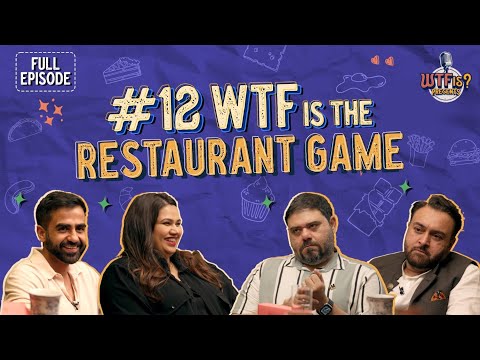
Ep# 12 | WTF is The Restaurant Game? Nikhil w/ Pooja Dhingra, Zorawar Kalra & Riyaaz Amlani
Nikhil Kamath (host), Nikhil Kamath (host), Pooja Dhingra (guest), Zorawar Kalra (guest), Riyaaz Amlani (guest), Nikhil Kamath (host), Zorawar Kalra (guest), Riyaaz Amlani (guest), Pooja Dhingra (guest), Pooja Dhingra (guest), Pooja Dhingra (guest), Riyaaz Amlani (guest), Zorawar Kalra (guest)
In this episode of Nikhil Kamath, featuring Nikhil Kamath and Nikhil Kamath, Ep# 12 | WTF is The Restaurant Game? Nikhil w/ Pooja Dhingra, Zorawar Kalra & Riyaaz Amlani explores a restaurateur’s crash course: building, scaling, and surviving India’s F&B This episode is framed as a practical masterclass for aspiring restaurant entrepreneurs, mixing personal origin stories with tactical advice on what actually makes restaurants work (or fail) in India.
A restaurateur’s crash course: building, scaling, and surviving India’s F&B
This episode is framed as a practical masterclass for aspiring restaurant entrepreneurs, mixing personal origin stories with tactical advice on what actually makes restaurants work (or fail) in India.
The guests argue that restaurants are a high-failure, under-capitalized business where success depends on disciplined unit economics, ruthless attention to execution, and a differentiated product/experience—far more than glamour or celebrity association.
They break down key levers: location selection using on-ground surveys and aggregator data, managing food/labor/rent ratios, building systems to reduce pilferage, and designing menus and interiors to influence customer behavior and repeat visits.
A major theme is the delivery ecosystem: aggregators create demand but compress margins through commissions + discovery fees + discounting; ONDC and direct channels are discussed as emerging counterweights. The episode ends with a commitment to fund and mentor a young under-22 F&B entrepreneur.
Key Takeaways
Most restaurants fail fast—plan for runway, not just launch capex.
They cite extreme mortality (roughly ~90% within a year and ~96% within 18 months) and blame under-capitalization: founders fund interiors/equipment but not gestation, forcing quality compromises that accelerate failure.
Get the full analysis with uListen AI
Passion matters, but it’s not enough—systems and cash discipline are the moat.
They define passion as “what you’d do for free,” yet admit motivation fluctuates; survivability comes from SOPs, audits, recipe discipline, and strong financial control rather than romantic attachment to the idea.
Get the full analysis with uListen AI
Location is still the biggest bet—validate it with a 2-day site survey and triangulated data.
Zorawar emphasizes visiting and observing competition; Riyaaz adds triangulation via brokers/JLL, supplier intelligence (who’s buying what where), and aggregator demand-supply mismatch data.
Get the full analysis with uListen AI
Use a low-capex test before opening a full outlet.
Pooja describes using a cloud-kitchen-style neighborhood test (e. ...
Get the full analysis with uListen AI
Restaurants are ‘real estate + experience’ businesses—monetize dead hours and surfaces.
They discuss restaurants as monetizable inventory: daytime coworking (SOCIAL), brand logo placements, art/crockery sales, and alternate models where advertising or ancillary revenue subsidizes food.
Get the full analysis with uListen AI
Unit economics: target clear cost bands and watch them weekly (or daily for bars).
Rules of thumb mentioned include COGS ~30–35% (varies by cuisine), labor ideally <15%, rent around ~15%, and disciplined reporting. ...
Get the full analysis with uListen AI
Aggregator growth has trained customers to chase deals, squeezing restaurant profitability.
Riyaaz claims effective take can reach ~40%+ when you add commissions + paid discovery/visibility, plus heavy discounting pressure; the guests warn this creates ‘discount addiction’ and undermines brand loyalty.
Get the full analysis with uListen AI
Negotiate with aggregators only when you have undeniable demand or exclusivity leverage.
Riyaaz’s blunt advice: build a strong product/recall first; institutions can command better terms. ...
Get the full analysis with uListen AI
ONDC is positioned as a long-term margin reset, but execution must match on-demand speed.
They see ONDC as democratization; current friction is storefront/discovery and reliance on third-party logistics. ...
Get the full analysis with uListen AI
Menu engineering and design influence AOV and repeat visits—use both print and digital intentionally.
They discuss ‘stars/dogs/workhorses’ and behavioral pricing/placement. ...
Get the full analysis with uListen AI
Celebrity restaurants rarely last—product and hospitality outlive launch buzz.
They argue celebrities can drive initial traffic but not retention; the only durable advantage is consistent quality and hospitality, with Nobu cited as a rare global exception.
Get the full analysis with uListen AI
Word of mouth is the enduring growth engine; theatrics fade, hospitality compounds.
Tableside drama and ‘Instagrammable’ design cycles change quickly; they emphasize ‘remarkable’ experiences—often even a single iconic dish—plus ‘hospitality vs service’ as the flywheel for organic growth.
Get the full analysis with uListen AI
Staff retention improves when employees see a credible growth path and feel ‘seen.’
Referrals are the top hiring channel; retention comes from approachable managers, empathy training, service charge distribution, and a clear multi-year progression plan (designation + pay), echoing Udupi/Shetty restaurant ladders.
Get the full analysis with uListen AI
Regulation is a major bottleneck; simplify to health, safety, and tax compliance.
Riyaaz critiques police NOCs and excessive licensing (30+), plus timing and excise constraints; they argue restaurants are infrastructure for community/culture and a major employer, so friction is economically counterproductive.
Get the full analysis with uListen AI
Notable Quotes
“This is a crash course in restauranteuring.”
— Nikhil Kamath
“90% of restaurants fail within the first year… the biggest reason… is under-capitalization.”
— Zorawar Kalra
“Why do I need a police permission to sell a sandwich?”
— Riyaaz Amlani
“India is not a price-sensitive market, it’s a value-sensitive market.”
— Riyaaz Amlani
“Restaurants are the final bastion of hope for human offline social engagement.”
— Zorawar Kalra
Questions Answered in This Episode
On failure rates: What’s your operational definition of ‘restaurant failure’—closure, cash-loss, or sub-scale profitability—and how does it vary by format (QSR/CDR/fine-dine/cloud kitchen)?
This episode is framed as a practical masterclass for aspiring restaurant entrepreneurs, mixing personal origin stories with tactical advice on what actually makes restaurants work (or fail) in India.
Get the full analysis with uListen AI
Capital planning: What minimum cash runway (months) would you insist on before opening, and what are the top 3 ‘gestation’ costs first-timers forget?
The guests argue that restaurants are a high-failure, under-capitalized business where success depends on disciplined unit economics, ruthless attention to execution, and a differentiated product/experience—far more than glamour or celebrity association.
Get the full analysis with uListen AI
Location playbook: Walk through an exact 48-hour site survey checklist—what do you count/observe, at what times, and what numbers are deal-breakers?
They break down key levers: location selection using on-ground surveys and aggregator data, managing food/labor/rent ratios, building systems to reduce pilferage, and designing menus and interiors to influence customer behavior and repeat visits.
Get the full analysis with uListen AI
Cloud kitchen debate: Zorawar vs Riyaaz—what specific conditions (brand strength, CAC, AOV, density, cuisine) make a new cloud kitchen profitable today?
A major theme is the delivery ecosystem: aggregators create demand but compress margins through commissions + discovery fees + discounting; ONDC and direct channels are discussed as emerging counterweights. ...
Get the full analysis with uListen AI
Aggregator economics: Can you break down a real order P&L (₹500, ₹800) showing commission + discovery spend + discounts + packaging to illustrate the margin squeeze?
Get the full analysis with uListen AI
Transcript Preview
[upbeat music] This show, uh, is meant solely as an exercise in education for entrepreneurs. [upbeat music] Uh, I think this will be incredibly useful to so many young people who want to start a restaurant.
This is a crash course in restauranteuring. [upbeat music]
Okay, guys, ready, start? [upbeat music] Hi, guys.
Hello.
Thank you for, uh, flying down to Bangalore.
On a Friday night.
On a Friday night. I hope this is not the worst way to spend your Friday night. We'll try and make it as fun as we can. Uh, the intent of this show is very much not to make it about ourselves. Uh, so typically, you know, none of our egos come into play or what we do too much. I- it's more focused on an entrepreneur who wants to start a restaurant. I think pretty much everybody wants to open one. At some point in their life, they've thought of it. I've thought of it. I've attempted it and failed a bunch of times. So we'll focus on that, and through the show, let's try and cover all that might be needed in opening a restaurant, and every point that we can cover, we'll try and approach. Let's start with introductions. Uh, let's start with Pooja first.
Hmm.
Tell us about you.
Where do I start from?
From the beginning.
From the beginning.
[chuckles]
So I'm from Bombay. I grew up there.
Yeah.
Uh, I started baking when I was six years old, uh, with my aunt, and I just thought it was really beautiful, simple ingredients.
Tell us a bit about your parents as well.
Um, my parents, so my dad, um, ran his own business, which was, um, importing ball bearings, and my mom was, uh, a, a housewife, and so she used to cook and bake a lot, so I used to bake with her. And-
Is there a lot of money in ball bearings? So what we're trying to do is a euphemized way of asking was your dad wealthy?
Um, he wasn't initially. He [chuckles] he started off, uh, you know... H- he was kicked out from the family, so he had to start his own business. It took him a lot of time to kind of find his ground. Um, so we actually grew up with, uh, you know, being very conservative and being told that, "You can't afford this," and, "You can't do that," but they did the best that they could for us, right? Uh, we went to a good school, and then as we grew up, like, his business also did well, and then that kind of, um, you know, we saw him, uh... At least for me, that was, uh, that was a great sort of thing to see what you can build from scratch. And, and I always knew that if I had to do anything, it would never be, um, a job. I would always do something of myself, so-
And things got better while you were in high school or something?
Install uListen to search the full transcript and get AI-powered insights
Get Full TranscriptGet more from every podcast
AI summaries, searchable transcripts, and fact-checking. Free forever.
Add to Chrome