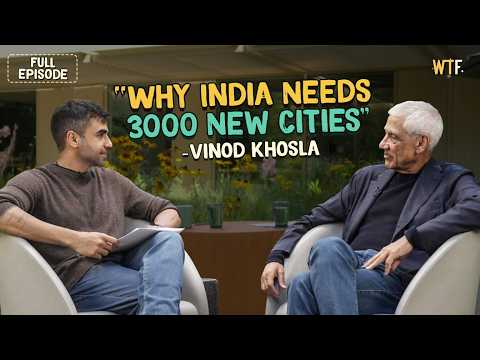
Vinod Khosla: College Degrees Are Becoming Useless | People by WTF | Episode 12
Nikhil Kamath (host), Vinod Khosla (guest)
In this episode of Nikhil Kamath, featuring Nikhil Kamath and Vinod Khosla, Vinod Khosla: College Degrees Are Becoming Useless | People by WTF | Episode 12 explores vinod Khosla on AI, education, cities, and entrepreneurship strategy Khosla predicts AI will be able to do “80% of 80%” of jobs within a few years, making traditional career planning and narrow specialization increasingly fragile.
Vinod Khosla on AI, education, cities, and entrepreneurship strategy
Khosla predicts AI will be able to do “80% of 80%” of jobs within a few years, making traditional career planning and narrow specialization increasingly fragile.
He frames success—both as an entrepreneur and investor—as imagining what technology makes possible and persistently making that world happen, rather than seeking certainty or incremental validation.
He outlines a near-term entrepreneurial playbook: apply AI to obsolete non‑AI incumbents on cost/quality, while differentiating via strategy, team-building, and selecting high-quality advice.
Khosla extends the conversation to societal infrastructure: AI could make education, legal, and much of medical expertise close to free, pushing economies toward deflation and forcing new redistribution policies, while also influencing urbanization, mobility, sovereign AI, and crypto/blockchain adoption.
Key Takeaways
Assume AI will do most job tasks soon.
Khosla’s core forecast is that AI can handle “80% of 80%” of jobs within 3–5 years, and in 10–15 years there are few roles where humans remain uniquely necessary (often due more to regulation than capability). ...
Get the full analysis with uListen AI
Optimize for flexibility, not a fixed profession.
He advises young people to build the “ability to learn” and move across domains quickly—because the future is defined by unpredictable “improbables. ...
Get the full analysis with uListen AI
Be a generalist who can use AI well.
Khosla explicitly recommends generalism over specialization: AI will commoditize many specialist outputs, while people who can frame problems, learn fast, and leverage AI tools will outcompete those who don’t.
Get the full analysis with uListen AI
Entrepreneurial advantage shifts to strategy, teams, and advice quality.
If AI capabilities are democratized, Khosla expects differentiation to come from long-horizon strategy (the “Everest camps” analogy), recruiting and decision-making, and especially knowing whose advice to trust. ...
Get the full analysis with uListen AI
The near-term startup play is ‘obsolete non‑AI incumbents’.
His practical rubric for the next decade: find any industry where applying AI beats providers not using AI on cost, performance, or quality. ...
Get the full analysis with uListen AI
AI can make key services nearly free—if policy enables it.
Khosla describes a world where AI tutors, doctors, therapists, lawyers, and even judges provide expertise at near-zero marginal cost, expanding access in places like India. ...
Get the full analysis with uListen AI
Expect deflation in many ‘expertise’ services; redistribution becomes necessary.
He favors an AI-driven deflationary path—where abundant AI labor makes services cheap/free—over pure cash transfers, but still predicts some form of redistribution is “absolutely essential” by ~2050. ...
Get the full analysis with uListen AI
Notable Quotes
“Almost certainly, with no doubt, there isn't a job where AI won't be able to do eighty percent of eighty percent of all jobs.”
— Vinod Khosla
“Skeptics never did the impossible.”
— Vinod Khosla
“I learned the ability to learn.”
— Vinod Khosla
“Anybody in any industry not using AI will be obsoleted by somebody who's using AI.”
— Vinod Khosla
“The single most important decision an entrepreneur makes is whose advice to trust on what topic.”
— Vinod Khosla
Questions Answered in This Episode
Khosla predicts AI can do “80% of 80% of jobs” in 3–5 years—what concrete job categories does he think will be last to fall, and why (capability vs regulation)?
Khosla predicts AI will be able to do “80% of 80%” of jobs within a few years, making traditional career planning and narrow specialization increasingly fragile.
Get the full analysis with uListen AI
If generalism wins, what should a 22-year-old *practice weekly* to build ‘learning agility’ and first-principles thinking (projects, reading, AI workflows)?
He frames success—both as an entrepreneur and investor—as imagining what technology makes possible and persistently making that world happen, rather than seeking certainty or incremental validation.
Get the full analysis with uListen AI
Khosla says your starting industry “almost doesn’t matter”—what are the exceptions where choosing the wrong starting environment permanently handicaps learning compounding?
He outlines a near-term entrepreneurial playbook: apply AI to obsolete non‑AI incumbents on cost/quality, while differentiating via strategy, team-building, and selecting high-quality advice.
Get the full analysis with uListen AI
In his ‘obsolete non‑AI incumbents’ playbook, what are 3 India-specific sectors where incumbents are structurally unable to adopt AI fast enough (and why)?
Khosla extends the conversation to societal infrastructure: AI could make education, legal, and much of medical expertise close to free, pushing economies toward deflation and forcing new redistribution policies, while also influencing urbanization, mobility, sovereign AI, and crypto/blockchain adoption.
Get the full analysis with uListen AI
He argues most VC advice is bad—what signals help founders distinguish high-quality strategic advice from short-term revenue-maximizing guidance?
Get the full analysis with uListen AI
Transcript Preview
[upbeat music] You seem like a very certain person. You take the contrarian opinion in a very certain manner.
Almost certainly, with no doubt, there isn't a job where AI won't be able to do eighty percent of eighty percent of all jobs. And that's what today's twenty or twenty-two-year-old has to take for granted.
[upbeat music] Hi, Vinod. Thank you for doing this. For our audience in India, which are largely entrepreneurs or going to be entrepreneurs, I don't want to introduce you. Maybe you can tell us a little bit about your life. Your story is very well known, so I don't have to rehash it for them. But maybe you tell us a bit about life, how you began, and where you are today.
Well, I, you know, life, [chuckles] my life has been pretty simple. I haven't done too many things-
Mm.
-too many different things. But I was always curious about technology, and the piece people don't understand is, or don't know, I would say, there's nothing to understand. Do you want me to stop when there's a sound overhead or keep going?
Is it okay?
Keep going.
Yeah, it's okay.
Okay. Uh-
Makes it more natural. [chuckles]
Okay. Yeah, sometimes people do, and sometimes people don't.
Right. Do you do a lot of these interviews?
I do a fair number. [chuckles] Yeah. Um, when I was sixteen, I'd go from Delhi Cantonment, where I lived-
Mm-hmm
... to Old Delhi to rent old magazines. That's how you got access to information. There was no place to go-
Mm-hmm
-to get access to magazines or others, unless you could afford to buy them, and we couldn't, so. Uh, but I used to get old issues of technology magazines, uh, especially the Electronic Engineering Times, to see what was going on. And I read about Andy Grove as a Hungarian immigrant-
Mm-hmm
... coming and starting a company here, and that's what fascinated me and got me interested in, "Why can't I start a technology company?" I had very little interest and still have very little interest in business.
Mm-hmm.
I do it because it needs to be done, but I mostly am interested in technology and the impact it can have. So I got enamored by this guy. Uh, and all I knew about Hungary was they had great stamps. So if you collected stamps, back then, you always wanted Hungarian stamps. [chuckles]
Mm-hmm.
But, uh, I followed his story.
Why did you want Hungarian stamps?
Oh, I used to collect stamps as a kid.
Mm-hmm.
There wasn't, like, sixteen things to do.
Mm.
There was no internet, there was no libraries you had access to, there was not a lot of magazines.
Mm-hmm.
There wasn't much to read or get information f- uh, from. So you had hobbies like stamp collecting or coin collecting or... Uh, I, I couldn't afford vintage car collecting, which some people did, but I worked on cars like that. But, uh, so there wasn't a whole lot to do. Um, and I used to read these magazines by renting them, and usually when the magazine got old in the area, like in the US, they got shipped-
Install uListen to search the full transcript and get AI-powered insights
Get Full TranscriptGet more from every podcast
AI summaries, searchable transcripts, and fact-checking. Free forever.
Add to Chrome