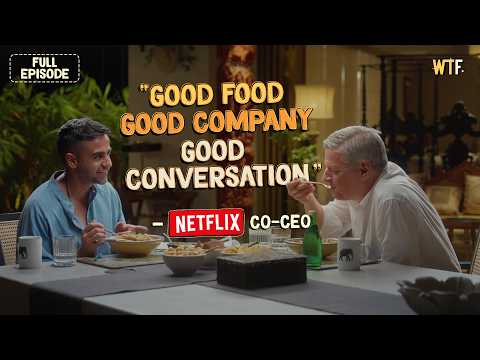
Nikhil Kamath x Netflix Co-CEO, Ted Sarandos | People by WTF | Ep. 10
Nikhil Kamath (host), Ted Sarandos (guest)
In this episode of Nikhil Kamath, featuring Nikhil Kamath and Ted Sarandos, Nikhil Kamath x Netflix Co-CEO, Ted Sarandos | People by WTF | Ep. 10 explores ted Sarandos on Netflix’s evolution, culture, storytelling, and India strategy Ted Sarandos recounts Netflix’s early DVD-by-mail days, Reed Hastings’ original vision for global internet-delivered entertainment, and the practical lessons Netflix took from beating Blockbuster’s “managed dissatisfaction” (late fees, poor selection, bad customer experience).
Ted Sarandos on Netflix’s evolution, culture, storytelling, and India strategy
Ted Sarandos recounts Netflix’s early DVD-by-mail days, Reed Hastings’ original vision for global internet-delivered entertainment, and the practical lessons Netflix took from beating Blockbuster’s “managed dissatisfaction” (late fees, poor selection, bad customer experience).
He explains Netflix’s distinctive operating model: an unusually high “talent density” culture (sports-team mindset), a tech-first delivery obsession, and a content strategy focused on helping each user quickly find something they’ll truly watch through to the end.
On content, Sarandos argues that “good” is the only durable bet, that authentically local stories travel best globally, and that greenlighting is primarily gut-driven rather than algorithmic—backed by deep viewing literacy and a willingness to fail.
The discussion turns to India’s unique dynamics (subscriptions, broadband/TV penetration, global tastes), Netflix’s stance on sports and theaters, how AI may change creativity more than distribution, and why podcasts/video creators could increasingly belong on Netflix.
Key Takeaways
Netflix’s “pivots” still followed one original vision: digital global delivery.
Sarandos says Hastings described Netflix in 1999 almost exactly as it exists today—DVDs were simply the cheapest way to “move bits” before internet bandwidth made streaming viable.
Get the full analysis with uListen AI
Blockbuster lost on the peak-pain moment: late fees and second-choice shopping.
Netflix designed its model to remove the worst emotional memory (late fees) and the “didn’t get what I came for” issue by using queues, selection depth, and next-day logistics.
Get the full analysis with uListen AI
Talent density beats rules—otherwise you “idiot-proof” into mediocrity.
Sarandos defends Netflix’s sports-team culture: high bar, clear expectations, and fast exits to avoid rule-heavy bureaucracy that attracts people who prefer compliance over excellence.
Get the full analysis with uListen AI
A Netflix win is not a click; it’s completion and sustained satisfaction.
The core success metric is “push play, do you stay? ...
Get the full analysis with uListen AI
The most valuable global hits tend to be “authentically local.”
Sarandos argues Squid Game worked because it stayed fundamentally Korean while expressing universal themes; sanding off cultural edges to “travel” often makes content less compelling everywhere.
Get the full analysis with uListen AI
Length is not a format decision; it’s a story decision.
He suggests many documentaries fail by choosing the wrong running time (short vs. ...
Get the full analysis with uListen AI
Tech quality is table stakes; seamless delivery is a strategic moat.
Netflix invested heavily in device-by-device optimization, adaptive bitrate (“downshift” without obvious buffering), compression, and Open Connect edge delivery—making playback/seek feel smoother than rivals.
Get the full analysis with uListen AI
Big sports rights are structurally low-margin for distributors.
Sarandos believes the leagues capture most profits; building fandom (e. ...
Get the full analysis with uListen AI
India is a long game: payments culture, broadband growth, and changing addressable market.
He notes early misunderstandings about recurring payments and that India’s subscription hesitancy is partly cultural and credit-access related; the real unlock is rising fixed broadband and big-screen adoption.
Get the full analysis with uListen AI
Ads can expand access, but ads-only cannot fund Netflix’s ambition.
Sarandos says Netflix will remain “choice-based” (ad-free option always) and expects ads to be meaningful but limited; too much ad load undermines premium storytelling economics.
Get the full analysis with uListen AI
AI’s disruption will likely be creative tooling, not replacing human storytelling.
He frames AI as cost-reducing and capability-expanding (e. ...
Get the full analysis with uListen AI
Greenlighting is gut-led and creator-led—algorithms don’t pick projects.
Sarandos says Netflix can’t reverse-engineer themes for success; decisions rely on story quality, whether audiences will care about characters, and whether the creators can deliver—often betting on unproven talent (e. ...
Get the full analysis with uListen AI
Notable Quotes
““You can idiot-proof your business, but then you’re gonna end up with a business full of idiots.””
— Ted Sarandos
““This is not a family. This is a sports team, a high-performing sports team.””
— Ted Sarandos
““The thing that we really value is when you push play, do you stay?””
— Ted Sarandos
““Authentically local storytelling being the most globally valuable is unintuitive but totally true.””
— Ted Sarandos
““Big league sports, likely the league owners keep all the profits always.””
— Ted Sarandos
Questions Answered in This Episode
On Netflix culture: How does Netflix prevent “talent density” from turning into burnout or fear-based performance management, especially outside the U.S.?
Ted Sarandos recounts Netflix’s early DVD-by-mail days, Reed Hastings’ original vision for global internet-delivered entertainment, and the practical lessons Netflix took from beating Blockbuster’s “managed dissatisfaction” (late fees, poor selection, bad customer experience).
Get the full analysis with uListen AI
On recommendations: When you say the goal is “the movie you’ll love,” how do you balance personalization with helping people discover outside their existing taste bubble?
He explains Netflix’s distinctive operating model: an unusually high “talent density” culture (sports-team mindset), a tech-first delivery obsession, and a content strategy focused on helping each user quickly find something they’ll truly watch through to the end.
Get the full analysis with uListen AI
On India strategy: If Sacred Games was “too novel too early,” what specific genres or formats would you launch first if you were rebooting Netflix India today?
On content, Sarandos argues that “good” is the only durable bet, that authentically local stories travel best globally, and that greenlighting is primarily gut-driven rather than algorithmic—backed by deep viewing literacy and a willingness to fail.
Get the full analysis with uListen AI
On tech moat: What are the 2–3 most important engineering bets Netflix made (adaptive bitrate, Open Connect, device optimization, etc.) that competitors still underestimate?
The discussion turns to India’s unique dynamics (subscriptions, broadband/TV penetration, global tastes), Netflix’s stance on sports and theaters, how AI may change creativity more than distribution, and why podcasts/video creators could increasingly belong on Netflix.
Get the full analysis with uListen AI
On greenlighting: Can you describe a recent project you said yes to with limited data—and what concrete signals in the creator/story reduced your risk?
Get the full analysis with uListen AI
Transcript Preview
[upbeat music] If you were to describe Ted, the human, in three words, what would the three words be? [upbeat music] Hi, Ted.
Hey, how are you?
Thank you. Good.
Thanks for having me.
Thank you for coming. Uh, so you've been in India for 12 hours now?
About [chuckles] about 12 hours, yeah.
How does it feel?
I love being- coming to India so much, and it's... I never get enough time here.
Mm-hmm.
Usually I come, and I've got a- they've got me working and grinding me out, and then shoot me back out, back in the sky.
What-
But it's, uh, it's a, it's a... I love the energy of India.
What have you done so far today?
Today, I, uh, came in, I met with the ministers, and I met-- I went to the Waves conference and spoke on stage-
Mm-hmm
... and was interviewed. Uh.
Do you have a favorite creator in India?
That's like, you know, we work with so many, it'd be like, uh, picking your kids, but, you know, picking your favorite child almost. But I have to tell you, early, early in coming to India, I met, uh, Shah Rukh Khan right away-
Mm-hmm
... early, and we just, he hosted a very nice little dinner for, for me, and we just hit it off immediately. And, uh, I've come back since with my, with my wife, and we've had, uh, a ni- nice times together. I, he, we visited with each other in Los Angeles when his son was in school, uh, so we got to go out to dinner. So going, having dinner with Shah Rukh Khan in India is much different than having dinner with him-
Yeah
... in, in Los Angeles. Uh, but so I would say, I mean, that's probably who, someone I know the most-
Yeah
... and really enjoy working with.
So you've been at Netflix forever.
Twenty-five years this, this... Just recently passed 25th, my past, my 25th year anniversary.
I have watched a lot of your interviews, probably most of them.
Sorry. [laughing]
[laughing] I know Reed a little bit-
Yeah
... 'cause we're in the Gates pledge together, so we have one offsite we do every year, which Gates organizes. And funnily enough, me and him did a speaking session last year, not on camera.
Yeah.
And I was asking him a bunch of questions on the, on a lot of the same stuff, like, "Where is content, the media space today, and where will it be at tomorrow?" And I've been reading about the story of Netflix and how many pivots you've had from starting off one way-
Yeah
... to becoming another thing, to becoming another thing, and maybe you're another thing tomorrow altogether again. Uh, would you like to tell me the story in your words? You've been there almost from the beginning, and-
Yeah, I, I met Reed in 1999-
Mm
... October of 1999, and he... I, I had a, I was in the home video business for many years before. Um, I knew of Netflix because I bought a DVD player, and I opened up the box, and there was a card in there to join this thing called Netflix, and you could rent DVDs through the mail. Not subscription yet.
Install uListen to search the full transcript and get AI-powered insights
Get Full TranscriptGet more from every podcast
AI summaries, searchable transcripts, and fact-checking. Free forever.
Add to Chrome