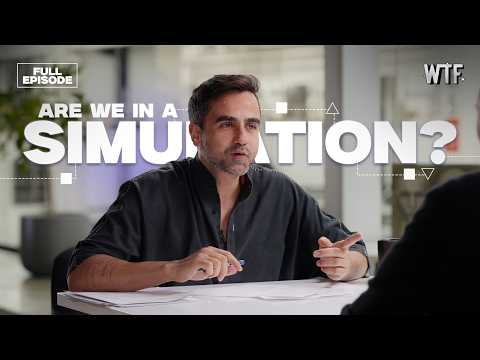
Elon Musk: A Different Conversation w/ Nikhil Kamath | Full Episode | People by WTF Ep. 16
Nikhil Kamath (host), Elon Musk (guest)
In this episode of Nikhil Kamath, featuring Nikhil Kamath and Elon Musk, Elon Musk: A Different Conversation w/ Nikhil Kamath | Full Episode | People by WTF Ep. 16 explores musk on X, AI future, meaning, politics, and building value Musk frames X as a “global town square” optimized for high-signal text today but increasingly video/real-time AI in the future, aiming for a cross-language “collective consciousness.” He argues AI and robotics will drive radical productivity gains—possibly making work optional within 10–20 years—reshaping money, inflation/deflation dynamics, and even the relevance of nation-states. The conversation ranges from simulation theory and morality to practical topics like Starlink’s physics constraints, investing criteria, AI regulation, and the business–politics boundary. He closes with direct advice to entrepreneurs: focus on building useful products, create more value than you take, and expect intense effort with real risk of failure.
Musk on X, AI future, meaning, politics, and building value
Musk frames X as a “global town square” optimized for high-signal text today but increasingly video/real-time AI in the future, aiming for a cross-language “collective consciousness.” He argues AI and robotics will drive radical productivity gains—possibly making work optional within 10–20 years—reshaping money, inflation/deflation dynamics, and even the relevance of nation-states. The conversation ranges from simulation theory and morality to practical topics like Starlink’s physics constraints, investing criteria, AI regulation, and the business–politics boundary. He closes with direct advice to entrepreneurs: focus on building useful products, create more value than you take, and expect intense effort with real risk of failure.
Key Takeaways
X’s edge is high-density information, not pure entertainment.
Musk claims text is a smaller share of total internet “bits” than video but is often higher-value and more compressed; he positions X as strongest among “readers, writers, and thinkers,” while acknowledging the internet will increasingly optimize for dopamine-driven video.
Get the full analysis with uListen
Musk’s ideal for X is cross-language collective consciousness.
He emphasizes features like automatic translation to unify discourse across languages, arguing better information flow among humans enables qualitatively new collective achievements (analogous to how many cells enable a mind).
Get the full analysis with uListen
Starlink is structurally complementary to terrestrial networks, not a city-wide replacement.
Because of physics (distance/beam geometry), Starlink can’t compete with 1 km-away cell towers in dense cities; it excels in rural/underserved areas and disaster recovery, with satellite laser links providing resilience when undersea cables fail.
Get the full analysis with uListen
He predicts “work will be optional” within ~10–20 years.
Musk argues AI plus robotics will push productivity so high that humans won’t need jobs for basic goods/services—work becomes more like a hobby—leading to “universal high income” rather than mere subsistence-level support.
Get the full analysis with uListen
In the long run, he expects money to fade and energy to be the binding constraint.
He describes money as an information system for allocating labor; as AI/robots satisfy needs and close the production loop (robots making robots/chips/solar), money’s role declines, leaving energy generation/usage as the practical ‘currency’ (Kardashev scale framing).
Get the full analysis with uListen
AI-driven productivity is his proposed escape valve for the US debt trajectory.
He notes US interest payments exceeding military spending and argues only massive productivity growth can stabilize the situation; he expects a shift toward deflation once goods/services growth outpaces money supply growth (he speculates ~3 years for that crossover).
Get the full analysis with uListen
For safe AI, prioritize truth-seeking, beauty, and curiosity.
Musk warns forcing AI to “believe falsehoods” can create incoherent reasoning and dangerous outcomes (citing HAL in 2001); he argues aligning AI around truth, an appreciation of beauty, and curiosity makes human flourishing more likely than human harm.
Get the full analysis with uListen
Politics is unavoidable at scale but usually damaging to engage directly.
He calls politics a “blood sport,” advising avoidance where possible; once companies reach scale, political forces ‘find you,’ and direct involvement tends to end badly for business leaders.
Get the full analysis with uListen
Operational fixes beat rhetoric in government efficiency.
His DOGE example stresses auditability: requiring payment codes and meaningful notes could save massive sums by making fraud/waste detectable; he claims pushback often uses sympathetic narratives that mask corruption.
Get the full analysis with uListen
Entrepreneurship: pursue usefulness, not money; grind is non-negotiable.
He advises founders to build products/services that are genuinely useful and to ‘make more than you take’; financial outcomes follow value creation, but only with sustained hard work and acceptance of failure risk.
Get the full analysis with uListen
Notable Quotes
““The text tends to be higher value… more densely compressed information.””
— Elon Musk
““My goal is not… the most dopamine-generating video stream… It becomes like a drug type of thing.””
— Elon Musk
““My prediction is… in less than 20 years, working will be optional.””
— Elon Musk
““Don’t force an AI to believe falsehoods. I think that can be very dangerous.””
— Elon Musk
““It is very easy to give money away to get the appearance of goodness. It is very difficult to give money away for the reality of goodness.””
— Elon Musk
Questions Answered in This Episode
On X: What concrete product changes would move X from “town square” to a true WeChat-like super-app without degrading discourse quality?
Musk frames X as a “global town square” optimized for high-signal text today but increasingly video/real-time AI in the future, aiming for a cross-language “collective consciousness. ...
Get the full analysis with uListen AI
Collective consciousness: How would you measure whether translation and information flow are actually increasing collective understanding rather than just scaling conflict?
Get the full analysis with uListen AI
Starlink: If physics blocks dense-city competitiveness, what’s the realistic upper bound of Starlink’s addressable market by population and geography?
Get the full analysis with uListen AI
Work optional: What social institutions (education, status, purpose, community) do you think break first in a post-work economy, and how would you redesign them?
Get the full analysis with uListen AI
UHI vs UBI: What mechanism distributes ‘universal high income’—ownership of productive AI, taxation, public provisioning, or something else?
Get the full analysis with uListen AI
Transcript Preview
[upbeat music] Our audience is largely wannabe entrepreneurs in India, and I feel like all of us have so much to learn from you because you've done it so many times over in so many different domains.
Yeah.
Uh, so we will speak to them today, and I will try and center all my questions in that direction so they can take advantage of this conversation and maybe start, take a chance, and build something. [upbeat music]
[laughing]
Do you want a coffee?
Um, sure, why not?
Okay.
Okay. Are we gonna be talking for a while? [laughing]
[laughing] I hope we are.
Okay, good. Sure. Um-
Meghna?
May I trouble you for a coffee?
Can we get another coffee?
Anything specific?
Uh, cappuccino, I guess.
Cappuccino.
All right. [chuckles]
Are you a coffee drinker, Elon?
Uh, yeah, yeah.
Yeah.
I mean, yeah, I have coffee once, usually in the mornings, you know.
Okay.
[laughing]
One a day kind of thing?
Yeah, pretty much.
Ah. You want to wait for it? Or-
No, I'm, I'm, I'm good.
[laughing]
[laughing]
[chuckles] The first thing I must say-
Okay
... is you're a lot bigger and bulkier, muscular than I would have thought you are.
Oh, oh, stop. You're, you're making me blush. [laughing]
[laughing] Really, seriously. [laughing]
[laughing] Yeah, I mean, look, on the internet, I'm small, you know. [laughing]
[laughing] You're essentially... What percentage of internet-
Yeah
... is spent on Twitter? Is there a number to it, on X?
Well, I, I, m- so we have, like, about six hundred million monthly users.
Mm-hmm.
Um, well, although it, it can spike up if there's, if there's some major event in the world, it can get up to, I don't know, eight hundred million or, or, or a billion, um, if there's some major event in the world.
Mm-hmm.
So, uh, so, so, so there's, I don't know, two hundred and fifty to three hundred million per week type of thing.
Right.
It's, it's a pretty decent number, and, and it, it tends to be, um, readers, you know-
Mm-hmm
... people that read words. [laughing]
[laughing]
Um, you know, so-
Do you think that'll change?
Um, yeah, I mean, it, it, there's, uh, there's certainly a lot of video on, on, um, on the X system, but, uh, at this point, increasing amounts of video. But I, I think where, where, uh, the X network is strongest is among people who, who think, who think a lot and read a lot, you know? So it's-- that's where it's gonna be strongest because we have words. [laughing]
[laughing]
And, and, you know, so, um, among, among readers, writers, and thinkers, I think, uh, X is number one in the world.
As far as social media goes, the form factor, if you had to wager a guess for tomorrow-
Yeah
... how much is text? How much is video? Uh, I've heard you speak about maybe voice and hearing being the next form of communication with AI. What happens to X in its true form? How does it evolve?
Install uListen to search the full transcript and get AI-powered insights
Get Full TranscriptGet more from every podcast
AI summaries, searchable transcripts, and fact-checking. Free forever.
Add to Chrome