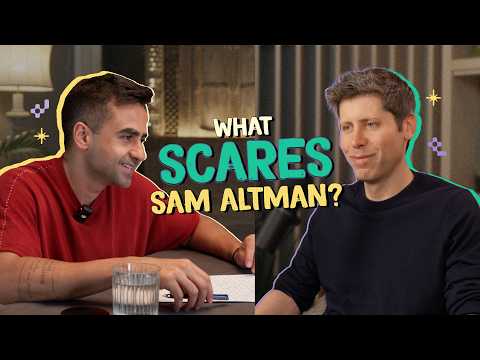
Sam Altman x Nikhil Kamath: How to Win When AI Changes Everything | People by WTF | Episode 13
Sam Altman (guest), Nikhil Kamath (host)
In this episode of Nikhil Kamath, featuring Sam Altman and Nikhil Kamath, Sam Altman x Nikhil Kamath: How to Win When AI Changes Everything | People by WTF | Episode 13 explores sam Altman on GPT-5, careers, economics, and human value Altman frames GPT-5 as a step-change in fluency, reliability, and “one integrated model” usability, making prior-generation models feel meaningfully worse and enabling longer, more agentic workflows.
Sam Altman on GPT-5, careers, economics, and human value
Altman frames GPT-5 as a step-change in fluency, reliability, and “one integrated model” usability, making prior-generation models feel meaningfully worse and enabling longer, more agentic workflows.
For careers and startups, he argues the biggest near-term advantage is AI-tool fluency: small teams (or individuals) can now build software, marketing, support, and even legal review workflows with unprecedented leverage.
He emphasizes durable value creation over “thin wrappers,” likening AI to the transistor and the App Store era: some apps become platform features, while others (e.g., Uber-like) become enduring businesses by owning the customer relationship and real-world complexity.
The conversation broadens to societal impacts—redistribution/UBI experiments, capital’s shifting role under potential deflation, the enduring value of real human identity, and upcoming “AGI-feeling” moments like everyday robots and ambient AI hardware form factors—ending with strong optimism about India’s producer potential.
Key Takeaways
GPT-5’s biggest upgrade is everyday usability, not just benchmarks.
Altman says the most striking change is how painful it feels to revert to older models—GPT-5 brings a new baseline of “fluency and depth,” plus higher reliability that makes it useful across many real tasks.
Get the full analysis with uListen AI
Integrated “one model” design lowers friction and expands adoption.
By removing the need to choose among multiple model variants, GPT-5 becomes a default tool—closer to having always-available expert help for writing software, research, planning, and operations.
Get the full analysis with uListen AI
Career edge shifts from credentials to AI-native execution.
He downplays which specific subject to study (biology vs physics, etc. ...
Get the full analysis with uListen AI
A practical way to become AI-native: build tiny software for your own life.
Altman describes iterating with GPT-5 to draft and refine small apps as a hands-on method to learn prompting, iteration, and workflow design—turning daily problems into an AI skill gym.
Get the full analysis with uListen AI
AI unlocks ‘team-sized’ output for solo founders, but doesn’t grant defensibility.
He warns that “using AI itself does not create a defensible business”; founders must convert the tech boost into durable value—distribution, customer relationships, domain depth, trust, or workflow lock-in.
Get the full analysis with uListen AI
Wrappers will bifurcate: many get absorbed, some become enduring companies.
Using iPhone-era examples (flashlight apps vs Uber), he argues thin feature-wrappers are likely to be subsumed as models/platforms improve, while companies solving full-stack problems can remain durable.
Get the full analysis with uListen AI
In an AI-abundant world, ‘real human’ identity may appreciate in value.
Altman expects people to keep caring about humans for cultural/biological reasons—so authenticity, story, and social meaning can outperform pure intelligence in domains like media and public-facing work.
Get the full analysis with uListen AI
Societal systems likely move toward more redistribution and experimentation.
Rather than a clean shift to “socialism,” he anticipates increased social support via experiments like sovereign wealth funds, UBI-like mechanisms, or even redistribution of AI compute—varying by country.
Get the full analysis with uListen AI
Robots and ambient hardware may be the most visceral ‘AGI-feeling’ shift soon.
He predicts everyday robots doing normal tasks will feel transformative, and that current phone/computer form factors are ill-suited for proactive, context-rich AI companions—driving experimentation in wearables and ambient devices.
Get the full analysis with uListen AI
Notable Quotes
“Going back from GPT-5 to our previous generation model, is just so painful. It's just, like, worse at everything.”
— Sam Altman
“It's just one thing that works, and it is like having PhD-level experts in every field available to you twenty-four seven.”
— Sam Altman
“Learning how to use AI tools is probably the most important, specific, hard skill to learn.”
— Sam Altman
“No one knows what happens next.”
— Sam Altman
“Using AI itself does not create a defensible business.”
— Sam Altman
Questions Answered in This Episode
When you say GPT-5 feels like “one integrated model,” what specific capability tradeoffs were made (latency, cost, safety constraints) versus specialized model switching?
Altman frames GPT-5 as a step-change in fluency, reliability, and “one integrated model” usability, making prior-generation models feel meaningfully worse and enabling longer, more agentic workflows.
Get the full analysis with uListen AI
What does “much better agentic workflows” concretely mean—longer context, better tool use, better planning, fewer failure modes, or improved instruction-following under ambiguity?
For careers and startups, he argues the biggest near-term advantage is AI-tool fluency: small teams (or individuals) can now build software, marketing, support, and even legal review workflows with unprecedented leverage.
Get the full analysis with uListen AI
You compare AI to the transistor: what are the strongest counterarguments that AI is instead closer to a platform winner-take-most dynamic?
He emphasizes durable value creation over “thin wrappers,” likening AI to the transistor and the App Store era: some apps become platform features, while others (e. ...
Get the full analysis with uListen AI
For a 25-year-old in India, what are 3–5 concrete project types (not industries) that best build AI fluency quickly—e.g., internal tools, bots, data pipelines, customer-support automations?
The conversation broadens to societal impacts—redistribution/UBI experiments, capital’s shifting role under potential deflation, the enduring value of real human identity, and upcoming “AGI-feeling” moments like everyday robots and ambient AI hardware form factors—ending with strong optimism about India’s producer potential.
Get the full analysis with uListen AI
On ‘thin wrappers’: what signals reliably predict whether a wrapper will be absorbed by the base model versus becoming an Uber-like enduring business?
Get the full analysis with uListen AI
Transcript Preview
[upbeat music] Uh, but please check where Nikhil is. Nikhil?
You've told him five minutes?
Like, he has two minutes, no?
Yeah, two minutes.
Everything looks good, just the monitor, the main monitor, uh, went off.
Everyone who's done can leave. [upbeat music] Hi, Sam.
Hey, Nikhil.
How are you?
I'm good. Sorry I'm late. I got caught up in getting ready for the launch tomorrow and lost track of time and excitement with the final results, but-
Hey, no worries. I'm guessing it must be really hectic, right?
It is a very hectic day.
[upbeat music] I have the model, and I've been playing with it a little bit. How is it different, Sam? I'm not an expert at this, so yeah.
There's all these ways we can talk about, you know, it's better at this metric, or it's, you know, can do this amazing coding demo that the, you know, GPT-4 couldn't. But the thing that has been most striking for me is, in ways that are both big and small, going back from GPT-5 to our previous generation model, is just so painful. It's just, like, worse at everything, and I've taken for granted that there is a fluency and a depth of intelligence with GPT-5 that we haven't had in, in any previous model. Um, it's an integrated model, so you don't have to, like, pick on our model switcher and know if you should use GPT-4o or o3 or o4 mini or any of the complicated things. It's just one thing that, that works, and it is like having PhD-level experts in every field available to you twenty-four seven for whatever you need. Not only to ask anything, but also to do anything for you. So if you, you know, need a piece of software created, it can kind of do it from scratch all at once. If you need a, um... If you need a research report on some complicated topic, it can do that for you. If you needed to, you know, plan an event for you, it could do that too.
Is it more agentic in nature in the sense that sequential tasking, you're one, one step closer to it? 'Cause I was trying that-
It's much better at things like that. The, the sort of the robustness and reliability, uh, has greatly increased, and that, that's very helpful for agentic workflows. So I, I'm, like, very impressed by how, uh, long and complex of a task it can carry out.
So we did a call a couple of weeks ago when I was bugging you about what sectors and themes to invest in for the next-
Yeah
... decade. Uh, so I don't want to talk about that too much. I thought we'll keep today about first principles and how the world is changing by virtue of all that is changing in the world that you dominate. So the very first thing I want to start with is, if I were a twenty-five-year-old boy or girl living in Mumbai or Bangalore in India, uh, I know you've said a bunch of times that colleges are not, are not holding on to the place of relevance they might have had when I was growing up, but what do I do now? A, what do I study? If I'm starting a company, what kind of company do I start? Or if I were to even find a job, what industry do you think has some kind of tailwind? I'm not talking ten years down the line, but even as close as three to five years down the line.
Install uListen to search the full transcript and get AI-powered insights
Get Full TranscriptGet more from every podcast
AI summaries, searchable transcripts, and fact-checking. Free forever.
Add to Chrome