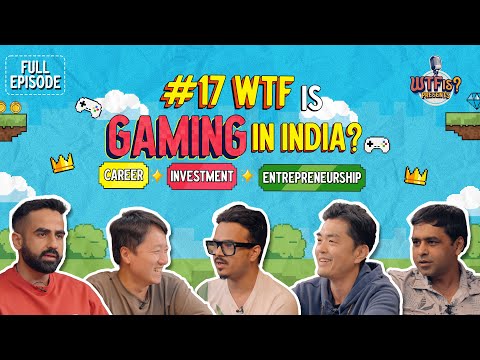
Ep# 17 | WTF is Gaming in India? | Career, Investment, Entrepreneurship
Nikhil Kamath (host), Nitish Mittersain (guest), Sean Hyunil Sohn (guest), Nikhil Kamath (host), Animesh Agarwal (guest), Joseph Kim (guest), Animesh Agarwal (guest), Sean Hyunil Sohn (guest), Sean Hyunil Sohn (guest), Nitish Mittersain (guest), Sean Hyunil Sohn (guest), Nitish Mittersain (guest), Nikhil Kamath (host)
In this episode of Nikhil Kamath, featuring Nikhil Kamath and Nitish Mittersain, Ep# 17 | WTF is Gaming in India? | Career, Investment, Entrepreneurship explores inside India’s gaming boom: careers, monetization, regulation, and AI future Nikhil Kamath hosts Nazara founder/CEO Nitish Mittersain, Krafton India CEO Sean Hyunil Sohn, Lila Games founder Joseph Kim, and esports creator/entrepreneur Animesh “8Bit Thug” Agarwal to unpack what “gaming in India” really means in 2024.
Inside India’s gaming boom: careers, monetization, regulation, and AI future
Nikhil Kamath hosts Nazara founder/CEO Nitish Mittersain, Krafton India CEO Sean Hyunil Sohn, Lila Games founder Joseph Kim, and esports creator/entrepreneur Animesh “8Bit Thug” Agarwal to unpack what “gaming in India” really means in 2024.
They cover the Indian market’s mobile-first reality, why shooters/BGMI dominate revenue, and why India has huge consumption but limited globally successful original game development (monetization, talent, and cultural perceptions).
A major thread is career-building: streamer vs pro gamer economics, the long tail’s low earnings, and practical advice (build a portfolio/digital footprint, learn engines, retention metrics, iterate fast, and keep a backup plan).
They also debate real-money gaming regulation and GST changes, then zoom out to future shifts driven by AI, UGC platforms like Roblox, and immersive interfaces (VR/AR), ending with a community pledge to fund/mentor promising young builders.
Key Takeaways
Listing can be a strategic credibility and partnership lever, not just capital raising.
Mittersain argues Nazara’s IPO boosted brand visibility and trust with global partners (e. ...
Get the full analysis with uListen AI
India’s gaming strength is demand/consumption; the main gap is original, globally competitive development and monetization.
India leads in downloads and has massive gamer counts, but speakers point to limited global hits beyond Ludo King (huge downloads, weak revenue), citing ecosystem maturity, monetization know-how, and services-heavy historical roots.
Get the full analysis with uListen AI
BGMI/Free Fire succeeded because they matched India’s moment: mobile + 4G + social squads + watchability.
They emphasize social voice chat, repeatable unpredictability (battle royale variability), and the importance that a game must be fun to play and fun to watch—critical for creator-driven distribution and esports viability.
Get the full analysis with uListen AI
Gaming careers are real—but extremely skewed; streaming is the scalable money engine.
Top Indian creators can make ~$1M/year largely via brand endorsements and content, while pro esports salaries are closer to ~₹30–35L/year for a small top cohort (~150). ...
Get the full analysis with uListen AI
For aspiring gamers in India, the pragmatic path is ‘backup first’ until meaningful traction or a contract.
Animesh advises not treating gaming as the only pursuit initially; he suggests a pivot to full-time when you have stable team income (e. ...
Get the full analysis with uListen AI
For aspiring builders, iterate and ship fast; track retention not downloads.
Mittersain stresses short build cycles to avoid running out of money and confidence. ...
Get the full analysis with uListen AI
UGC platforms are a near-term ‘escape hatch’ for Indian creators to earn globally.
Roblox/UEFN enable small teams (even teens) to build experiences; they cite examples like Blox Fruits reportedly generating tens of millions annually. ...
Get the full analysis with uListen AI
AI is likely to compress game creation from ‘long vector’ (big teams, huge budgets) to ‘small vector’ (small teams, massive output).
Joseph frames AI as internet-scale disruption: conversational NPCs, code assistants, art pipeline automation, and new AI-native game designs. ...
Get the full analysis with uListen AI
Hyper-casual’s ad-driven model is weakening; hybrid-casual and IAP-centric designs matter more.
They attribute hyper-casual decline to Apple privacy/IDFA changes reducing targeting economics, pushing developers away from forced-ad loops toward deeper mechanics and monetization via in-app purchases.
Get the full analysis with uListen AI
Real-money gaming demand won’t vanish; policy design determines whether it’s safer above-ground or risky underground.
Mittersain argues bans often push activity into less responsible grey markets. ...
Get the full analysis with uListen AI
Notable Quotes
““By going public as India’s first gaming company, we could really plant a flag… Very good PR—if things are going well.””
— Nitish Mittersain
““It was being called Splinternet… if China and Russia are on one side, I wanna be on the other side.””
— Joseph Kim
““There are 13-year-old kids making games on Roblox… it’s not that complicated.””
— Joseph Kim
““Downloads may mean nothing… If my D1 retention is 40% and D7 is 20%, my eyes will start lighting up.””
— Nitish Mittersain
““Gaming cannot be the only thing that you are pursuing in India right now. You need to have a backup.””
— Animesh Agarwal (8Bit Thug)
Questions Answered in This Episode
Nazara’s IPO: What specific partner deals, hiring outcomes, or distribution wins became easier post-listing—and which new constraints hurt the most?
Nikhil Kamath hosts Nazara founder/CEO Nitish Mittersain, Krafton India CEO Sean Hyunil Sohn, Lila Games founder Joseph Kim, and esports creator/entrepreneur Animesh “8Bit Thug” Agarwal to unpack what “gaming in India” really means in 2024.
Get the full analysis with uListen AI
BGMI economics: If BGMI’s share is ‘5–10%’ (as Sean says), where is the rest of India’s mid-core revenue concentrated—other shooters, RMG, or something else?
They cover the Indian market’s mobile-first reality, why shooters/BGMI dominate revenue, and why India has huge consumption but limited globally successful original game development (monetization, talent, and cultural perceptions).
Get the full analysis with uListen AI
India’s global hit problem: What are the top 3 bottlenecks—talent (design), capital, or monetization expertise—and what’s the fastest fix that could work within 24 months?
A major thread is career-building: streamer vs pro gamer economics, the long tail’s low earnings, and practical advice (build a portfolio/digital footprint, learn engines, retention metrics, iterate fast, and keep a backup plan).
Get the full analysis with uListen AI
Roblox path: If someone has only a low-end laptop, what exact learning path (tools, Lua, templates, analytics) would you recommend to ship their first playable Roblox experience in 30 days?
They also debate real-money gaming regulation and GST changes, then zoom out to future shifts driven by AI, UGC platforms like Roblox, and immersive interfaces (VR/AR), ending with a community pledge to fund/mentor promising young builders.
Get the full analysis with uListen AI
Retention benchmarks: For India-first mobile games, what D1/D7/D30 retention and ARPDAU thresholds make you say ‘this is investable’?
Get the full analysis with uListen AI
Transcript Preview
so we just start rolling, okay?
Yeah.
So how we typically start this-
Yeah
- is each one of us says something controversial about us [upbeat music] that nobody knows right now. [upbeat music] Ready, guys? So how we typically start this-
Yeah
... is each one of us says something controversial about us that nobody knows right now.
Hmm.
Hmm. [laughing] I'm a listed company boss.
So what? [laughing]
I'm part of a listed company too. [laughing]
Maybe you can talk about something not related to the company, more like personal.
Yeah.
I don't know. [chuckles]
Yeah.
Okay. Shall I go?
Yeah.
Well, I'm very, uh, temperamental, which people think I'm not.
You are temperamental?
Can be.
Ah.
Very explosive, one percent of the time. [chuckles]
Wow! I haven't really seen you. [chuckles]
Or point one percent of the time. My image is-
Uh
... uh, in the industry to be the most, uh, calmest person around.
Yeah, true.
And who are you usually temperamental with?
Just very mood... Sometimes very moody. [chuckles]
Oh.
[chuckles]
So if I were to meet your childhood classmate, your best friend-
Yeah
... and ask him if Nitish is capable of one extremely naughty thing in life-
Yeah
... at the age of forty, fifty, whatever-
Yeah
... what would he prophesize you'd be capable of doing?
He wouldn't believe it. Nothing. [chuckles]
Come on.
I was the most simplest, most quietest, uh, kid in school.
Yeah?
Yeah. Absolutely, very introvert-ish.
Yeah.
I've changed now.
Hmm. [chuckles]
[chuckles]
Do you consider yourself an introvert today?
Yes, but much better than what I was, uh, when I was much younger. And I think YPO changed me a lot-
Yeah
... in the last, uh, decade or so.
Do you wanna tell everybody who does not know what is YPO? Give us a-
Sure
... minute on YPO.
YPO is, uh, the Young Presidents' Organization. It's a originally a US organization, but, uh, has fourteen cha- uh, more than fourteen chapters, I think fifteen or sixteen chapters now in India. Uh, it come- brings together, uh, businessmen, uh, professionals, in a very close group. So in, uh, Mumbai, for example, I think a total of three hundred members might be there, and we organize a lot of learning events. Like I was just telling, right, we're, we're visiting Seoul next week, and we're doing a lot of learning activity. We're actually visiting Sean's large Krafton office, where we're meeting the CEO, et cetera. I think it's a great networking event, and you make, uh, get to know a lot of great people. You are in YPO, so you can add to that, what I didn't.
Yeah.
But, yeah. [chuckles]
I think of YPO very differently.
Yeah.
I have very first principles questioning about why people give so much money to an organization, and then work for the organization-
Yeah
... for free. Uh, when I was not in YPO, I say bad things about everybody, okay?
Install uListen to search the full transcript and get AI-powered insights
Get Full TranscriptGet more from every podcast
AI summaries, searchable transcripts, and fact-checking. Free forever.
Add to Chrome