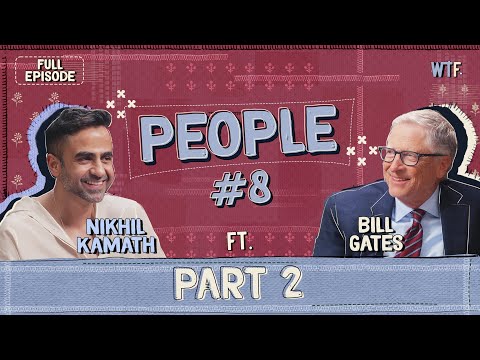
Bill Gates x Nikhil Kamath Part 2 | People by WTF | Ep.8
Nikhil Kamath (host), Bill Gates (guest), Bill Gates (guest)
In this episode of Nikhil Kamath, featuring Nikhil Kamath and Bill Gates, Bill Gates x Nikhil Kamath Part 2 | People by WTF | Ep.8 explores gates on focus, childhood, AI abundance, and purposeful competition ahead Gates reflects on his memoir Source Code, emphasizing a stable childhood, a demanding but non-traumatic family dynamic, and an early, largely genetic capacity for deep focus.
Gates on focus, childhood, AI abundance, and purposeful competition ahead
Gates reflects on his memoir Source Code, emphasizing a stable childhood, a demanding but non-traumatic family dynamic, and an early, largely genetic capacity for deep focus.
They examine whether adversity is necessary for entrepreneurial success, contrasting Gates’ background with figures like Jobs and Musk and discussing how being hard on oneself shapes leadership and hiring.
Gates lays out a long-horizon view of AI: as “free intelligence” expands into white- and blue-collar work via robotics, shortages in doctors, teachers, and labor may disappear, forcing a philosophical rethink of work, markets, and status.
The conversation ends on motivation and modern relevance—how ego can exist even in giving, why tech competition differs from philanthropy, and practical advice for getting closer to the AI frontier (e.g., working with OpenAI).
Key Takeaways
Gates attributes his focus more to genetics than trauma.
He describes an early-emerging ability to sit with confusion until it resolves and to ignore distractions—traits he sees as largely innate rather than trained by his parents.
Get the full analysis with uListen AI
A stable upbringing can still produce extreme ambition.
Gates pushes back on the idea that high achievement requires childhood adversity, noting his childhood was “almost ideal,” with the main tension being a push-pull for freedom and expectations with his mother.
Get the full analysis with uListen AI
Being hard on yourself helps performance but can harm early management.
Gates argues rigorous self-critique prevents self-deception, but admits it initially made him manage others too harshly and build overly homogeneous, engineering-centric teams.
Get the full analysis with uListen AI
“Talent” is broader than IQ, and organizations suffer when leaders miss that.
He describes an early belief that math ability mapped to universal competence, later learning to value varied strengths (sales, people management, field work, government navigation), especially in foundation work.
Get the full analysis with uListen AI
AI may break the scarcity logic that underpins capitalism and markets.
Gates predicts AI plus capable robotics will eliminate many labor shortages, making “markets about scarce resources” less explanatory and pushing society toward new norms for distributing time, purpose, and status.
Get the full analysis with uListen AI
A post-work world doesn’t erase competition; it redirects it.
Both agree humans will still seek differentiation; Gates suggests societies may even reserve some roles or activities for humans (sports, caregiving) despite machine superiority to preserve meaning and hierarchy.
Get the full analysis with uListen AI
Philanthropy and profit aren’t morally “pure” opposites—ego can fuel both.
Gates notes giving can be egotistical and socially rewarded, yet still produces real outcomes (e. ...
Get the full analysis with uListen AI
Notable Quotes
““I'm not somebody who had a traumatic childhood that explains my… energy or ambition.””
— Bill Gates
““If you want to work hard and not fool yourself, you better be pretty hard on yourself.””
— Bill Gates
““We will have created… free intelligence.””
— Bill Gates
““Markets are about scarce resources… and it’s hard… to adjust my mind.””
— Bill Gates
““You can never do anything that's totally pure.””
— Bill Gates
Questions Answered in This Episode
In Source Code, what did you intentionally leave out—relationships, failures, or moments of doubt—and why?
Gates reflects on his memoir Source Code, emphasizing a stable childhood, a demanding but non-traumatic family dynamic, and an early, largely genetic capacity for deep focus.
Get the full analysis with uListen AI
You say focus has a strong genetic component; what habits or environments helped you amplify it rather than burn out?
They examine whether adversity is necessary for entrepreneurial success, contrasting Gates’ background with figures like Jobs and Musk and discussing how being hard on oneself shapes leadership and hiring.
Get the full analysis with uListen AI
Which specific management mistake at Microsoft most changed how you built teams at the Gates Foundation?
Gates lays out a long-horizon view of AI: as “free intelligence” expands into white- and blue-collar work via robotics, shortages in doctors, teachers, and labor may disappear, forcing a philosophical rethink of work, markets, and status.
Get the full analysis with uListen AI
On AI ending “shortages” (doctors/teachers/labor): what policy mechanisms prevent abundance from concentrating power even further?
The conversation ends on motivation and modern relevance—how ego can exist even in giving, why tech competition differs from philanthropy, and practical advice for getting closer to the AI frontier (e. ...
Get the full analysis with uListen AI
You mention robotics needing “good hands” for hotel cleaning and construction—what breakthroughs (hardware, data, incentives) make you confident this happens in ~20–30 years?
Get the full analysis with uListen AI
Transcript Preview
[upbeat music] If I were to ask you to extrapolate, in the world of tomorrow, ten years from now, from a very capitalistic lens, is a huge population a boon or a bane? Hmm. [upbeat music] Can you sleep, Bill, if you drink coffee so late at night?
It might delay my going to sleep a little bit-
Yeah.
-but it'll keep me energized, so, uh... I have a long flight, so I get, uh, the sleep is always complicated.
You're always in a hurry when you're in India. It's so much nicer to spend time with you when you're not in India. Why is that?
Um, well, I'll organize some of my trips where I take time off here. Uh, you know, next year we're talking about, that I'll go up to Assam, and they tell me that's pretty nice. So hopefully-
Mm
... I'll schedule a couple days, uh, for just pure relaxation. Uh, but when I'm working, you know, it's, it's great to see there's so many new innovators here. Uh, we did manage to pack the schedule. You know, there's a lot of ministries that we have partnerships with.
Yeah.
I think I saw more ministers this time [chuckles] than ever before, but it was... They were all great meetings.
Right.
It's been a fun trip. We did a thing with Sachin, I guess-
Yeah
... it's your production company or something-
Yeah
... that helped-
Yeah
... put together a very creative, uh-
So you played cricket. First time?
Well, we, we were on a tennis court-
Ah
... and so we were hitting balls with a cricket bat and the tennis. We were kind of making fun of the-
Mm
... the, the two different sports. Uh-
Yeah.
So that, that, that was relaxing.
Yeah. So we met recently in Switzerland, and I asked you many things off camera. Uh, so I spent the last week reading Source Code.
Oh, thanks!
Yeah. It took me a long time. I read much slower than you, I presume.
[chuckles]
It took me fourteen, fifteen hours, so my time in the car, on my flight, in all my travel, and before going to bed, has been Source Code, so I know more about you now than I have ever.
Fantastic.
[chuckles] So a lot of what is in the book, Bill... It's a great book. I, I would recommend everybody read it, but a lot of what is in the book is also something I might expect of Bill Gates. Like, my childhood was very different in the sense that when you used to sneak out of home when your parents went to bed, you went to a computer lab to work.
[chuckles]
Right?
Yes. That was... I, I was very lucky I got to use computers a lot, even in high school.
So what isn't in the book, Bill?
You know, the book, I, I feel like I, you know, was pretty frank about, uh, you know, the challenges my parents felt raising me, and, uh, you know, how, uh, my- originally I was not a very good student. You know, at least I wasn't getting good grades, and then I eventually... It bugged me that people thought maybe I wasn't that smart, so I just said, "Okay, I guess I should get good grades." Uh, you know, I got in trouble at Harvard, uh, when I was doing, first using the computer, and-
Install uListen to search the full transcript and get AI-powered insights
Get Full TranscriptGet more from every podcast
AI summaries, searchable transcripts, and fact-checking. Free forever.
Add to Chrome