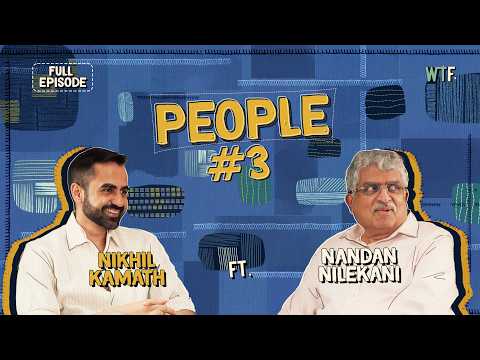
Nikhil Kamath x Nandan Nilekani | People by WTF | Ep #3
Nandan Nilekani (guest), Nikhil Kamath (host)
In this episode of Nikhil Kamath, featuring Nandan Nilekani and Nikhil Kamath, Nikhil Kamath x Nandan Nilekani | People by WTF | Ep #3 explores nandan Nilekani explains India Stack, UPI, and startup opportunities today Nikhil Kamath interviews Nandan Nilekani on the origins and evolution of India Stack—starting with Aadhaar as a digital-first unique ID and expanding into eKYC, eSign, DigiLocker, and UPI as open API “public rails” for private innovation.
Nandan Nilekani explains India Stack, UPI, and startup opportunities today
Nikhil Kamath interviews Nandan Nilekani on the origins and evolution of India Stack—starting with Aadhaar as a digital-first unique ID and expanding into eKYC, eSign, DigiLocker, and UPI as open API “public rails” for private innovation.
Nilekani frames the core design principle as “population scale”: digital systems must work for everyone to truly shift inclusion, formalization, and economic growth in India.
They map key inflection points (especially 2016: 1B Aadhaar, UPI launch, Jio’s data revolution, demonetization, BHIM) and discuss newer layers like Account Aggregator (consent-based data exchange), Fastag as a vehicle identity/payment rail, and protocol approaches like Beckn/ONDC.
The conversation closes with views on AI (LLMs as commodities; value in Indian-language voice interfaces), and “Finternet” (tokenization + mainstream finance) as a possible next architecture shift—while emphasizing that the best startup ideas often come from unexpected, practical frictions.
Key Takeaways
India Stack is designed as public rails with private innovation on top.
Nilekani repeatedly stresses the internet/GPS analogy: government-funded, open, API-led infrastructure enables startups and incumbents to build competitive services without rebuilding core primitives.
Get the full analysis with uListen AI
Aadhaar’s differentiator was making ID online-verifiable in real time.
The mandate began as “unique ID,” but Nilekani pushed a digital-first approach: online authentication so a person can prove identity instantly, enabling downstream services like bank accounts and SIM issuance.
Get the full analysis with uListen AI
Regulatory buy-in is as important as technology for infrastructure adoption.
Aadhaar-based KYC required multi-year coordination across RBI, TRAI/DoT, IRDA, SEBI and legal frameworks (e. ...
Get the full analysis with uListen AI
2016 combined multiple tailwinds that accelerated digital adoption at once.
Nilekani lists 1B Aadhaar (April), UPI launch (April), Jio (September), demonetization (November), and BHIM (December) as a compounding set of shocks that shifted India from “voice economy” to “data + digital payments.”
Get the full analysis with uListen AI
UPI scaled because it made money movement as simple as messaging.
Unlike net-banking-era transfers, UPI made peer-to-peer payments real-time, app-based, and interoperable across banks/apps via a shared protocol—then got boosts from demonetization and the pandemic’s QR behavior.
Get the full analysis with uListen AI
Account Aggregator is a consented data-pipe, not a central data warehouse.
AA enables real-time encrypted transfer from “Financial Information Providers” (banks, tax, GST, mutual funds) to “Financial Information Users” (lenders, apps) without the aggregator being able to read or store the data.
Get the full analysis with uListen AI
Protocols like Beckn attempt to unbundle platform monopolies into open networks.
Using UPI as a mental model, Beckn defines a transaction “language” so discovery, ordering, fulfillment, and payment can be modular across participants—enabling models like Namma Yatri where drivers pay a SaaS fee and keep 100% of fares.
Get the full analysis with uListen AI
For India, AI advantage is in distribution and language access, not training frontier LLMs.
Nilekani argues LLM training is already commoditizing due to massive US capex and open source (e. ...
Get the full analysis with uListen AI
Finternet proposes tokenization rails inside regulated finance.
Separating crypto technology from crypto ideology, Finternet is described as an architecture to tokenize regulated assets (deposits, stocks, bonds), transact via a high-speed engine, and “un-tokenize” back—potentially enabling new products and faster settlement.
Get the full analysis with uListen AI
Energy transition startup opportunity may sit in ‘little energy’ market design.
Nilekani distinguishes grid-scale capital-heavy projects (“big energy”) from distributed systems (rooftop solar, home batteries). ...
Get the full analysis with uListen AI
Notable Quotes
“If you're going to build an ID, it has to be a digital ID. It has to be online. It has to be verifiable online with real time.”
— Nandan Nilekani
“We call this as public rails and private innovation.”
— Nandan Nilekani
“It was a remarkable year for our digital transformation.”
— Nandan Nilekani
“It made sending money as easy as sending an email or sending a WhatsApp message.”
— Nandan Nilekani
“Account aggregation… it’s not a repository… it’s just an exchange.”
— Nandan Nilekani
Questions Answered in This Episode
Aadhaar began as “unique ID”—what were the toughest technical design decisions that made uniqueness reliable at India’s scale (deduplication, biometrics, error rates)?
Nikhil Kamath interviews Nandan Nilekani on the origins and evolution of India Stack—starting with Aadhaar as a digital-first unique ID and expanding into eKYC, eSign, DigiLocker, and UPI as open API “public rails” for private innovation.
Get the full analysis with uListen AI
You describe DPI as “public rails.” What governance choices (open APIs, pricing, onboarding rules) prevented these rails from becoming captured by a few large players?
Nilekani frames the core design principle as “population scale”: digital systems must work for everyone to truly shift inclusion, formalization, and economic growth in India.
Get the full analysis with uListen AI
On eKYC: what were the specific regulator objections early on (privacy, fraud, AML), and what concrete compromises or safeguards unlocked acceptance?
They map key inflection points (especially 2016: 1B Aadhaar, UPI launch, Jio’s data revolution, demonetization, BHIM) and discuss newer layers like Account Aggregator (consent-based data exchange), Fastag as a vehicle identity/payment rail, and protocol approaches like Beckn/ONDC.
Get the full analysis with uListen AI
UPI succeeded where earlier bank transfer UX didn’t—what were the 2–3 non-obvious product/architecture choices (e.g., virtual IDs, dispute handling, chargebacks, interoperability mandates) that mattered most?
The conversation closes with views on AI (LLMs as commodities; value in Indian-language voice interfaces), and “Finternet” (tokenization + mainstream finance) as a possible next architecture shift—while emphasizing that the best startup ideas often come from unexpected, practical frictions.
Get the full analysis with uListen AI
Account Aggregator adoption is still ramping: what’s the biggest bottleneck today—coverage of data sources, consent UX, liability rules, or incentives for banks and FIUs?
Get the full analysis with uListen AI
Transcript Preview
[upbeat music]
Are we good?
Ready, guys? Should we start? [laughing] You've done so many interviews now.
Never felt so intimidated.
[laughing] There is so much information around the India Stack, uh, that is so relevant to a young person who wants to be an entrepreneur in India. Hopefully, by the end of it, we can learn from you what should be built on top of the India Stack, and what is the opportunity today from the lens of capitalism? [upbeat music] Hi, Nandan.
Hi.
Thank you for doing this.
My pleasure, Nikhil.
Uh, I don't think many people know, but I end up meeting Nandan most often in his house or when he's traveling to one of hundred different countries that he goes to every year.
That's right.
Uh, so where are you going next, Nandan?
Uh-
In your travels, where are you heading?
... I'd say th- this month is a slow month, in the sense I'm going to be right here in, uh, uh, uh, Bangalore and in India. But I'm going next month, uh, I'm going to Basel, I'm going to London.
All around this technology broadly that you're involved with, most of these places?
Yeah, I, I basically have two hats.
Mm-hmm.
I have a, a public hat-
Mm
... which is really the bulk of what I do-
Mm
... which is enabling digital public infrastructure.
Mm-hmm.
You know, Aadhaar, UPI, that kind of stuff. And now we are trying to make that go global. So part of this is globalization of this DPI concept. And then I have a private sector hat as the chairman of Infosys and a few investments, so some of my travel is that, or if I go on a vacation, I just work for a couple of days, so.
I watched a bunch of your interviews-
Why would you do that? [laughing]
[laughing] ... over the last 48 hours.
Seem to be a sucker for punishment.
[chuckles] I feel like I know Nandan, the person in private. I, I have never heard you speak at length publicly in that way. I've heard you speak at your house when you host dinners and all of that. So it was actually intriguing, and there is so much information around the India Stack, uh, that is so relevant to a young person who wants to be an entrepreneur in India. So we thought we'd focus today on that.
Sure.
Uh, so I'm going to play the part of a twenty-year-old who knows nothing about the India Stack. I'll start the journey from the very beginning, and hopefully, by the end of it, we can learn from you what should be built on top of the India Stack, and what is the opportunity today from the lens of capitalism? What can me, a twenty-year-old, start to make money out of it, on top of the India Stack in any way? If we were to begin with Infosys, uh, is that where you would say the, the journey began in that manner, where you saw scale incrementally?
Install uListen to search the full transcript and get AI-powered insights
Get Full TranscriptGet more from every podcast
AI summaries, searchable transcripts, and fact-checking. Free forever.
Add to Chrome