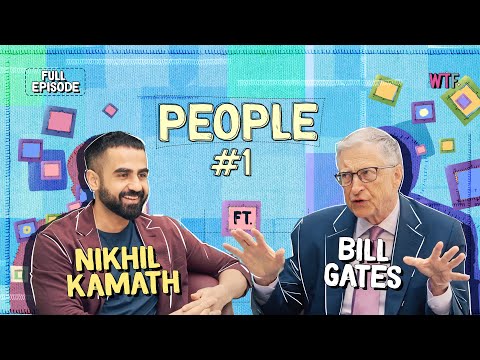
Nikhil Kamath x Bill Gates | People by WTF | Ep. #1
Nikhil Kamath (host)
In this episode of Nikhil Kamath, featuring Nikhil Kamath, Nikhil Kamath x Bill Gates | People by WTF | Ep. #1 explores nikhil Kamath and Bill Gates on India, philanthropy, climate, AI Nikhil Kamath interviews Bill Gates with an explicit goal: practical guidance for young entrepreneurs in India, while avoiding over-asked questions.
Nikhil Kamath and Bill Gates on India, philanthropy, climate, AI
Nikhil Kamath interviews Bill Gates with an explicit goal: practical guidance for young entrepreneurs in India, while avoiding over-asked questions.
Gates describes his long relationship with India through Microsoft talent, major Foundation investments (nearly $1B/year direct and indirect), and programs spanning vaccines, HIV prevention, and agriculture.
They debate what philanthropy can and cannot do versus markets and government, with Gates framing philanthropy as a risk-taking, pilot-funding “third sector” that can catalyze scalable public programs.
The conversation then shifts to founder advice on climate innovation pathways, and a nuanced view of AI/AGI—near-term application opportunities in India (health, agriculture, legal productivity) and longer-term societal disruption from extreme productivity gains.
Key Takeaways
India is a core geography for Gates’ impact work, not an afterthought.
Gates frames India as the Foundation’s largest focus after the US, citing major investments and long-running partnerships with government and institutions, especially around vaccines, HIV prevention, and agriculture.
Get the full analysis with uListen AI
Philanthropy’s comparative advantage is risk-taking and piloting innovation.
Gates argues safety nets must be government-run because they require dependable, recurring funding, while philanthropy is best used to fund experiments, convene talent, and prove models that governments can later scale.
Get the full analysis with uListen AI
Capitalism is the best discovery engine, but needs guardrails and a safety net.
He defends markets as a freedom-preserving mechanism for allocating resources and rewarding better products, while emphasizing government’s role in anti-monopoly enforcement and ensuring access to essentials like education and healthcare.
Get the full analysis with uListen AI
Climate transition entrepreneurship is broad; breakthroughs will often come from startups.
Gates lists many “begging for innovation” areas—better solar/wind, fission/fusion, rice and livestock emissions reduction, green hydrogen, and low-carbon steel—arguing large incumbents rarely produce the most radical breakthroughs alone.
Get the full analysis with uListen AI
If you’re 22 with limited capital, pursue grants/fellows programs then specialist risk capital.
He recommends early non-dilutive support (e. ...
Get the full analysis with uListen AI
In AI, India’s biggest near-term edge is application-layer products, not foundational models.
Gates notes building frontier models can require $2–3B, so most Indian founders should leverage existing platforms (Microsoft/Google/etc. ...
Get the full analysis with uListen AI
AI could reshape society if productivity becomes ‘replacement-level,’ but that’s not imminent.
Gates expects massive gains from tutors and advisors first; if systems eventually replace entire professions, society may need to rethink work, value, and distribution—but he personally doubts that extreme ‘world of excess’ arrives within 20 years.
Get the full analysis with uListen AI
Notable Quotes
“Other than the US, this is the country we spend the most money in.”
— Bill Gates
“There are some things that only philanthropy can do because they require taking risks.”
— Bill Gates
“We’re not trying to take over government functions. We couldn’t possibly afford to do that.”
— Bill Gates
“I’d say there’s a thousand opportunities where you… use one of those base-level models… to go after a particular application.”
— Bill Gates
“We’re already superhuman… in a dimension that is kind of surprising.”
— Bill Gates
Questions Answered in This Episode
You mentioned India is close to ‘a billion a year’ for the Foundation—how much is direct grants versus vaccine procurement via Gavi and other indirect channels?
Nikhil Kamath interviews Bill Gates with an explicit goal: practical guidance for young entrepreneurs in India, while avoiding over-asked questions.
Get the full analysis with uListen AI
On vaccines in India: what were the hardest lessons about partnering ‘as foreigners’ without being perceived as imposing solutions, and what would you do differently now?
Gates describes his long relationship with India through Microsoft talent, major Foundation investments (nearly $1B/year direct and indirect), and programs spanning vaccines, HIV prevention, and agriculture.
Get the full analysis with uListen AI
Avahan is cited as successful HIV prevention—what were the specific operational tactics that made it work (measurement, incentives, government coordination)?
They debate what philanthropy can and cannot do versus markets and government, with Gates framing philanthropy as a risk-taking, pilot-funding “third sector” that can catalyze scalable public programs.
Get the full analysis with uListen AI
You argue safety nets aren’t philanthropy’s job—where exactly is the boundary (e.g., recurring nutrition programs, primary healthcare staffing, sanitation infrastructure)?
The conversation then shifts to founder advice on climate innovation pathways, and a nuanced view of AI/AGI—near-term application opportunities in India (health, agriculture, legal productivity) and longer-term societal disruption from extreme productivity gains.
Get the full analysis with uListen AI
In climate, if you had to pick 3 of the ‘20 areas’ that are most underfunded today, which are they and why?
Get the full analysis with uListen AI
Transcript Preview
[upbeat music] I'm not going to ask you anything generic or anything I've heard you answer already. Uh, I'm going to be a little selfish and ask you questions that, uh, I try to answer for myself a lot of the time. Maybe like, you know, uh, there's no better person to learn from. [upbeat music] So we do this once in a month, Bill, and, uh, we primarily cater to the young entrepreneur in India. Uh, the idea is to get really good people on the show and help a young twenty-year-old boy or girl in India who's looking to become an entrepreneur, give them, uh, advice, guidance, uh, help them learn from what you might have learned already. I've met Bill a bunch of times. I think the very first time I met you was, uh, when I caught you at WEF and bugged you for an hour with random questions a few years ago. I joined Bill's pledge last year.
Yeah. Thank you.
Uh, the one thing I want to clarify is a lot of Indians, when they hear about an Indian sign on to the pledge... I think there's four of us, right? We're all from Bangalore, and all of us are friends. Uh, people somehow assume that the money is going out of India, the money which is going to make society better. Uh, it's actually not the case. And, uh, I, I would also like to say, I think The Gates Foundation, who I've worked with in the past, uh, we've done a school project together, we're doing something around, uh, malnutrition together. I think the impact and the effort that they're putting into India in improving society, uh, is, is, uh, is great, and I hope you guys continue this association with India for a long time. Do you want to talk a little bit about your relationship with India and how it's evolved over the last many years?
Well, I mean, I've had a fantastic relationship with India, starting with the, the Microsoft experience, where, you know, we hired some very smart IT graduates, brought them to Seattle. Later, they go back, uh, create a development center for us, uh, that's now in four locations, twenty-five thousand people. And, of course, a lot of the amazing people I work with and have so much fun, uh, in the Microsoft success with are, uh, part of the team we have hired from India. You know, top of that list is Satya-
Mm-hmm.
... uh, who now, uh, is doing a, a great job as CEO. So in my digital first career, uh, the connection to India was, uh, fun and made a huge difference, um, in what the company was able to achieve. It was during that time that I was kind of learning, oh, wow, India is such a study in contrasts, you know. You know, first class in so many ways, but still a lot of poverty, uh, and challenges. And, uh, you know, I was beginning to think, "Okay, how do I give this money back?" Uh, together with, uh, Melinda, and so she came over as we were starting to do foundation work. Um, I start the foundation, I fund it in the year two thousand, so I'm forty-five years old and still, um, full time. I stayed full time for another, uh, eight years. Uh, but India becomes, you know, an important place for us because we realized that vaccines, uh, were this missing, uh, thing, and it was a crime that these, uh, diarrhea rotavirus vaccines were getting to the rich kids. So, you know, I get to know Serum, I learn about making cheap, uh, vaccines. Uh, you know, the Indian government at the time had not adopted new vaccines for a long time. You know, so, uh, how do we, as foreigners, uh, form partnerships and not come across, uh, in the wrong way? So it's a heck of a learning curve. Uh, another big program we had here at the start, called Avahan, uh, was about making sure that the HIV epidemic didn't explode, you know, by making sure that, um, the sex workers were insisting on condom use and so that the, the numbers would stay small. And that was also quite successful and very much a partnership with the government. Um, you know, other than the US, this is the country we spend the most money in. Uh, we have a fantastic team of people here.
Install uListen to search the full transcript and get AI-powered insights
Get Full TranscriptGet more from every podcast
AI summaries, searchable transcripts, and fact-checking. Free forever.
Add to Chrome