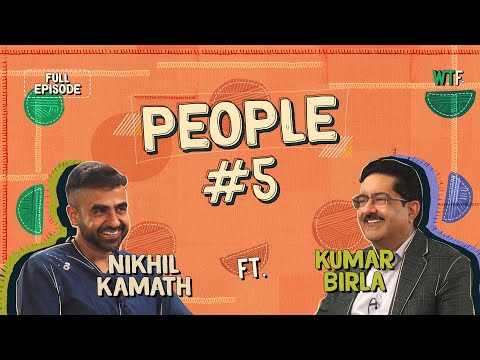
Nikhil Kamath x Kumar Birla | People by WTF Ep #5
Nikhil Kamath (host), Kumar Birla (guest), Nikhil Kamath (host)
In this episode of Nikhil Kamath, featuring Nikhil Kamath and Kumar Birla, Nikhil Kamath x Kumar Birla | People by WTF Ep #5 explores kumar Mangalam Birla on leadership, legacy, conformity, and business pivots Kumar Mangalam Birla reflects on a secure, values-driven childhood split between Calcutta and Bombay, shaped heavily by three generations of business leaders at home and a strict school environment.
Kumar Mangalam Birla on leadership, legacy, conformity, and business pivots
Kumar Mangalam Birla reflects on a secure, values-driven childhood split between Calcutta and Bombay, shaped heavily by three generations of business leaders at home and a strict school environment.
He describes his father’s demanding mentorship, the forced discipline of completing a CA and MBA, and how his father’s early death shifted him into major responsibility—using work as both duty and emotional refuge.
Birla explains how India’s post-1991 liberalization changed competition, investor expectations, and the need for strategy and talent, and why conglomerates must continually build “new engines of growth.”
The discussion also moves into personal philosophy: the liberating effect of caring less about public opinion, the costs of conformity, the role of corporates as societal stakeholders, and his view of “legacy” as impact rather than acclaim.
Key Takeaways
Scale demands more creativity, not less.
Birla argues that once “low-hanging fruit” is gone, management shifts from science to art—creating new value requires out-of-the-box thinking even more in large organizations.
Get the full analysis with uListen AI
A secure childhood can create durable self-assuredness.
He attributes confidence to stable family ties and strong roots, contrasting his simpler, less media-saturated upbringing with the complexity children face today.
Get the full analysis with uListen AI
Demanding mentorship can compress decades of learning into years.
Sitting beside his father for 8–9 hours daily became a “real-time MBA,” exposing him to hiring/firing, AGMs, government issues, and varied business cycles—fast-tracking judgment under pressure.
Get the full analysis with uListen AI
Fear can motivate performance, but shouldn’t define modern parenting.
He admits fear was used as a motivator in his era (e. ...
Get the full analysis with uListen AI
Lower need for conformity expands life’s option set.
Birla says life becomes easier when the need to conform is lower, because it increases latitude in career and personal choices—while still acknowledging conformity’s social “gravity.”},{
Get the full analysis with uListen AI
Notable Quotes
“For me, the most creative thing you can do is build or run a business.”
— Kumar Mangalam Birla
“Life is much easier when your need to conform is lower.”
— Kumar Mangalam Birla
“Legacy to me is more about impact, not so much about accolades.”
— Kumar Mangalam Birla
“Giving back… is a given… it’s almost a responsibility.”
— Kumar Mangalam Birla
“It was like a real-time MBA.”
— Kumar Mangalam Birla
Questions Answered in This Episode
You say scale requires more creativity—what’s a concrete example of a “creative” decision you made at large scale that looked risky or non-obvious at the time?
Kumar Mangalam Birla reflects on a secure, values-driven childhood split between Calcutta and Bombay, shaped heavily by three generations of business leaders at home and a strict school environment.
Get the full analysis with uListen AI
When you took over after your father’s death, what were the first 3 decisions you made that most reduced existential risk to the group?
He describes his father’s demanding mentorship, the forced discipline of completing a CA and MBA, and how his father’s early death shifted him into major responsibility—using work as both duty and emotional refuge.
Get the full analysis with uListen AI
You emphasize speaking to the “appropriate audience” rather than media—how do you decide when a topic belongs privately vs publicly?
Birla explains how India’s post-1991 liberalization changed competition, investor expectations, and the need for strategy and talent, and why conglomerates must continually build “new engines of growth.”
Get the full analysis with uListen AI
On conformity: where do you draw the line between ‘not caring about opinions’ and maintaining social responsibility as a high-visibility industrialist?
The discussion also moves into personal philosophy: the liberating effect of caring less about public opinion, the costs of conformity, the role of corporates as societal stakeholders, and his view of “legacy” as impact rather than acclaim.
Get the full analysis with uListen AI
You describe philanthropy as trusteeship and ‘gupt daan’—do you think modern CSR transparency improves outcomes or incentivizes performative giving?
Get the full analysis with uListen AI
Transcript Preview
[upbeat music]
If you had one chance to redo life today, starting afresh, you're not Kumar Mangalam Birla, but you're just Kumar starting off. What business would you put the money in? [upbeat music] Firstly, thank you for, uh, doing this. So the format of this is very casual. It's typically a bunch of friends sitting and chatting. How it started was I used to have a, a few people over for dinner in Bangalore on the weekends, and some of the conversations we had were so interesting that a lot of people would go back home from dinner and say that, "You know, I wish more people could be a part of that."
Mm.
Like, extremely contrarian opinions on different viewpoints, so stuff like that.
Oh, that sounds interesting.
Yeah. So this is all in, like, uh, an effort to help many people who could learn from your own journey. Uh, most of our audience are entrepreneurs and wanna-be entrepreneurs who are quite young, in the age bracket of, I would say, fifteen to thirty-five, forty. And, uh, from-
Starting at fifteen?
Yeah, very young. And a lot of them want to be entrepreneurs, and they could learn a lot from your own journey. So if I could start at the beginning, wherever you wanna talk, and think of it as a two-way conversation. If you feel like you want to ask me anything-
Sure, sure.
... feel free to ask me-
Yeah
-anything about anything, and I will try and answer as honestly as I can.
Done.
Theek hai?
Mind, I end up asking you more than you ask me. [chuckles]
[chuckles] So tell us-
Okay
... uh, a little bit about the early years. First, uh, vivid memory that comes to you from childhood. Start from there.
Yeah, so very happy childhood, to say the least. Very secure, lots of, um, laughter, uh, great sense of positivity, high energy, uh, you know, very, uh, close family ties.
And where was this?
So a part of it was in Calcutta.
Right.
Uh, the rest of it was in Bombay. But, uh, you know, on holidays, I always went back to Calcutta-
Mm-hmm
... because the larger family was there. So for me, childhood means Calcutta much more than Bombay. Uh, it's very secure. I think it just gives you, uh, an anchor and very strong roots.
And, uh, what era was this?
Era? [chuckles]
Yeah. [chuckles] What generation?
We moved to Bombay in '69, I think.
Mm.
So at least for the n- next twenty years after that.
Right. Leading up to this, I watched all your interviews. Uh, everything from-
There aren't too many.
Yeah, there's so few.
I don't, uh... Yeah.
Yeah. There's very few about you. There are a couple about you acquiring a company, entering the ARC business-
Mm
... uh, talking about Ratan Tata at his demise, stuff like that. But the one interview I found of you was twenty-six years ago, I think Simi Garewal.
Install uListen to search the full transcript and get AI-powered insights
Get Full TranscriptGet more from every podcast
AI summaries, searchable transcripts, and fact-checking. Free forever.
Add to Chrome