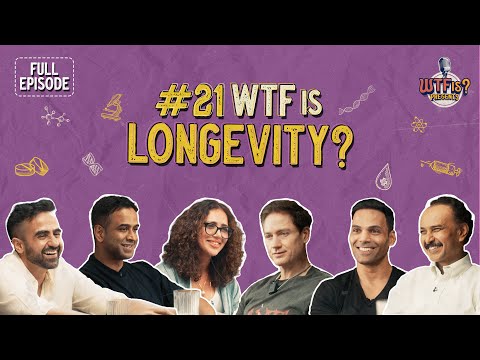
Ep #21 | WTF is Longevity? | Nikhil ft. Nithin Kamath, Bryan Johnson, Prashanth, Jitendra & Seema
Nikhil Kamath (host), Prashanth Prakash (guest), Jitendra Chouksey (guest), Nikhil Kamath (host), Nikhil Kamath (host), Seema Kamath (cameo), Nikhil Kamath (host), Seema Kamath (cameo), Nikhil Kamath (host), Seema Kamath (cameo), Nikhil Kamath (host), Jitendra Chouksey (guest), Nikhil Kamath (host), Nikhil Kamath (host), Seema Kamath (cameo), Nikhil Kamath (host), Seema Kamath (cameo)
In this episode of Nikhil Kamath, featuring Nikhil Kamath and Prashanth Prakash, Ep #21 | WTF is Longevity? | Nikhil ft. Nithin Kamath, Bryan Johnson, Prashanth, Jitendra & Seema explores longevity meets India: data-driven health, air quality, business opportunities, AI ethics Nikhil Kamath convenes Bryan Johnson and Indian health/VC voices to answer two practical questions: what to put in your body, and where to build businesses in health. The conversation starts with Mumbai’s PM2.5 and expands into a broader thesis: modern health is best approached via continuous measurement, longitudinal datasets, and evidence-driven iteration rather than guru advice.
Longevity meets India: data-driven health, air quality, business opportunities, AI ethics
Nikhil Kamath convenes Bryan Johnson and Indian health/VC voices to answer two practical questions: what to put in your body, and where to build businesses in health. The conversation starts with Mumbai’s PM2.5 and expands into a broader thesis: modern health is best approached via continuous measurement, longitudinal datasets, and evidence-driven iteration rather than guru advice.
Bryan outlines his Blueprint routine (highly controlled diet, time-restricted eating, heavy testing, and supplement stack pegged to biomarkers) and argues that “food is guilty until proven innocent,” advocating third-party-tested, transparent nutrition products. JC and others push back on unvalidated longevity compounds (e.g., NAD precursors, autophagy claims), emphasizing basics, measurable deficiencies, and the limits of current science.
A central philosophical arc links longevity to superintelligence: Bryan proposes “Don’t Die” as a universal objective function for aligning humans and AI—don’t die, don’t kill each other, don’t kill the planet, align AI accordingly—while others challenge its practicality and ethical completeness. The panel ends by mapping concrete startup opportunities: indoor air solutions, India-specific datasets, actionable diagnostics, clinician/doctor quality systems, and new preventive-care clinic models.
Key Takeaways
Air quality is a top-tier longevity variable with limited individual control.
Bryan treats Mumbai PM2. ...
Get the full analysis with uListen AI
An N95 mask is framed as a direct, high-impact intervention in polluted cities.
Bryan claims an N95 can reduce PM2. ...
Get the full analysis with uListen AI
Blue Zones are contested; fundamentals still dominate.
Prashanth cites activity and community as “blue zone” ingredients, but JC argues the concept is likely cherry-picked and controversial. ...
Get the full analysis with uListen AI
The panel’s shared meta-rule: don’t trust philosophies—trust data you can measure.
Bryan repeatedly urges: take supplements and make dietary choices only when you can tie them to measurable endpoints (HbA1c, vitamins, lipids, omega index, etc. ...
Get the full analysis with uListen AI
NAD/NR/NMN illustrates the central problem in supplements: unclear transport, unclear targets, unclear outcomes.
JC explains NAD’s role in mitochondrial redox but questions whether oral/IV NAD meaningfully reaches mitochondrial inner membranes or improves function. ...
Get the full analysis with uListen AI
Bryan’s ‘Blueprint’ approach is extreme consistency + time-restricted eating + transparent documentation.
He describes repetitive meals (vegetables, lentils, nuts/seeds, proteins), fermented foods, olive oil with meals, and a ~6-hour eating window. ...
Get the full analysis with uListen AI
Longevity guidance becomes actionable when diagnostics are integrated, longitudinal, and interpreted with support.
Prashanth positions “Medicine 3. ...
Get the full analysis with uListen AI
Bryan’s ‘Don’t Die’ reframes longevity as a cross-domain alignment goal, not just self-optimization.
He argues humanity lacks a plan for superintelligence and proposes ‘Don’t Die’ as a universal agreement: don’t die, don’t kill each other, don’t kill the planet, align AI to these constraints. ...
Get the full analysis with uListen AI
Notable Quotes
“Air quality.”
— Bryan Johnson
“You can filter almost any water… but with air, you have no control. You’re in a system.”
— Bryan Johnson
“I’m not very convinced on the idea of blue zones… classic case of cherry-picking.”
— Jitendra Chouksey (JC)
“I’m the most measured person in human history.”
— Bryan Johnson
“Food is guilty until proven innocent.”
— Bryan Johnson
Questions Answered in This Episode
On air quality: What’s the quantified health ROI of (a) N95 use, (b) home HEPA, (c) HVAC sealing—especially for people who also exercise outdoors?
Nikhil Kamath convenes Bryan Johnson and Indian health/VC voices to answer two practical questions: what to put in your body, and where to build businesses in health. ...
Get the full analysis with uListen AI
On Bryan’s claim: What contaminant thresholds and lab methods support “food is guilty until proven innocent,” and which contaminants show up most in common staples in India?
Bryan outlines his Blueprint routine (highly controlled diet, time-restricted eating, heavy testing, and supplement stack pegged to biomarkers) and argues that “food is guilty until proven innocent,” advocating third-party-tested, transparent nutrition products. ...
Get the full analysis with uListen AI
On supplements: Which biomarkers meaningfully change in Bryan’s regimen versus placebo/behavior effects, and which changes are clinically predictive (not just ‘optimal’)?
A central philosophical arc links longevity to superintelligence: Bryan proposes “Don’t Die” as a universal objective function for aligning humans and AI—don’t die, don’t kill each other, don’t kill the planet, align AI accordingly—while others challenge its practicality and ethical completeness. ...
Get the full analysis with uListen AI
On NAD precursors: What evidence would settle the debate about whether NR/NMN improves mitochondrial function in humans (transporters, tissue-level measures, hard endpoints)?
Get the full analysis with uListen AI
On diagnostics business models: How can India make metabolomics/microbiome testing both affordable and clinically responsible (avoiding over-testing and anxiety)?
Get the full analysis with uListen AI
Transcript Preview
Okay, so what I want for today: A, to figure out what to put in my body, what not to put in my body. The second question I want answered, in this realm of health, where is the opportunity to start a business, and what business should they start? [upbeat music] Ready? Rolling. Ready? Okay, full house today. Uh, thank you, all four of you, for doing this. Bryan, welcome to India for the first time. What is the one thing you're looking at more than anything in India right now?
[chuckles] Air quality. [laughing]
[laughing] How bad is it?
I can't really see you over there. [laughing]
[laughing] This is Mumbai. We're mostly from Bangalore, so it's okay. [laughing]
[laughing]
So what does that mean? So what is the number right now?
Uh, the, the PM 2.5, I think it's one thirty, one forty-
Okay
... which is over 10X, uh, what is reasonable, what, what is appropriate.
So what is it doing to me?
Uh, these contaminants, uh, wreak havoc on the body. It can create neurological dysfunction, it can cause asthma, it can cause lung irritation. It just- like, it's whole body damage. It gets into tissues, it lodges in. It's very hard to remove it, so it's not like something the body just cleans it out. It's, it's very hard to remove, so you really don't wanna mess with these airborne contaminants.
So if I were to pick a city to live in, how big a role would air quality play in choosing which one?
Close to top three.
What would be the other options? What would be top one, two, and three?
Uh, for health?
Mm-hmm.
I don't, I don't think that really-
That makes a difference.
I mean, air quality, water quality, maybe.
Air, water, and food.
Bryan, do you agree?
I guess, like, you are thinking through this because, you know, you can filter almost any water and get it to be pure.
Mm-hmm.
Uh, with food, you can grow your own food, but with air, you have no control.
Mm-hmm.
Uh, you're in a system.
Mm-hmm.
So there's this idea of, can you make at least your home a blue zone?
Mm.
Right, you can't externally change anything.
Yeah.
So it's usually EMF, you know-
Mm
... some radiations at home, and then there is, uh, the air, which can be largely purified if, if you're in a very closed environment. And, uh, toxins in water and toxins in your vegetables. If you can manage these, uh, on a continuous basis in your home, you can at least make a, a blue zone kind of environment at home.
So is that what is working for blue zones, they have these three things going for it?
I think they, in addition to that, they define two other important aspects, right? One is, uh, uh, how active, uh, they are-
Mm-hmm
... through their daily lives.
Mm-hmm.
And, uh, uh, second aspect that they emphasize is community, right? And how much of, uh, connectedness do they kind of... is, is imbibed into their way of living. I think these are the two other, other than food and-
Install uListen to search the full transcript and get AI-powered insights
Get Full TranscriptGet more from every podcast
AI summaries, searchable transcripts, and fact-checking. Free forever.
Add to Chrome