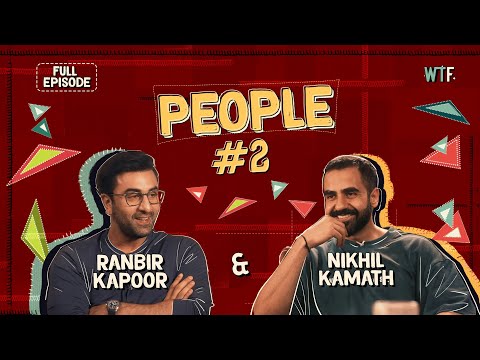
Nikhil Kamath x Ranbir Kapoor | People by WTF Ep #2
Nikhil Kamath (host), Ranbir Kapoor (guest)
In this episode of Nikhil Kamath, featuring Nikhil Kamath and Ranbir Kapoor, Nikhil Kamath x Ranbir Kapoor | People by WTF Ep #2 explores nikhil Kamath and Ranbir Kapoor on identity, success, detachment, love Nikhil Kamath and Ranbir Kapoor trade life stories to understand what makes someone intriguing in public while remaining private, touching childhood conditioning, media narratives, and personal philosophy.
Nikhil Kamath and Ranbir Kapoor on identity, success, detachment, love
Nikhil Kamath and Ranbir Kapoor trade life stories to understand what makes someone intriguing in public while remaining private, touching childhood conditioning, media narratives, and personal philosophy.
Ranbir reflects on growing up in a famous, emotionally volatile household; his introversion, avoidant detachment, difficulty expressing grief, and how fatherhood has reshaped his relationship to emotion and mortality.
They discuss the controversy around Animal, the role of movies vs. morality, and the tension between artistic risk, public judgment, and social media outrage cycles.
The conversation widens into faith, therapy, mental health (especially for men), ambition, status, creative sacrifice, and how success alters relationships and daily life.
Key Takeaways
Mystery can be a strategy—but authenticity sells long-term.
Ranbir values staying off social media to preserve “mystery,” while Nikhil argues modern audiences bond with flaws and vulnerability, and that authentic narrative control becomes crucial when launching celebrity-adjacent businesses (e. ...
Get the full analysis with uListen AI
Early family volatility can hardwire conflict-avoidance and emotional shutdown.
Ranbir describes growing up hearing intense parental fights and fearing his father’s volatile tone; he links this to discomfort with loud voices, difficulty expressing emotions, and a lifelong “detached/avoidant” style.
Get the full analysis with uListen AI
Fatherhood can override long-held detachment and reframe mortality.
Ranbir says his daughter’s birth felt like “heart in your hand,” triggering new fear of death and making him question indifference/detachment that previously defined him.
Get the full analysis with uListen AI
Controversial art becomes a referendum on the viewer’s politics and morality.
On Animal, they argue audiences tolerate violence in classics like The Godfather yet condemn certain gendered dynamics; Ranbir believes social media amplifies labels (“misogynist”), overshadowing craft and intention, even when mass audiences enjoy the film.
Get the full analysis with uListen AI
Therapy fails when trust is low—or when it feels like ‘life-hacking.’
Ranbir tried therapy but felt he couldn’t be fully honest and that the process seemed like learning “methods” to manage conflict, which he interpreted as manipulating life; Nikhil frames therapy as “gym for the mind” that improves performance by contextualizing emotions like guilt.
Get the full analysis with uListen AI
Guilt after loss is often irrational but psychologically dominant.
Both share grief stories: Ranbir didn’t cry after his father’s death and carries guilt about emotional distance; Nikhil describes guilt about not being present when his father died, followed by cascading family crises, reinforcing how narratives in the mind intensify suffering.
Get the full analysis with uListen AI
Longevity in cinema (and any craft) requires patience and sacrifice—not just talent.
Ranbir claims patience and sacrifice are non-negotiable in the arts; he cites the industry as “mini heartbreaks” where few films succeed, and notes the personal cost seen in peers who lose family relationships to audience devotion.
Get the full analysis with uListen AI
Notable Quotes
“I was always on the staircase just hearing them fight.”
— Ranbir Kapoor
“I don’t think movies should be where society derives their sense of morality.”
— Nikhil Kamath
“I just quietly apologize… I don’t really agree with them, but I’m… not in that phase in my life that I really don’t argue with anybody.”
— Ranbir Kapoor
“When she was born… it’s like somebody’s kind of taken your heart out and just put it in your hand.”
— Ranbir Kapoor
“The act of even attempting to learn alleviates anxiety for me.”
— Nikhil Kamath
Questions Answered in This Episode
On ‘mystery’ vs authenticity: What specific parts of your life would you reveal publicly to support your brand without eroding your privacy?
Nikhil Kamath and Ranbir Kapoor trade life stories to understand what makes someone intriguing in public while remaining private, touching childhood conditioning, media narratives, and personal philosophy.
Get the full analysis with uListen AI
On Animal: If you could redo the promotional narrative, what would you clarify about intention vs endorsement of the protagonist’s behavior?
Ranbir reflects on growing up in a famous, emotionally volatile household; his introversion, avoidant detachment, difficulty expressing grief, and how fatherhood has reshaped his relationship to emotion and mortality.
Get the full analysis with uListen AI
On detachment: Do you see detachment as emotional self-protection, or as a genuine philosophy—and how has fatherhood changed that definition?
They discuss the controversy around Animal, the role of movies vs. ...
Get the full analysis with uListen AI
On grief: You said you haven’t grieved your father fully—what would ‘grieving’ look like for you in practical terms?
The conversation widens into faith, therapy, mental health (especially for men), ambition, status, creative sacrifice, and how success alters relationships and daily life.
Get the full analysis with uListen AI
On therapy skepticism: What kind of therapist or modality might feel less like ‘manipulation’ and more like emotional truth for you?
Get the full analysis with uListen AI
Transcript Preview
[upbeat music] As an entrepreneur, right, we speak mostly to young wannabe twenty-year-old boys and girls who want to start a business, to be desirable, uh, from the lens of getting funding, to be wanted. I think that innate quality, uh, I feel like you do it very well. We want to be able to teach a young guy or girl how to emulate that. [upbeat music] Hi, Ranbir.
Hi, Nikhil.
How's it going? Uh...
Uh, nervous, uh, excited.
Mm-hmm.
You know, over the years, I've heard so much about you, about your achievements, and, and all of that. But I, uh, uh, I was on Reels one day on Instagram, and I came across this one reel of yours, where you spoke about, uh... was it detachment, indifference?
Detachment, yeah.
Uh, detachment.
Mm-hmm.
And it was something which really resonated with me because I felt like, okay, that's something that I connected with. Uh, it's not something that I probably believe also, but it's not something that I could say it openly. Uh, I was very afraid to say something like that. Uh, and I think that really kind of... I, I, I felt you there, you know? So, uh, so I got very excited to speak to you, and really happy to be on the show.
And I looked for a bunch of interviews of yours.
You have-
For some reason, you never do one more than 20 minutes.
Uh, no. Because that's the thing, right?
Yeah.
When you are, when you are promoting a film, that's the only time you give interviews. It's so film-centric, and it's... sometimes it's... I think the relationship of film actors with Indian media, especially entertainment media, is a bit, um, shaky. It's because you start talking to them before the film is released.
Mm-hmm.
And people are not really interested in knowing about the film as much as they're interested in your personal life.
Mm-hmm.
As much as at one time it was my marriage, then it was Raha, then it was now it's fatherhood. So that's what stands out, you know? So I think a lot of actors and film people realize that interviews is not the way to go to promote a film.
Mm-hmm.
Uh, you have something inspiring to say, uh, then do an interview, and that's what I believe in. Because when you talk, you're inspiring, you're inspiring people, you're sharing your own experiences. If you don't have anything to share, I'm not interested in talking about myself.
Mm-hmm.
I'm not interested in talking about my achievements-
Mm
... or, or my personal achievements.
Mm-hmm.
Uh, but something like this, uh, uh, is, is stimulating. It's stimulating for me-
Yeah
... it's inspiring for me. And I hope, like, with this conversation, we can inspire somebody, you know? With some experience.
Yeah. I have a lot of curiosity around our conversations that day, and I genuinely wanted to get to know you more. Uh, so I have no questions for today.
Install uListen to search the full transcript and get AI-powered insights
Get Full TranscriptGet more from every podcast
AI summaries, searchable transcripts, and fact-checking. Free forever.
Add to Chrome