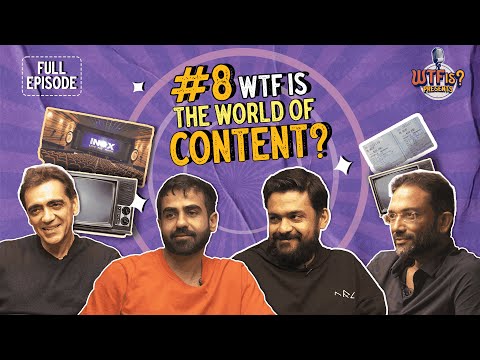
Ep #8 | WTF is Going on in the World of Content | w/ Nikhil, Ajay Bijli, Vijay S. & Sajith S.
Nikhil Kamath (host), Ajay Bijli (guest), Sajith Sivanandan (guest), Vijay Subramaniam (guest), Nikhil Kamath (host), Sajith Sivanandan (guest), Nikhil Kamath (host), Ajay Bijli (guest), Ajay Bijli (guest), Vijay Subramaniam (guest), Sajith Sivanandan (guest)
In this episode of Nikhil Kamath, featuring Nikhil Kamath and Ajay Bijli, Ep #8 | WTF is Going on in the World of Content | w/ Nikhil, Ajay Bijli, Vijay S. & Sajith S. explores india’s content economy decoded: theaters, OTT, TV, talent, creators, AI Nikhil Kamath hosts Ajay Bijli (PVR), Vijay Subramaniam (Collective Artists Network), and Sajith Sivanandan (Disney+ Hotstar) to map the Indian content ecosystem for entrepreneurs and investors.
India’s content economy decoded: theaters, OTT, TV, talent, creators, AI
Nikhil Kamath hosts Ajay Bijli (PVR), Vijay Subramaniam (Collective Artists Network), and Sajith Sivanandan (Disney+ Hotstar) to map the Indian content ecosystem for entrepreneurs and investors.
They quantify key market segments: OTT streaming at roughly $2B (ads+subscriptions), TV at ~$8–10B, and theatrical box office at ~₹10,000 crore, with multiplexes generating ~70% of box office despite being a minority of screens.
The group debates the industry’s profitability problems—especially talent fees (often 20–50% of big-film budgets), opaque deal structures, and weak incentives for writers and creators—arguing the long-term fix is better stories and fairer IP/royalty economics.
They also discuss consumption shifts toward short-form video and creators, sports as a funnel for OTT, gaming as attention competition, and AI/deepfakes as a potential disruptor, ending with charity commitments and a viewer poll model.
Key Takeaways
India’s OTT business is still small versus TV—yet the upside is massive.
They cite OTT streaming at about $2B total (ads+subs) versus TV at ~$8–10B, while TV reaches ~800M people and OTT has ~80–90M paying subscribers at least once. ...
Get the full analysis with uListen AI
Multiplexes dominate box office revenue despite fewer screens.
India has ~9,000 screens, with ~3,500 multiplex screens, yet multiplexes contribute ~70% of box office because average ticket prices are much higher (multiplex ~₹200 vs single-screen ~₹80–90). ...
Get the full analysis with uListen AI
Single screens are shrinking due to real estate economics, not just demand.
Ajay explains many single-screen owners convert properties into smaller cinemas plus commercial real estate, and ~500 screens close annually while multiplexes add ~300, keeping total screens roughly flat. ...
Get the full analysis with uListen AI
The theatrical window still matters for recouping big budgets—and also markets OTT.
They argue big films struggle to recoup if released straight to streaming; post-COVID windows shortened (e. ...
Get the full analysis with uListen AI
Sports is an acquisition engine more than a pure subscription product.
Sajith describes sports (especially cricket) as a huge top-of-funnel driver bringing “hundreds of millions” to the platform; monetization then depends on discovery and retention into entertainment. ...
Get the full analysis with uListen AI
Talent fees aren’t the only problem—opaque back-end economics are.
Vijay defends high upfront fees as rational when creators lack transparent participation in downstream value (global rights, syndication, music royalties, profit points). ...
Get the full analysis with uListen AI
The biggest structural bottleneck is story supply and writer incentives.
All converge on “better stories” as the core fix: strong writing can create new stars (e. ...
Get the full analysis with uListen AI
Notable Quotes
“Box office-wise, 70% of the revenues come from multiplexes.”
— Ajay Bijli
“The creator becomes the product and the distribution.”
— Sajith Sivanandan
“Anywhere between 20 to 50% of that [a big film budget goes to the actor].”
— Vijay Subramaniam
“If content is king, movie content, then theater is the kingdom.”
— Ajay Bijli
“Why is it wrong for a celebrity to make money? Why is it an issue?”
— Vijay Subramaniam
Questions Answered in This Episode
On the $2B OTT estimate: does it include YouTube-style long-form consumption, or only paid OTT apps (Hotstar/Netflix/Prime/SonyLIV/Jio)? What’s excluded?
Nikhil Kamath hosts Ajay Bijli (PVR), Vijay Subramaniam (Collective Artists Network), and Sajith Sivanandan (Disney+ Hotstar) to map the Indian content ecosystem for entrepreneurs and investors.
Get the full analysis with uListen AI
Ajay: you mentioned ~500 screens close and ~300 open annually—what specific policy changes (fire rules, zoning, taxation, licensing) would most increase net screen growth?
They quantify key market segments: OTT streaming at roughly $2B (ads+subscriptions), TV at ~$8–10B, and theatrical box office at ~₹10,000 crore, with multiplexes generating ~70% of box office despite being a minority of screens.
Get the full analysis with uListen AI
Sajith: if OTT has ~80–90M people who have paid at least once, what’s the realistic path to expand that base—lower pricing, more regional originals, bundling with telecom, or improving payments UX?
The group debates the industry’s profitability problems—especially talent fees (often 20–50% of big-film budgets), opaque deal structures, and weak incentives for writers and creators—arguing the long-term fix is better stories and fairer IP/royalty economics.
Get the full analysis with uListen AI
Vijay: what would a “fair” India-specific back-end participation model look like (profit points, revenue share by territory, viewership-based bonuses)? What data transparency is required for it to work?
They also discuss consumption shifts toward short-form video and creators, sports as a funnel for OTT, gaming as attention competition, and AI/deepfakes as a potential disruptor, ending with charity commitments and a viewer poll model.
Get the full analysis with uListen AI
The panel says writers aren’t incentivized: what concrete steps can platforms and talent agencies take in the next 12 months (minimum guarantees, residuals, writer rooms, fellowships, contests)?
Get the full analysis with uListen AI
Transcript Preview
Let's establish market size.
Box office-wise, 70% of the revenues-
Mm
... come from multiplexes.
Is OTT growing on the back of theaters?
[clears throat] Sure.
The actors fees, what percentage of the budget?
Anywhere between 20 to 50% of that. I think, I think we've got to change that. Why is it wrong for a celebrity to make money? Why is it an issue?
[upbeat music] How do you greenlight original content?
Uh, creativity and commerce is something that should happen hand in-
Hand in hand
... hand in hand.
I think short form-
Mm
... gives you a higher likelihood of success.
What do you have to give that's different?
The creator becomes-
The dis- the distribution
... the product and the distribution. [upbeat music]
Hi, everyone. Uh, [chuckles]
Hi.
I like how I'm sitting with the three of you and pretending to know what I'm doing here. [chuckles]
[chuckles]
It's, uh, two of us then.
Huh? [laughing]
[laughing] That's true.
Hotstar makes plenty of content. Uh, another interesting fact that I realized today is the three of you did not know each other before today.
No, that's right.
And, uh, how strange is that, that the head of the largest multiplex company, the largest streaming company, and the largest talent company of India do not know each other?
I mean, I, I knew of both of them. [laughing] Just I'm pretty sure they had no clue about me. Just, just to... [laughing]
And a non-industry, somebody who has nothing to do with content, is friends with all three of you and introducing you.
I think the compliment sticks with you.
Thank you. Yes. [laughing]
[laughing] I think you're doing something right.
My network is- [laughing]
At one level, it shows the diversity of the industry-
Yeah
... as well, isn't it?
Absolutely.
And I met the-
In their own field. [chuckles]
I met the three of you in the most interesting ways possible.
That's right.
Yeah.
I met Ajay many, many years ago at a common friend's Diwali party. Neeraj's Diwali, right?
That's right, Neeraj Kanwar.
Neeraj's Diwali party in Delhi.
Yeah.
And we sat and we spoke for a long time, and ate food, and stuff like that, and then we've always kept in touch. Sajith is, uh, again, a friend from Bangalore. I knew him when he was the CEO of Google Pay-
Okay
... which is what he did.
I should head it.
[chuckles]
CEO is a big term. [chuckles]
Which is what he did before being the CEO of Hotstar. Vijay and I, uh, we met on this random night in Bombay. So I was walking down Bandra and, uh, it was raining, and I had an umbrella with me and-
Uh-huh
... there was this guy with all these Bollywood actresses walking on the other side of the road. [laughing]
[laughing] Not true.
And you were, like, being very cozy with all of them. [laughing]
Sounds like a movie that Ajay would make. [laughing]
Install uListen to search the full transcript and get AI-powered insights
Get Full TranscriptGet more from every podcast
AI summaries, searchable transcripts, and fact-checking. Free forever.
Add to Chrome